America's Grid Can't Handle the AI Boom — and You're Already Paying for It
U.S. data center power demand is doubling year-over-year while a grid built in the 1950s buckles under the load. The $1.4 trillion scramble to fix it is creating winners, losers, and higher bills for everyone.

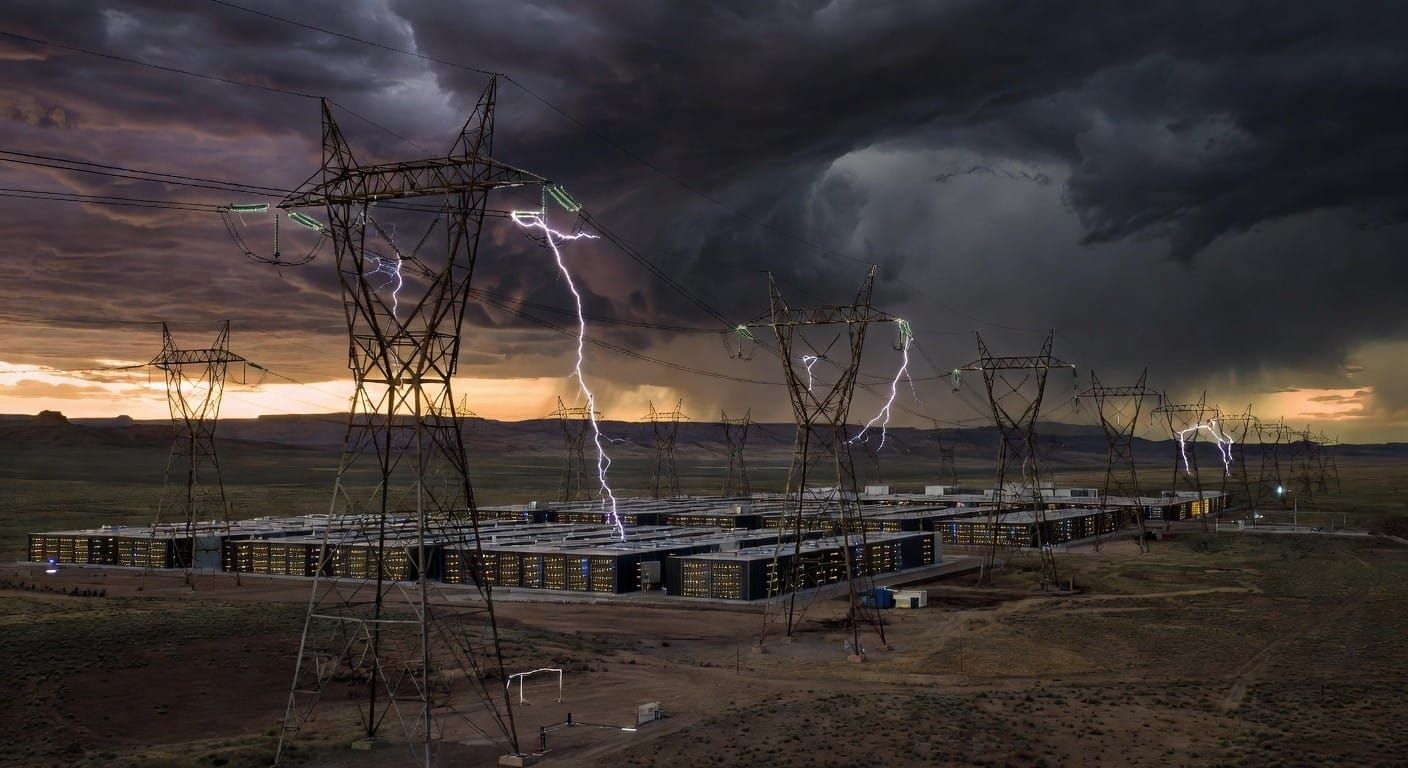
Every major AI company is spending billions on data centers. There's just one problem: America's power grid was built for a country that no longer exists.
The Numbers Don't Lie
U.S. data center power demand is projected to hit 41 GW in 2026 — up from 31 GW just a year ago — and Goldman Sachs expects it to reach 66 GW by 2027. That's not incremental growth. That's a vertical line on a chart, and the grid underneath it was largely built in the mid-twentieth century.
Roughly 70% of America's electrical grid infrastructure is nearing end-of-life. Meanwhile, data centers consumed approximately 176 terawatt-hours (TWh) of electricity in 2023 — about 4.4% of total U.S. electricity generation. Lawrence Berkeley National Laboratory projects that number could balloon to 325–580 TWh by 2028, representing up to 12% of national consumption. All while the grid struggles to keep the lights on in a Texas heat wave.
The Energy Information Administration now forecasts record U.S. power demand in both 2026 and 2027, with AI and crypto data centers as the primary accelerants. And according to a Sightline Climate report from April 2026, 30–50% of large data centers scheduled to open this year face delays or cancellations due to power availability — not chips, not capital, not demand. Power.
Of roughly 16 GW of announced data center capacity in the U.S., only about 5 GW is actually under construction. The other 11 GW shows no visible progress despite typical 12–18 month build timelines. The bottleneck isn't ambition. It's electrons.
The Interconnection Nightmare
Here's the part that doesn't make the earnings call: connecting a new data center to the grid can take four to ten years. Building the data center itself takes two to three.
PJM Interconnection — the grid operator serving 65 million people across 13 states and Washington, D.C. — sits at the epicenter of this crisis. Northern Virginia alone hosts the world's largest concentration of data centers, and the region is drowning in demand it can't service.
PJM's capacity auction for the 2026/2027 delivery year cleared at a record $329.17 per megawatt-day — hitting the FERC-approved price cap. That's up from $28.92 per MW-day just two years earlier. A 12x increase in capacity costs, driven overwhelmingly by data center load growth. PJM's peak demand forecast jumped by over 5,400 MW year-over-year, largely from data centers.
Wholesale power prices in PJM territory rose 76% year-over-year in Q1 2026, reaching $136.53 per megawatt-hour. The independent market monitor, Monitoring Analytics, attributes roughly 63% of recent wholesale price increases directly to data center demand. That translated to an estimated $9.3 billion in added capacity costs for ratepayers — with combined impacts from recent auctions exceeding $13 billion.
High-power transformers, the critical hardware that steps voltage up and down across the grid, now carry lead times of up to five years — double their pre-pandemic delivery schedule. You can't accelerate physics, and you can't wish copper into existence.
You're Paying for Big Tech's Power Bill
This is where the AI boom stops being an abstract tech story and starts hitting your mailbox.
A Gallup poll found that 71% of Americans now oppose having a data center near their home — higher opposition than for nuclear power plants. The top concern isn't noise or traffic. It's electricity bills.
Wholesale electricity prices near major data center clusters have risen as much as 267% over five years, and those costs flow through to residential customers. PJM estimates the capacity auction results alone could translate to 1.5–5% year-over-year bill increases for some customers, but broader analyses project far worse: NRDC modeling suggests an average PJM household could face roughly $70 per month in higher bills by 2028, with cumulative excess costs reaching $100–163 billion through 2033.
The backlash is materializing in real-time. In Utah, Governor Spencer Cox demanded assurances from a proposed data center complex — twice Manhattan's size, requiring more power than the entire state currently generates — that it won't raise residential bills or further stress the Great Salt Lake's water supply. In Virginia's "Data Center Alley," Dominion Energy has been forced to create a dedicated large-user rate class (GS-5) specifically to shield residential ratepayers from data center costs.
Bipartisan calls are growing louder — including from President Trump — for data centers to "pay their fair share" rather than socializing infrastructure costs across every household in the region. Poll after poll shows roughly 78% of Americans are concerned about bill increases tied to data center construction.
This is where the analysis gets actionable. AlphaBriefing members get the full investment framework — scenarios, positioning, and the bottom line.
Subscribe to AlphaBriefing — Free, Member, and Paid tiers available.