America's Battery Recyclers Are Going Bankrupt at the Worst Possible Moment
The end-of-life battery wave is finally arriving and Washington wants a domestic supply loop to break China's grip on refined metals. Yet the pure-play recyclers built to do it are collapsing. Here is who survives the shakeout — and how to position.

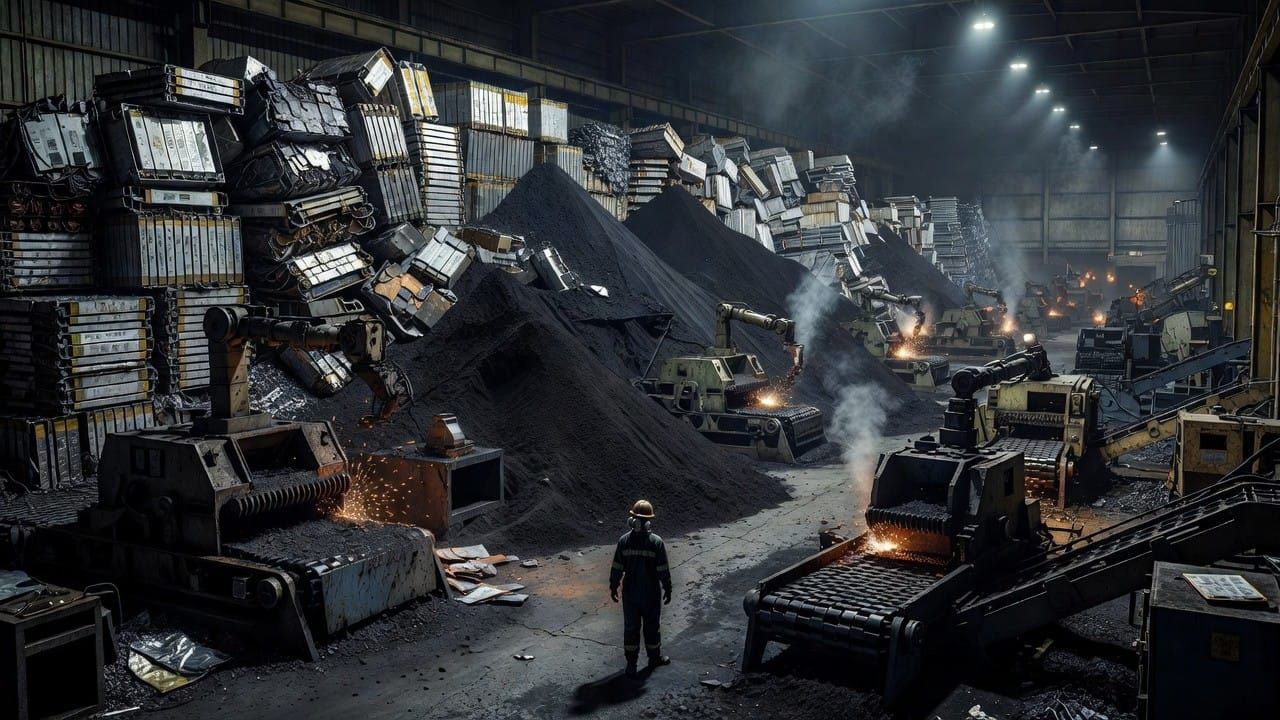
For a decade, battery recycling was sold as the inevitable backstop of the energy transition. Every electric vehicle on the road, every grid-scale storage installation, every laptop and phone was a future deposit of lithium, cobalt, and nickel waiting to be mined a second time — this time from a warehouse instead of a pit in the Congo or a brine flat in the Andes. The pitch was irresistible: a domestic, circular supply of the most strategically contested materials on Earth, immune to Chinese export controls and free of the geopolitical baggage of foreign mines.
The thesis was right. The timing has been brutal.
In May 2025, Li-Cycle — once the most-hyped pure-play recycler in North America, a SPAC darling with a flagship "Hub" in Rochester, New York — filed for creditor protection. Its marquee facility had ballooned from a $560 million budget to roughly $1 billion and never reached commercial operation. Glencore, which had sunk money into the company as a strategic backer, scooped up the assets out of bankruptcy for about $40 million. In April 2026, Ascend Elements, another flagship recycler backed by hundreds of millions in federal grants, filed for Chapter 11. The DOE awards that were supposed to anchor its Kentucky operations were cancelled.
This is not how a boom is supposed to look. And yet the underlying demand wave — the reason these companies raised billions in the first place — is only now beginning to crest.
The cliff is real
The defining feature of battery recycling is a timing mismatch the market has consistently mispriced. EV adoption surged from roughly 2018 onward, but lithium-ion packs last 10 to 15 years. That means the first large cohort of dead EV batteries is only reaching the scrapyard now — and the volume curve goes vertical later this decade.
Estimates vary widely by methodology, but the direction is not in dispute. Analysts project on the order of 300-plus gigawatt-hours of lithium-ion batteries reaching end-of-life by 2030, with roughly half of that coming from electric vehicles. Industry baseline studies put end-of-life EV battery volume above 800,000 metric tons worldwide as early as 2025. Add manufacturing scrap — the defective cells and trim waste from every gigafactory, which can run 5-10% of output during ramp — and there is already a meaningful feedstock stream today, growing into a flood.
Each of those packs is a concentrated ore body. Recovered "black mass" — the shredded, processed electrode powder at the heart of the industry — contains lithium, nickel, cobalt, copper, and manganese at grades that put natural ores to shame. A spent battery is, quite literally, a richer source of these metals than most of the rock mining companies pay to dig up.
China already won the first round
Here is the strategic problem, and the reason Washington cares. Recycling does not automatically mean domestic supply. The black mass produced in an American shredding plant can be — and often is — shipped to Asia for the high-value refining step. And refining is the part of the chain China has spent two decades locking down.
The numbers are stark. China controls roughly 70% of global battery recycling capacity, having built two-thirds of all new capacity added since 2020. On the critical refining step, China's grip is tighter still: industry trackers estimate it holds close to 78% of global black-mass pre-treatment and nearly 90% of refining capacity. Across critical minerals broadly, the IEA projects China will control around 60% of all refining by 2030, and it already refines roughly 80% of the world's cobalt.
In other words, the West can collect all the dead batteries it likes. If the refined metal still has to pass through a Chinese facility to become battery-grade material again, the loop isn't closed — it just has a longer leash. Breaking that dependency is the entire strategic rationale for an American recycling industry. It is also exactly where the economics get punishing.
Why the pure-plays broke
The companies now in bankruptcy court were not undone by a lack of demand. They were undone by the gap between a beautiful 2030 thesis and a difficult 2025 balance sheet.
Building a hydrometallurgical refining complex is a capital-intensive, chemically demanding, multi-year construction project — closer to building a specialty chemicals plant than a scrapyard. The pure-plays raised money against future feedstock volumes that hadn't materialized yet, then watched lithium and cobalt prices collapse from their 2022 highs, gutting the value of whatever they could recover. Federal grant money that anchored their business cases was delayed, clawed back, or cancelled amid a shifting policy environment. The result: enormous fixed costs, thin and volatile revenue, and a funding window that slammed shut.
The cliff is coming. Several of the companies built to climb it will not be there when it arrives. That divergence — a structurally inevitable industry whose first generation of public-market champions is being wiped out — is precisely where the opportunity, and the risk, now lives.