Americans Are Drowning in Subscriptions — and They're Finally Fighting Back
The average U.S. household spends $273 a month on subscriptions. With 55% planning to cut back in 2026, the era of frictionless recurring revenue may be over.

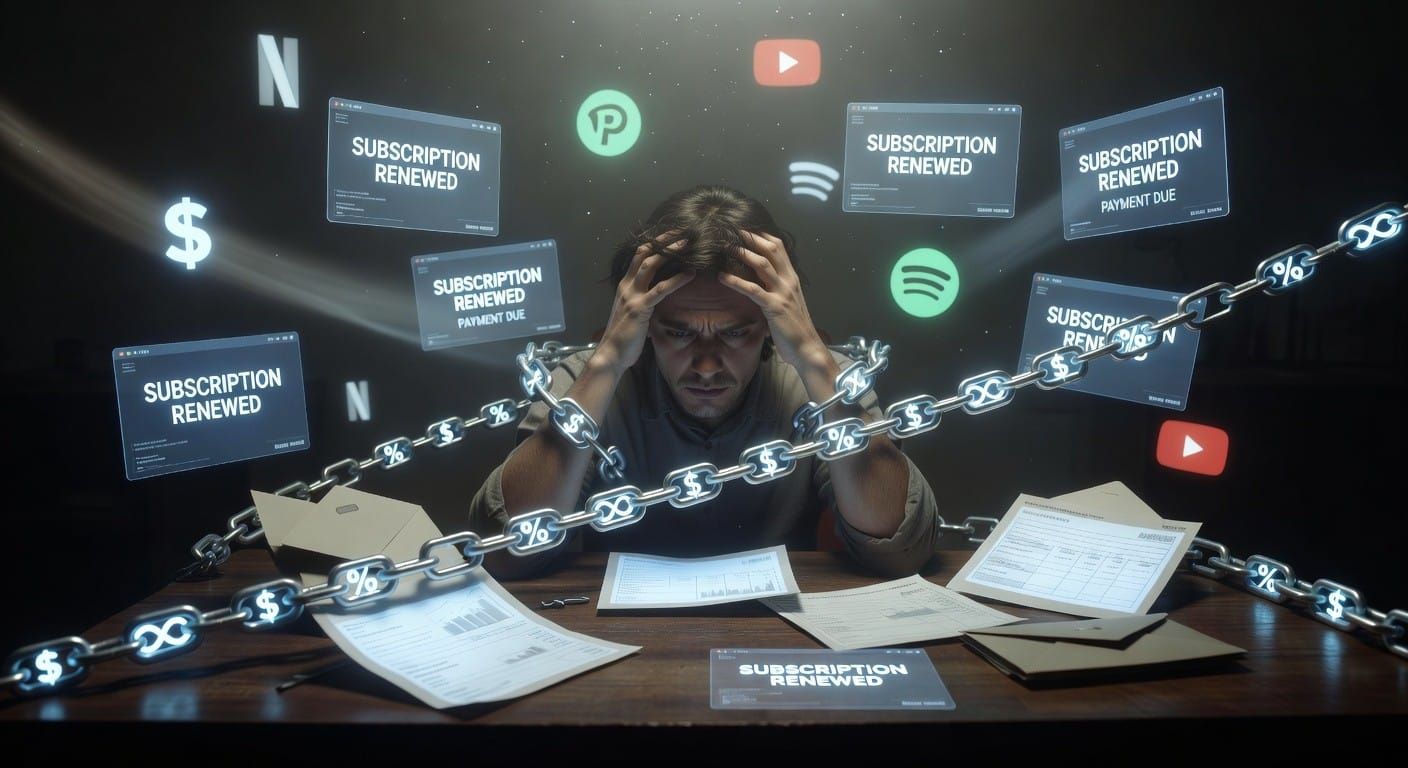
Americans now spend an average of $273 a month on subscriptions. For many households, the real number is closer to $400. That's streaming, cloud storage, fitness apps, meal kits, software, news, music, gaming, grocery delivery, and a dozen other recurring charges that slip through the cracks of monthly budgets like water through a sieve.
And people are finally fed up.
A recent survey found that 55% of Americans plan to cut at least one subscription in 2026. Over 40% have already canceled services specifically because of price hikes. Gen Z — the generation raised on digital everything — is leading the revolt, with 37% canceling at least one streaming service between late 2025 and early 2026.
This isn't a blip. It's a structural shift in how Americans relate to recurring payments — and it has implications for every company whose business model depends on monthly revenue.
The Boiling Frog Finally Jumped
The subscription model was a masterstroke of behavioral economics. Small monthly payments feel painless compared to large one-time purchases. Auto-renewal means inertia works in the company's favor. And for years, it worked beautifully — for the companies.
Netflix launched its streaming service at $7.99 a month in 2010. Today, the ad-free standard plan costs $19.99. The premium tier is $26.99. That's a 238% increase in 16 years — far outpacing inflation, wage growth, and the actual improvement in content quality most subscribers would point to.
Disney+ debuted at $6.99 in 2019, positioning itself as the affordable alternative. Its ad-free tier now costs $18.99 — a 171% increase in seven years. The bundles that were supposed to save money (Disney+, Hulu, and ESPN+ together) now run $20 to $30 a month.
Netflix has raised prices twice in 2026 alone. The company is betting subscribers won't leave. And for many, the bet has been right — revenue is up even as complaints spike. But the calculus is changing.
The $273 Trap
The average American household now juggles 11 to 12 active subscriptions. Streaming accounts for a chunk, but it's only part of the picture. Add Spotify or Apple Music ($11–$12/month), iCloud or Google storage ($3–$10), a gym membership ($30–$60), Amazon Prime ($15), a meal kit ($60–$80), a meditation app ($13), a password manager ($5), Microsoft 365 or Adobe ($10–$55), maybe a news subscription or two — and the monthly total climbs quickly.
The problem is that no single subscription feels expensive. Each one is "just" $10 or $15 a month. But the aggregate effect is a silent budget killer. When researchers at C+R Research tracked actual spending versus perceived spending, consumers underestimated their subscription costs by an average of 133%. People thought they were spending $86 a month. The real number was $200-plus — and that was in 2022, before the latest round of price hikes.
This is the subscription trap: each charge is small enough to ignore, but collectively they represent one of the largest discretionary spending categories in the American household budget. At $273 a month, subscriptions cost more than the average car payment ($250 in 2020, now $350+), more than most utility bills, and more than what many families spend on groceries beyond the basics.
The Revolt Goes Mainstream
What's changed in 2026 isn't just that prices went up. It's that consumers now have the tools and the motivation to fight back.
The FTC's "click-to-cancel" rule, which went into full enforcement in 2026, requires companies to make canceling a subscription as easy as signing up. No more calling a retention specialist. No more buried cancellation links. No more 14-step processes designed to exhaust you into giving up. If you can subscribe in two clicks, you must be able to cancel in two clicks.
This regulatory shift has been transformative. Companies that relied on friction to retain subscribers are seeing churn rates spike. The subscription management app industry — services like Rocket Money, Trim, and Truebill — has exploded, with users discovering and canceling forgotten charges worth an average of $38 a month.
Meanwhile, Gen Z is pioneering what researchers call "subscription rotation" — subscribing to one service, binge-watching or using it heavily for a month, canceling, and moving to the next. It's the streaming equivalent of library borrowing, and it's devastating to the lifetime-value models that Wall Street uses to value these companies.
The Industry Scrambles
The response from companies has been predictable but revealing. Unable to simply raise prices without consequences for the first time in a decade, they're experimenting with new models:
Ad-supported tiers have become the default play. Netflix's ad tier now accounts for a growing share of new signups. Disney+ reports that 52% of Gen Z subscribers choose the cheaper ad-supported option. The logic is simple: if consumers won't pay $20, maybe they'll accept ads at $9. But this fundamentally changes the value proposition that made streaming attractive in the first place — and it puts these platforms in direct competition with free, ad-supported content on YouTube and TikTok.
Bundling is the other major trend. Disney's triple bundle, the Paramount+/Showtime merger, and various carrier partnerships (T-Mobile includes Netflix, Verizon includes Disney+) are all attempts to reduce the perceived cost per service. The irony is thick: the streaming revolution was supposed to free consumers from the cable bundle. Now it's recreating it, one partnership at a time.
Microtransactions and hybrid models are the emerging frontier. Forbes reported that some companies are shifting from pure subscriptions to pay-per-use or credits-based systems, particularly in SaaS. The idea: let people pay for what they actually use rather than a flat monthly fee they may not fully utilize.
What This Means for Investors
The subscription economy isn't dying. The total market hit $492 billion in 2024 and is projected to reach $1.5 trillion by 2033. But the growth trajectory is bending, and the companies that thrived on subscription inertia are facing a new reality.
Churn is now a first-order risk. For years, investors could model subscription businesses with relatively predictable retention rates. That predictability is eroding. Any company with voluntary churn above 5% monthly should be flagged for scrutiny — and in streaming and SaaS, those numbers are climbing.
Customer acquisition costs are rising while lifetime values fall. The combination of easier cancellation, subscription rotation, and ad-tier migration means the average subscriber is worth less than they were two years ago. Companies spending heavily on content (Netflix's $17 billion annual content budget) or customer acquisition need to show that the unit economics still work.
The winners will be the aggregators and the tools. Subscription management apps, bundling platforms, and companies that can become the "one subscription to rule them all" — think Amazon Prime's expanding bundle, or Apple's One subscription — are positioned to capture the consolidation trend. The losers will be standalone services that can't justify their individual price point.
Watch the ad-tier economics. If ad-supported streaming becomes the dominant model, it shifts the competitive landscape dramatically. Suddenly, streaming companies are competing for advertising dollars against Google, Meta, and TikTok — a fight they are not well-equipped to win.
The Bigger Picture
Subscription fatigue is a symptom of something larger: the American consumer is running out of elasticity. Real wages have barely kept pace with inflation. Housing costs have consumed an ever-larger share of household budgets. And the "nickel-and-dime" economy — where every service, app, and convenience comes with a recurring charge — has quietly become one of the biggest drains on disposable income.
The fact that 55% of Americans plan to cut subscriptions this year isn't just a consumer trend. It's a signal about the state of the American household balance sheet. When people start scrutinizing $10 charges, it's because $10 has started to matter again.
For the companies built on the premise that consumers would keep paying indefinitely, that's a wake-up call. The subscription model isn't broken — but the era of frictionless, ever-expanding recurring revenue may be over. The companies that adapt will thrive. The ones that keep raising prices and hoping nobody notices are about to learn what happens when the boiling frog finally decides to jump.
Get this level of intelligence every day. Subscribe to AlphaBriefing — free, member, and paid tiers available.
Sources & Further Reading
- CNET — We're Tracking Streaming Price Hikes in 2026
- Variety — Netflix Raising Prices Second Time in a Year
- WFSB — More Than Half of Americans Plan to Cut Subscriptions in 2026
- Fortune — Gen Z Streaming Model Shifts
- Marketplace — Raising Prices Is Paying Off for Streaming Platforms
- Forbes — Combatting Subscription Fatigue With Microtransactions
- NY Post — Streaming Price Hikes Spark Subscriber Revolt
Disclaimer
AlphaBriefing is an independent intelligence publication. The content in this article is produced for informational and educational purposes only. Nothing published by AlphaBriefing constitutes financial, investment, legal, tax, or regulatory advice, nor should it be construed as a solicitation or recommendation to buy, sell, or hold any security, asset, or financial instrument.
All views expressed are those of the author at the time of writing and are subject to change without notice. Markets are volatile and unpredictable; past performance is not indicative of future results. Any investment involves risk, including the possible loss of principal.
AlphaBriefing and its principals, employees, or contributors may hold positions in securities or assets mentioned in this article. This should be considered a potential conflict of interest. No material relationship with any company referenced exists unless explicitly disclosed. Readers should conduct their own due diligence and consult qualified financial, legal, and tax advisors before making any investment decisions.
Information in this article is drawn from public sources believed to be reliable at the time of publication. AlphaBriefing makes no warranty, express or implied, as to the accuracy, completeness, or timeliness of any information herein. AlphaBriefing accepts no liability for any loss or damage arising from reliance on this content.
© AlphaBriefing. All rights reserved. Unauthorized reproduction or distribution is prohibited.