Amazon Is About to Employ More Robots Than People
Amazon already runs over a million warehouse robots against 1.56 million workers. The crossover is a milestone — but the durable trade is the suppliers and the labor-cost re-rating it forces across all of logistics.

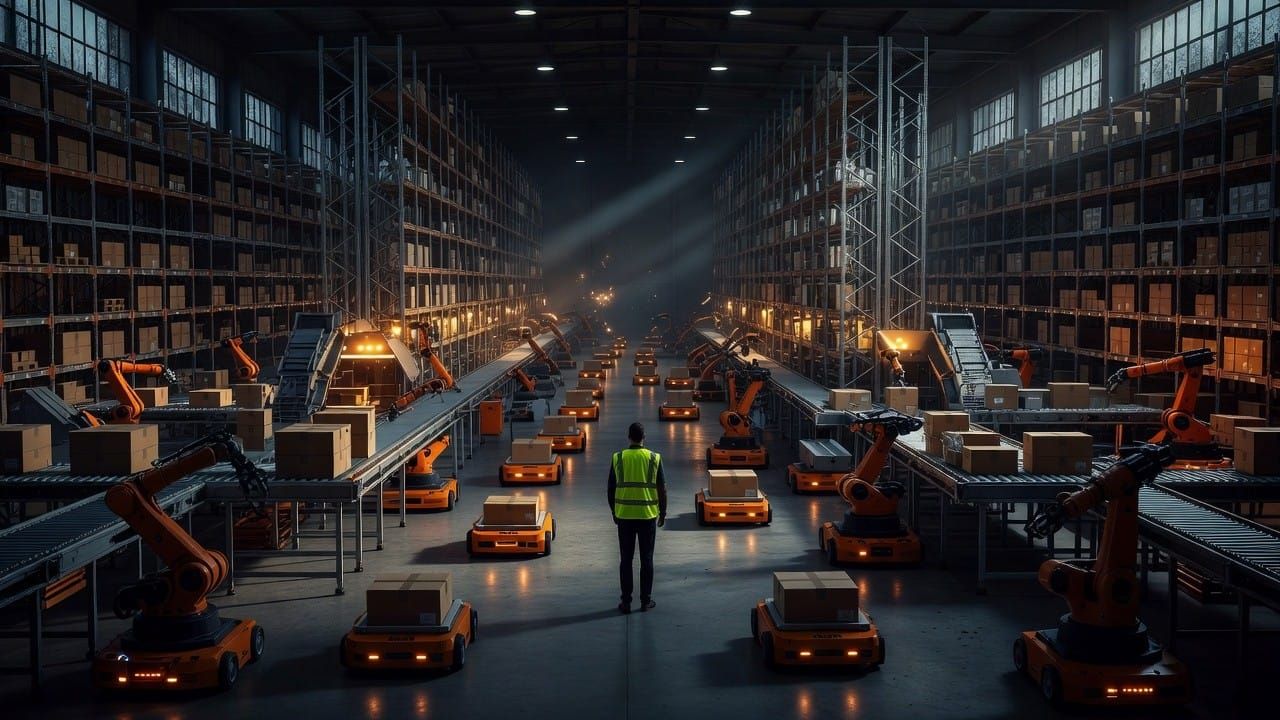
Sometime in the next few quarters, a number that has defined American commerce for a generation is going to invert. Amazon — the country's second-largest private employer, with roughly 1.56 million people on its payroll — already runs more than one million robots inside its fulfillment network. The two lines are converging fast, and Amazon's own engineers say the crossover is a matter of when, not if.
When it happens, it will be the first time in the modern era that a workforce of this scale employs more machines than people. That milestone is symbolic. The trade underneath it is not.
Because the story investors should be watching is not whether Amazon's robots outnumber its humans. It's what that crossover forces — a re-rating of labor costs across the entire logistics economy, and a capital cycle flowing to a narrow set of companies that build the arms, the actuators, the sensors, and the software no warehouse can automate without.
The crossover, by the numbers
In July 2025, Amazon deployed its one-millionth warehouse robot. At the same time it rolled out DeepFleet, a generative-AI "foundation model" that acts as a traffic-control brain for the entire fleet, coordinating how more than a million machines move across hundreds of buildings and cutting fleet travel time by roughly 10%.
A decade ago, Amazon had essentially zero mobile robots. It bought Kiva Systems in 2012 for $775 million, took the technology in-house, and has been compounding the fleet ever since. The robots now handle a growing share of the "pick, stow, and consolidate" choreography that used to require a human at every station.
The human headcount, meanwhile, has plateaued. Amazon still hires aggressively for seasonal peaks — it announced 250,000 holiday positions for the most recent quarter — but the structural trend is the opposite. Internal documents reported in late 2025 show Amazon planning to avoid hiring roughly 160,000 US workers by 2027 through automation, with longer-range internal goals of automating a large majority of operations. Hiring 250,000 temps for Christmas and avoiding 160,000 permanent hires are not contradictions. They are the two halves of the same machine.
What actually changed
For years, warehouse automation meant wheeled robots ferrying shelves to stationary human pickers. The bottleneck was always the hand — the dexterity to grab an arbitrary object out of a bin. That bottleneck is cracking on two fronts at once.
The first is multi-arm manipulation. In October 2025 Amazon unveiled "Blue Jay," a system coordinating several robotic arms to pick, stow, and consolidate in a single workspace, collapsing three stations into one — alongside "Project Eluna," an agentic-AI assistant for operators. Tellingly, Amazon discontinued the Blue Jay program by February 2026, folding the underlying tech back into other systems. That failure matters: it's a reminder that this build-out is iterative and littered with dead ends, not a straight line. The hype runs ahead of the hardware.
The second front is humanoids — bipedal robots meant to work in spaces built for people, no re-engineering required. Agility Robotics' "Digit" is already moving totes in GXO and Amazon facilities, and the company's RoboFab plant in Oregon is scaling toward 10,000 units a year. Figure AI's robot spent eleven months on BMW's Spartanburg line, contributing to more than 30,000 vehicles. Total venture funding into humanoids has blown past $6 billion — even as real-world deployments remain in the low thousands.
That gap — billions of dollars of capital against thousands of working units — is exactly where the money gets made and lost over the next 24 months. The question for an investor is not "are robots coming." They're here. The question is who gets paid as they scale, and who gets disrupted as the labor math changes.
This is where the analysis gets actionable. AlphaBriefing members get the full investment framework — scenarios, positioning, and the bottom line.
Subscribe to AlphaBriefing — Free, Member, and Paid tiers available.