AI's Biggest Bottleneck Isn't Chips. It's the Transformer.
Capacity prices on America's largest power grid just jumped tenfold. Federal officials are now floating breaking up PJM Interconnection. The real AI trade has moved from silicon to steel.

The price signal nobody on Wall Street is pricing
Capacity prices in PJM Interconnection — the grid that powers 65 million Americans across thirteen states and the District of Columbia — went from $28.92 per megawatt-day for delivery year 2024/25 to $329.17 per megawatt-day for 2026/27. That is more than a tenfold increase in twenty-four months, and it landed against a regulated price cap, not a market clearing level. Wholesale power across PJM rose 75.5 percent year over year in the first quarter, from $77.78 to $136.53 per megawatt-hour.
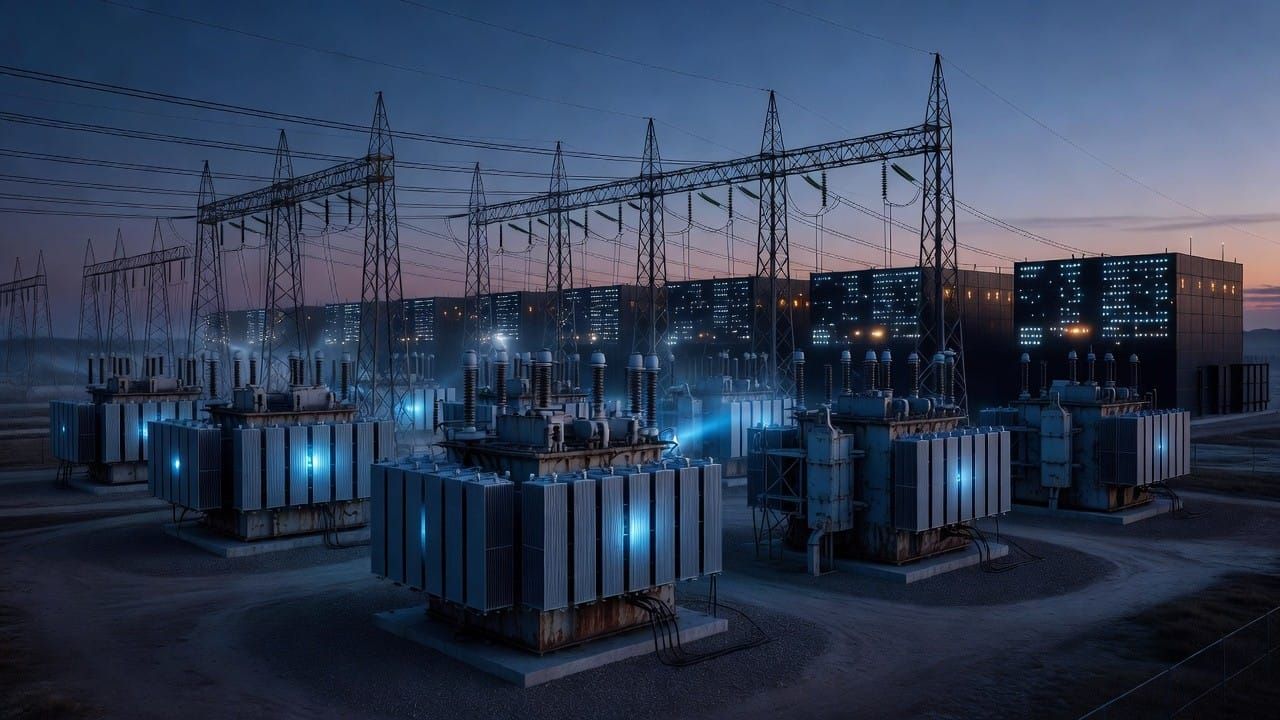
This is what happens when AI hyperscaler demand collides with a build-out cycle that physically cannot move faster than a 60-ton transformer can be wound.
On June 4, Bloomberg reported what had until then been a whispered idea inside the Department of Energy: the Trump administration is openly considering breaking up PJM, the largest grid operator in the United States, on the grounds that its single-zone capacity auction is exporting data-center costs onto residential ratepayers in Virginia, Pennsylvania, Maryland, New Jersey, Ohio, and beyond. Nine governors had already signed a joint letter to PJM in July 2025 demanding reform; Pennsylvania Governor Josh Shapiro had separately filed at the Federal Energy Regulatory Commission to force a cap. The price cap, lowered from north of $500 to $325 per megawatt-day with a $175 floor, did not solve the structural problem. It simply set the new range.
The narrative on AI infrastructure has spent eighteen months arguing about Nvidia allocation, Blackwell yields, and inference economics. The actual constraint has quietly moved one layer down the stack. It is no longer the GPU. It is the grid feeding the GPU — and inside the grid, it is a handful of pieces of long-lead electrical equipment whose order books are now sold out into the late 2020s.
The build-out has hit a steel wall
The numbers behind the PJM blow-up are not abstract. PJM forecasts peak demand will grow by 32 gigawatts between 2024 and 2030. All but two of those gigawatts are data centers. Northern Virginia's "Data Center Alley" alone is on track to require more new generation than the entire state of New York currently consumes at peak. PJM itself projects it will be six gigawatts short of its reliability requirement by 2027.
Meanwhile the inputs to closing that gap are scarce in a way that money cannot quickly fix:
- Large power transformers: pre-2020 lead times of 24 to 30 months have stretched to four to five years. The United States imports more than 80 percent of its grid-scale transformer capacity, with the largest manufacturers — Hitachi Energy, Siemens Energy, Hyundai, Hyosung — running flat out and selling 2028 and 2029 slots.
- Switchgear: medium- and high-voltage switchgear is reportedly sold out at the major OEMs through 2028.
- Interconnection queues: grid interconnection waits in Northern Virginia, Phoenix, and Dallas now run four to seven years. PJM's queue alone has more than 200 gigawatts of generation waiting in line.
- Skilled labor: building a high-voltage substation requires journeymen line workers and high-voltage technicians the country has not been training for two decades. The labor pipeline is the second bottleneck nobody is fixing on the timeline AI needs.
The S&P Global estimate that half of planned 2026 US data-center builds will slip or cancel — and that of the 12 gigawatts of new capacity originally penciled for 2026, only about a third is under active construction — is the cleanest read of how this lands. Hyperscalers are responding by signing direct PPAs with nuclear operators, restarting retired plants, and parking reciprocating gas generators on-site as bridging power. None of those moves remove the underlying bottleneck. They re-price it.
This is where the analysis gets actionable. AlphaBriefing members get the full investment framework — scenarios, positioning, and the bottom line.
Subscribe to AlphaBriefing — Free, Member, and Paid tiers available.