Your Electric Bill Is on the Ballot
Capacity prices in America's largest power market are up more than tenfold in three auctions, data centers are the reason, and one week before the midterms both parties are running against them. The grid is now a ballot issue.

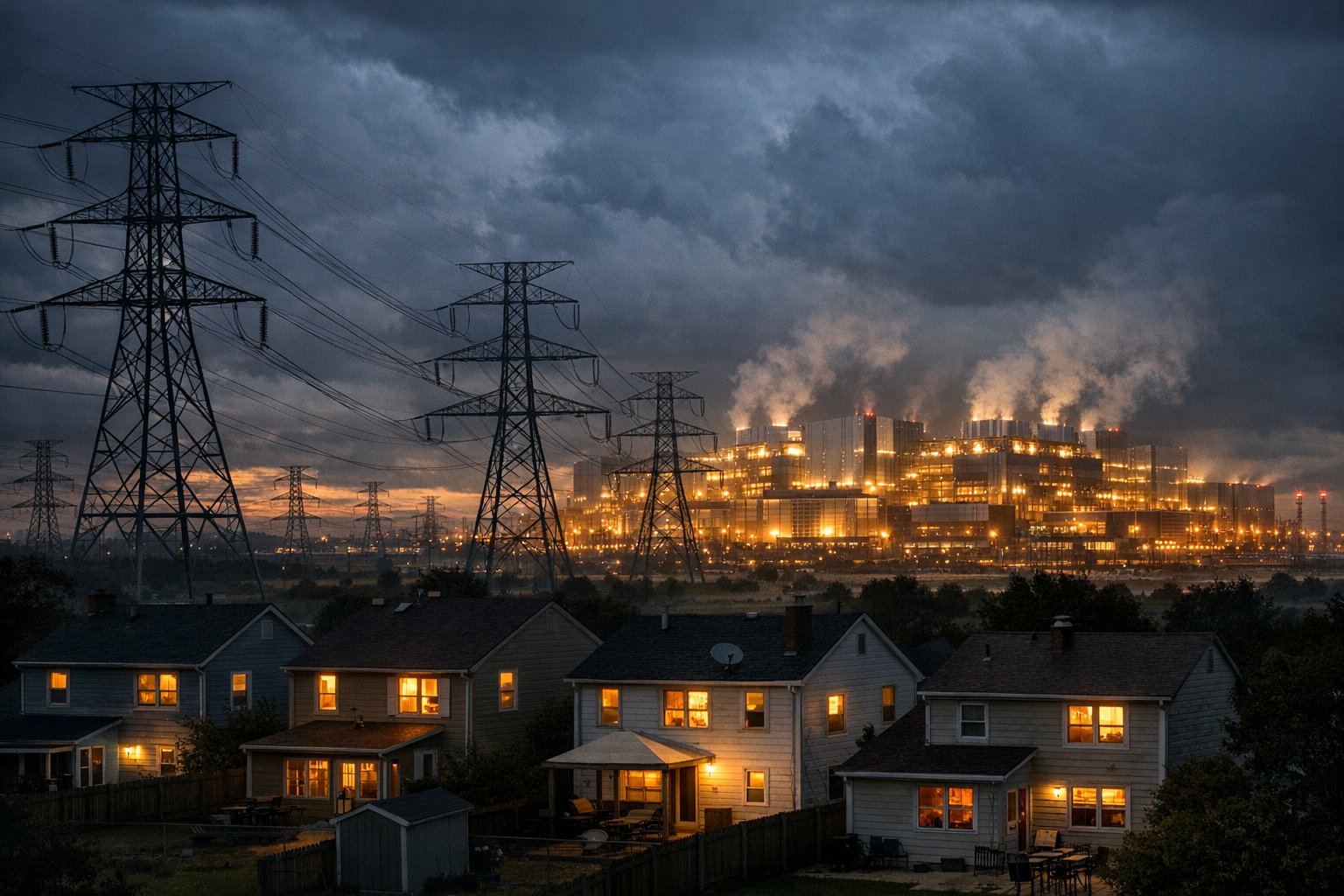
One week from today, Americans vote in the 2026 midterms. The issue showing up in attack ads from Ohio to Texas isn't the border, crime, or even inflation in the abstract. It's a building: the data center — and the electric bill that arrives after one gets built nearby.
This wasn't on anyone's bingo card two years ago. Data centers were an economic-development trophy that governors fought to land. Today, candidates in both parties are running against them, states are weighing outright bans, and the machinery that sets wholesale power prices in much of the eastern United States has hit its regulatory price ceiling two auctions in a row. Here's how electricity became a national political issue — and what it means for the AI buildout that caused it.
The auction that broke
Much of the eastern U.S. — 13 states plus Washington, D.C., roughly 67 million people — gets its power through PJM Interconnection, the country's largest grid operator. Every year, PJM runs a capacity auction: generators bid to promise they'll be available during future peak demand, and the clearing price becomes a line item that flows through to every electric bill in the region.
For years this was a sleepy, cheap formality. The 2024/25 delivery year cleared at $28.92 per megawatt-day — about $2.2 billion in total capacity costs across the region. Then data center demand projections hit the model:
- The 2025/26 auction cleared at $269.92/MW-day — total cost roughly $14.7 billion.
- The 2026/27 auction — the year consumers are paying for right now — cleared at $329.17/MW-day, a 22% increase and the exact maximum price federal regulators allowed. Total: about $16.1 billion. PJM has said that without the cap, it would have cleared around $388.57.
- In December 2025, the 2027/28 auction hit its cap again at $333.44/MW-day — and this time the auction failed to procure enough capacity to meet PJM's reliability requirement, falling short by more than 6,600 megawatts. Analysts estimate the uncapped price would have been around $530/MW-day, roughly 59% higher.
Read that sequence plainly: from $28.92 to $333.44 in three auction cycles — more than a tenfold increase — with the only thing standing between consumers and worse being a regulatory ceiling that the market slams into the moment it's set. The driver is not mysterious. PJM projects peak demand will grow by roughly 30 gigawatts by 2030, overwhelmingly from data centers, while new generation has barely budged.
Capacity is only one component of a retail bill, but the direction is unambiguous. The U.S. Energy Information Administration expects residential electricity to average about 18.2 cents per kilowatt-hour in 2026, up roughly 5% in a single year — faster than overall inflation — with some East Coast markets rising as much as 7% annually. And the EIA projects a genuine first: in 2027, commercial electricity consumption — the category that includes data centers — is expected to surpass residential use for the first time in American history. The grid's biggest customer is no longer the American household.
Briefings like this are free to read with a free AlphaBriefing membership. Join free →
The backlash arrived faster than the power plants
Public opinion didn't drift — it snapped. In September 2025, polling by Heatmap found Americans narrowly supported data center construction, 44% to 42%. By mid-2026, a Reuters/Ipsos survey found 64% saying the rapid pace of data center building is "not a good thing," and 77% worried that data centers will raise their electricity rates. A 2026 Gallup poll found 70% of Americans oppose an AI data center being built in their own community — 48% strongly. In polling compiled by Brookings, only 14% said they would be willing to live near one.
That sentiment now has infrastructure of its own. Researchers at Data Center Watch counted roughly $200 billion worth of data center projects blocked or delayed by local opposition in just the first half of 2026 — about 120 projects, including $68 billion in the second quarter alone. Organized opposition groups now number more than 800 across 49 states. The National Conference of State Legislatures reported in September that lawmakers in 16 states were considering restrictions or bans on data center development. New York has already imposed a statewide moratorium on new hyperscale facilities.
This is what makes the data center story different from most infrastructure fights: the opposition is bipartisan. Rural Republican counties and suburban Democratic districts are objecting to the same three things — electricity costs, water consumption, and the gap between the tax breaks these facilities receive and the handful of permanent jobs they create.
The campaign issue nobody planned for
The clearest test case is Ohio's Senate race. Democrat Sherrod Brown is running ads calling Republican incumbent Jon Husted "the face of data centers in Ohio," tying the state's rising power bills to tax incentives Husted championed when data centers were still an easy applause line. Husted, who once promoted the facilities as a "tremendous economic opportunity," is now defending that record in a state where the political ground has moved underneath it.
In Texas, Democratic gubernatorial candidate Gina Hinojosa has attacked Governor Greg Abbott as too accommodating to data center developers; Abbott — a Republican with one of the most industry-friendly records in the country — recently endorsed an "audit" of data center development. In Pennsylvania, Governor Josh Shapiro has shifted from courting the industry to signing an executive order imposing new rules on data center authorization. When incumbents from both parties start repositioning before an election rather than after one, the polling they're reading privately is worse than what's published.
The pattern across races, according to analysis from Brookings and campaign-trail reporting: nearly every competitive candidate in affected states now backs some form of ratepayer protection, and the argument has shifted from whether data centers should pay more to how much more. Moratoriums, "bring your own power" requirements, and special tariff classes that wall off data center costs from household bills have moved from fringe proposals to mainstream platform planks in under a year.
What it means for the AI trade
Whoever wins next Tuesday, one outcome is already locked in: the era of quietly socializing the AI buildout's power costs across household electric bills is ending. That has real consequences for how the next phase of the data center boom gets financed and built.
The cost of compute is going up, on paper where it was previously hidden. When a hyperscaler's power costs were blended into a utility's rate base, part of the bill landed on households. Special tariff classes and bring-your-own-power rules move that cost back onto the developer. For the companies spending tens of billions a year on data centers, electricity is shifting from a subsidized input to a market-priced one — and in PJM territory, a market-priced one that just cleared its price cap twice.
Behind-the-meter power becomes the default, not the workaround. The political logic now runs one direction: a data center that shows up with its own generation — contracted nuclear, gas turbines, eventually small modular reactors — is a tax-revenue story; one that plugs into the local grid is an attack ad. The wave of tech-company nuclear agreements over the past two years looks less like ESG positioning and more like political risk management that happened early.
Utilities are caught in the middle. Demand growth is the best thing that's happened to the sector in two decades, and it is now also the sector's biggest political liability. Commissions that approved data center interconnections without blinking in 2024 face elected officials who campaigned on power bills. Expect slower approvals, more cost-allocation fights, and a widening gap between utilities in states that court data centers with ring-fenced tariffs and those where the backlash sets policy.
And the capacity auction is now a political thermometer. PJM's next auction results won't just price reliability — they'll land in a post-election environment where legislatures from Harrisburg to Columbus have been told by voters exactly what they think of the current arrangement. If the 2028/29 auction clears at another cap, the question stops being whether the rules change and becomes how abruptly.
The hard version of the problem doesn't go away with better politics: the United States is trying to bolt a decade of demand growth onto a grid that spent twenty years planning for none. Blocking data centers doesn't build generation, and neither do moratoriums. But markets don't price physics — they price policy, and policy is about to be set by the angriest electricity consumers in a generation.
Next Tuesday, for the first time, the American power grid is on the ballot. Watch the races where the bills went up the most.
If this analysis was useful, this is what AlphaBriefing does every day — geopolitics and markets, connected to what it means for your money. Paid members get the investment frameworks, scenario pricing, and catalyst calendars behind the paywall.
A free membership gets you access to every free article at AlphaBriefing.com: Join AlphaBriefing free → — upgrade whenever it earns it.
Sources & Further Reading
- PJM — 2027/2028 Base Residual Auction Results (December 17, 2025)
- RTO Insider — PJM Capacity Auction Clears at Max Price, Falls Short of Reliability Requirement
- Power Engineering — Latest PJM power capacity auction clears maximum price in all zones
- Brookings — Why data centers are a top issue in the 2026 midterms
- Stateline — Data center backlash set to sway midterm elections
- Utility Dive — Commercial electricity use will likely surpass residential in 2027: EIA
- Data Center Watch — Blocked and Delayed Data Center Projects Report
- NPR — Voters are fed up with data centers. Both parties are trying to cash in for midterms
Get this level of intelligence every day. Subscribe to AlphaBriefing — free, member, and paid tiers available.
Disclaimer
AlphaBriefing is an independent intelligence publication. The content in this article is produced for informational and educational purposes only. Nothing published by AlphaBriefing constitutes financial, investment, legal, tax, or regulatory advice, nor should it be construed as a solicitation or recommendation to buy, sell, or hold any security, asset, or financial instrument.
All views expressed are those of the author at the time of writing and are subject to change without notice. Markets are volatile and unpredictable; past performance is not indicative of future results. Any investment involves risk, including the possible loss of principal.
AlphaBriefing and its principals, employees, or contributors may hold positions in securities or assets mentioned in this article. This should be considered a potential conflict of interest. No material relationship with any company referenced exists unless explicitly disclosed. Readers should conduct their own due diligence and consult qualified financial, legal, and tax advisors before making any investment decisions.
Information in this article is drawn from public sources believed to be reliable at the time of publication. AlphaBriefing makes no warranty, express or implied, as to the accuracy, completeness, or timeliness of any information herein. AlphaBriefing accepts no liability for any loss or damage arising from reliance on this content.
© AlphaBriefing. All rights reserved. Unauthorised reproduction or distribution is prohibited.