Why the American West Runs Out of Water Rules This Year
The 2007 rulebook governing the Colorado River expires December 31 with the seven basin states deadlocked. What replaces it — under federal authority, in a drought — will reprice farmland, food, housing, and water rights across the West.

On December 31, 2026, the rulebook that governs the most important river in the American West stops working.
Not the river — the rules. The 2007 Interim Guidelines that tell Lake Powell and Lake Mead how much water to release, who takes the first cut in a shortage, and how the two largest reservoirs in the United States balance against each other, expire at the end of this year. So do the 2019 Drought Contingency Plans layered on top of them. And with roughly six months left on the clock, the seven states that depend on the Colorado River have not agreed on what replaces them.
This is not an environmental story. It is a repricing event. The Colorado River supplies water to about 40 million people, irrigates some 5.5 million acres of farmland, and underpins a regional economy estimated at $1.4 trillion across Arizona, California, Nevada, Colorado, Utah, Wyoming, and New Mexico. When the framework that allocates that water gets rewritten under federal pressure rather than negotiated consensus, the losers and winners are not abstractions. They are farm counties, homebuilders, utilities, food prices, and a small, patient corner of the investment world that has spent a decade buying water rights and waiting for exactly this moment.
Here is what is actually happening, and why it matters for money.
The deal that's expiring
The modern Colorado River runs on a stack of agreements, not a single law. The foundational 1922 Colorado River Compact split the river between an "Upper Basin" (Colorado, Wyoming, Utah, New Mexico) and a "Lower Basin" (Arizona, California, Nevada), and it did so using a flawed assumption: that the river carried far more water on average than it actually does in a dry century. Everything since has been an attempt to manage that original over-allocation.
The 2007 Interim Guidelines were the last major patch. They created the shortage tiers that trigger mandatory cutbacks as Lake Mead drops, and they set the rules for coordinating releases between Powell and Mead. The 2019 Drought Contingency Plans added another layer of voluntary and mandatory conservation. Both were explicitly temporary. Both run out at the end of 2026.
The replacement is supposed to come from the seven states negotiating together and handing the federal Bureau of Reclamation a consensus plan to implement. That is the process that has broken down.
Deadlock, on schedule
Negotiations have collapsed more than once. A key deadline in February 2026 passed without agreement, with the Upper and Lower Basins submitting rival proposals built on incompatible math. The core dispute is old and simple: the Lower Basin, led by California's senior water rights, wants cuts shared based on reservoir levels and current law; the Upper Basin argues it cannot be forced to send water downstream that nature never delivered in the first place. Neither side wants to be the one that formally gives up acre-feet.
With the states stalled, the federal government stopped waiting. The Bureau of Reclamation released a Draft Environmental Impact Statement in January 2026 laying out a range of operating alternatives — some stretching decades into the future — and closed public comment in March with more than 18,000 responses. A Final EIS is expected around late July 2026, followed by a Record of Decision, with new operating rules needing to be in place by roughly October 1, 2026 to avoid an operational gap when the old guidelines lapse.
Translation: if the states don't agree, Washington decides. That shifts a negotiated, politically buffered process into a federally imposed one — and federal decisions are litigated, not compromised. The prospect of a Supreme Court fight over the compact itself is no longer a fringe scenario.
Briefings like this land in members' inboxes before the market prices them in. Join free →
The hydrology is not cooperating
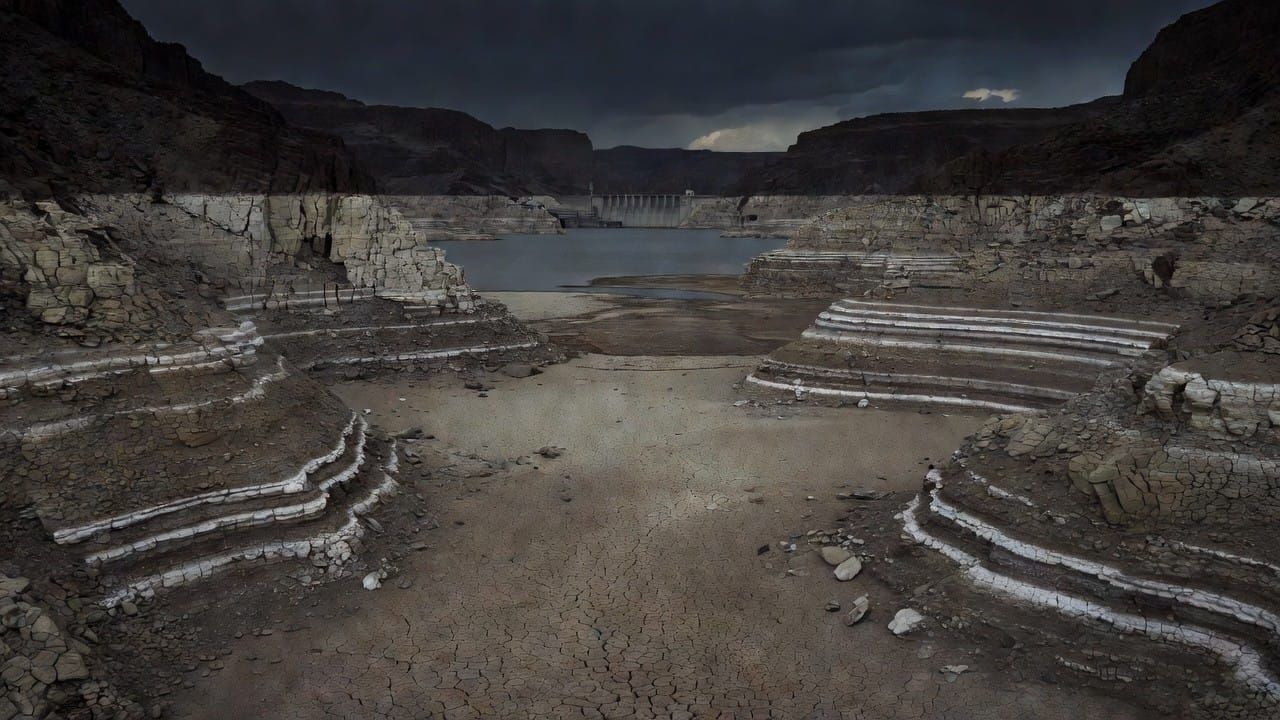
The negotiating clock is running against a reservoir system already near the edge. As of mid-July 2026, Lake Mead sits around 1,043 feet — flirting with its record low of roughly 1,041 feet set in 2022 — at about 27% of capacity. Lake Powell is near 3,524 feet, roughly 24% full and not far above the 3,490-foot threshold below which Glen Canyon Dam can no longer reliably generate hydropower.
Reclamation is already managing to those cliffs. Powell's releases for the 2026 water year were cut from an original 7.48 million acre-feet projection down to 6.0 million acre-feet to protect elevation, with supplemental releases from upstream Flaming Gorge helping to prop up inflows. Mead is operating under a Level 1 Shortage for 2026, which forces mandatory reductions — roughly 512,000 acre-feet from Arizona, 21,000 from Nevada, plus cuts from Mexico. And the April–July runoff forecast came in around 15% of average. The snowpack that is supposed to refill the system simply isn't showing up.
This is the backdrop that makes the legal deadline dangerous. You cannot write a generous new rulebook for a river that keeps under-delivering. Whatever replaces the 2007 guidelines will almost certainly allocate less water, more strictly, with the federal government holding the pen.
What it means for money
Farmland is the front line. Agriculture consumes roughly 75–80% of the basin's water, and more than half of that goes to low-value forage crops — alfalfa and hay grown to feed cattle, much of it in Arizona and California's Imperial Valley. When water gets cut, the economically rational move is to fallow the thirstiest, lowest-margin acres first. That is already happening through "buy-and-dry" deals, where cities and investors pay farmers to stop irrigating and transfer the water rights. Expect the pace to accelerate. Farmland values in the driest districts face real downward pressure; farmland tied to secure, senior water rights becomes scarcer and more valuable. The split between "land with water" and "land that used to have water" is the trade.
Winter produce and beef feel it downstream. The Yuma and Imperial regions grow up to 90% of America's winter leafy greens. Cuts to that acreage don't erase the supply, but they raise the cost of the marginal head of lettuce and every alfalfa-fed steer. This is a slow, structural input-cost story for food producers and grocers, not an overnight spike — but it's the kind of persistent margin pressure that compounds.
Growth-state real estate hits a permit wall. Arizona already moved to limit new housing approvals in parts of the Phoenix metro that couldn't prove a 100-year groundwater supply. Tighter river allocations extend that logic. In the fastest-growing corners of Arizona and Nevada, water availability — not land or demand — becomes the binding constraint on new development. Homebuilders with entitled, water-secured lots hold an option that gets more valuable; those betting on fringe expansion face a harder underwriting question.
Water itself is now an asset class. A specialized set of investors — water-focused asset managers, farmland funds, and infrastructure players — has spent years accumulating senior water rights across the West precisely because they are finite, legally durable, and increasingly transferable to cities willing to pay. A federally tightened regime that makes water scarcer and forces more transfers is, bluntly, the thesis these funds were built on. Utilities and water-infrastructure companies serving the Southwest also sit in the path of enormous mandated spending on reuse, recycling, desalination, and efficiency.
Municipal risk is real but manageable. Cities like Phoenix, Las Vegas, and Tucson have diversified supplies, aggressive conservation, and reserves — Las Vegas in particular recycles nearly all indoor water. Municipal water systems aren't about to run dry. But rating agencies increasingly treat long-term water security as a credit factor, and the districts most exposed to agricultural-to-urban transfer costs are the ones to watch in the muni market.
The bottom line
The Colorado River isn't going to stop flowing on New Year's Day. What ends on December 31 is the political fiction that seven states can keep dividing a shrinking river using rules written for a wetter one. The replacement is being drafted under drought, under deadline, and — increasingly — under federal authority rather than regional consensus.
For investors, the signal is not "the West is running out of water." It's that the price of water, and of everything water touches — farmland, food, housing permits, utility capex — is about to be reset by a legal process most markets aren't watching. The states ran out of rules before the river ran out of water. That gap is where the repricing happens.
If this analysis was useful, this is what AlphaBriefing does every day — geopolitics and markets, connected to what it means for your money. Free members get the daily brief in their inbox; paid members get the investment frameworks, scenario pricing, and catalyst calendars behind the paywall.
Sign up free → — upgrade whenever it earns it.
Sources & Further Reading
- U.S. Bureau of Reclamation — Post-2026 Colorado River Operations
- Colorado Politics — Deadlocked: Colorado Basin states' negotiations collapse
- Maven's Notebook — Post-2026 Operations: Lower Basin proposal and next steps
- Colorado Public Radio — Federal intervention over Colorado River water scarcity
- Public Policy Institute of California — The Colorado River
- American Farmland Trust — Colorado River challenges pose risks to Western agriculture
- National Agricultural Law Center — Looking ahead as Colorado River guidelines expire
Disclaimer
AlphaBriefing is an independent intelligence publication. The content in this article is produced for informational and educational purposes only. Nothing published by AlphaBriefing constitutes financial, investment, legal, tax, or regulatory advice, nor should it be construed as a solicitation or recommendation to buy, sell, or hold any security, asset, or financial instrument.
All views expressed are those of the author at the time of writing and are subject to change without notice. Markets are volatile and unpredictable; past performance is not indicative of future results. Any investment involves risk, including the possible loss of principal.
AlphaBriefing and its principals, employees, or contributors may hold positions in securities or assets mentioned in this article. This should be considered a potential conflict of interest. No material relationship with any company referenced exists unless explicitly disclosed. Readers should conduct their own due diligence and consult qualified financial, legal, and tax advisors before making any investment decisions.
Information in this article is drawn from public sources believed to be reliable at the time of publication. AlphaBriefing makes no warranty, express or implied, as to the accuracy, completeness, or timeliness of any information herein. AlphaBriefing accepts no liability for any loss or damage arising from reliance on this content.
© AlphaBriefing. All rights reserved. Unauthorised reproduction or distribution is prohibited.