Why Germany's Industrial Engine Runs on 25 Centimeters of Water
The Rhine is about to break its all-time low-water record — in July, not October. Barge rates have tripled, BASF is warning of force majeure days after raising guidance, and Europe's industrial heartland is discovering its river no longer has a backstop.

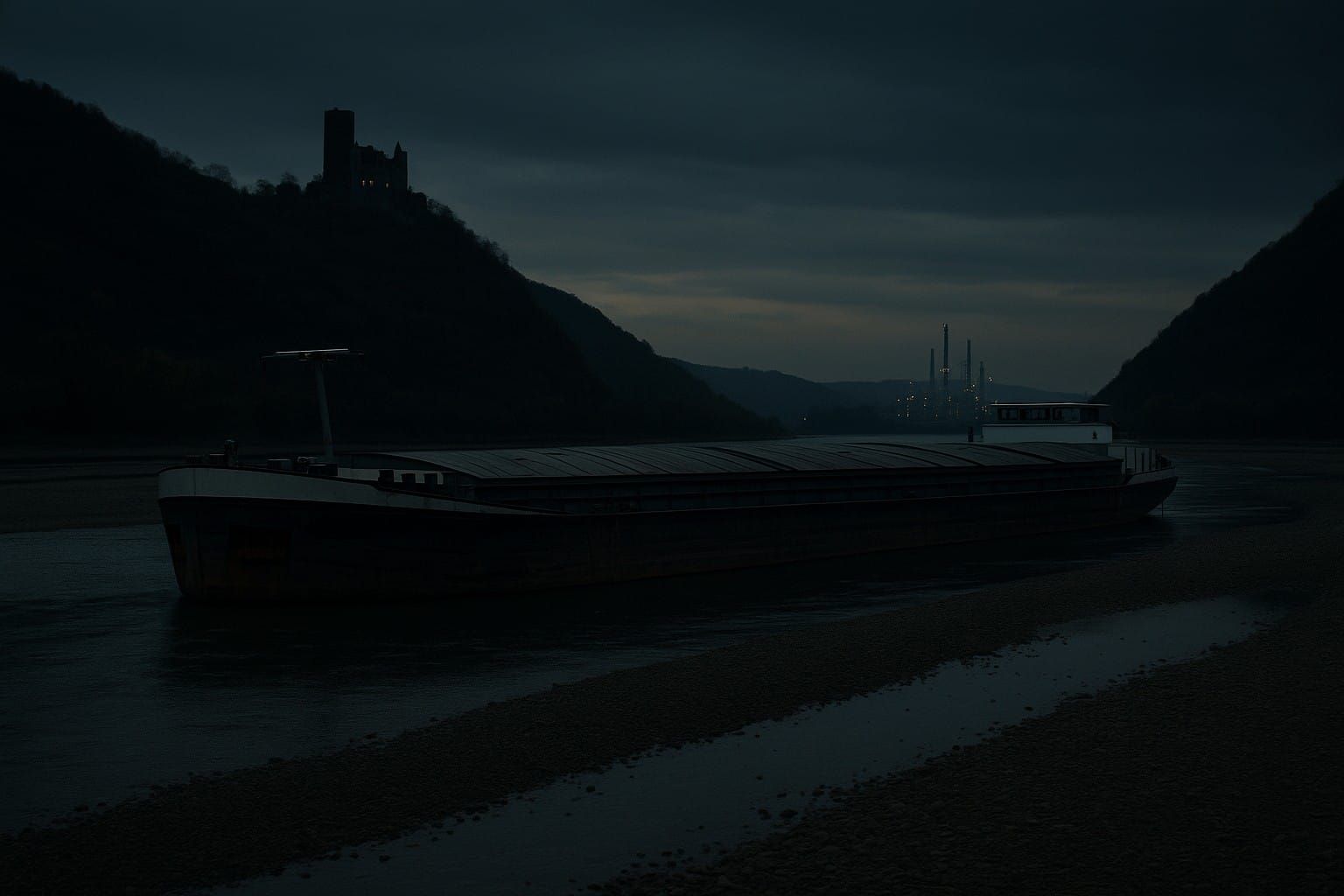
On Friday morning, the navigable depth of the Rhine at Kaub — the shallow bend between Mainz and Koblenz that determines whether Europe's busiest waterway functions — stood at roughly 25 centimeters. That matches the all-time low of 25 cm set in October 2018, the worst low-water event in the river's modern records. The federal forecast says the gauge falls to about 21 cm by August 1. Sometime this weekend, the Rhine will most likely set a record low with two months of summer still to run.
The market signal arrived faster than the water fell. Tanker barge rates from Rotterdam to Karlsruhe were around €45 a ton at the end of June. By midweek they had reached €60–70. On Friday, quotes ran as high as €150–155 a ton — more than triple in a month — because a vessel that normally pushes 1,200 to 2,500 tons through Kaub can currently load about 250 tons before its hull sits too deep. Operators are running at roughly 20% capacity and billing low-water surcharges on every ton. There is no slack to absorb the difference: one fully loaded barge carries the equivalent of 50 to 150 truckloads, and Germany's rail network is already running near its freight capacity.
Why 25 Centimeters Moves a Trillion-Euro Economy
The Rhine carries roughly 80% of Germany's inland-waterway freight — iron ore for the steel mills of Duisburg, coal for power plants, crude products for the refineries of Karlsruhe and Cologne, and the chemical feedstocks that supply the industrial corridor running from Rotterdam to Basel. Kaub is the chokepoint: the gauge there is the reference number written into freight contracts, surcharge triggers, and the loading decisions of every operator on the river.
The companies at the end of those barge routes are already saying the quiet part. On July 29, BASF chief executive Markus Kamieth told analysts it "would not be wise to exclude that there could be force majeure announcements or product shortages in individual cases," and that the company may need to curtail certain products in the coming weeks. BASF's Ludwigshafen complex — the largest integrated chemical site in the world — receives roughly 40% of its raw materials by barge. LyondellBasell's Wesseling site has reportedly already declared force majeure on butadiene.
The historical precedent is exact, because this has happened before — twice in the last eight years. In 2018, months of low water cut BASF's earnings by about €250 million and forced production cuts at Evonik and Lanxess; the German economy shrank 0.2% in the third quarter of that year, with the Rhine cited as a contributing cause. In 2022 the river bottomed at 31 cm and Germany's chemical and refining sectors spent the summer improvising. Researchers at the Kiel Institute for the World Economy have since put a number on the mechanism: when the Kaub gauge spends 30 days below 78 centimeters, German industrial production falls by about 1%. The gauge has been below that threshold for most of July — and the two prior events bottomed out in August and October.
Here is the tension the market has not resolved: BASF raised its full-year outlook on July 29 — the same day its CEO floated force majeure. The river is now at record lows earlier in the season than either 2018 or 2022, against an economy already flirting with stagnation. Someone is wrong about the third quarter — and the answer determines more than chemical earnings.
The rest of this briefing is free — it just requires a free AlphaBriefing account: the full exposure map of who eats the freight bill (chemicals, steel, refining, and the inland fuel markets that spike when the barges stop), the other side of the trade — the barge owners and purpose-built low-water fleet earning scarcity rates, the macro math on Germany's Q3, and the structural story: why the Rhine's Alpine buffer is disappearing and what that repricing means for adaptation capex.
Create your free account → — 30 seconds, no card.