Who Gets Crypto When Washington Splits It in Two?
The Senate has three weeks to pass the law that divides crypto between the SEC and the CFTC. After bitcoin's slide from $80,000, almost none of it is priced in — and the biggest winners aren't coins.

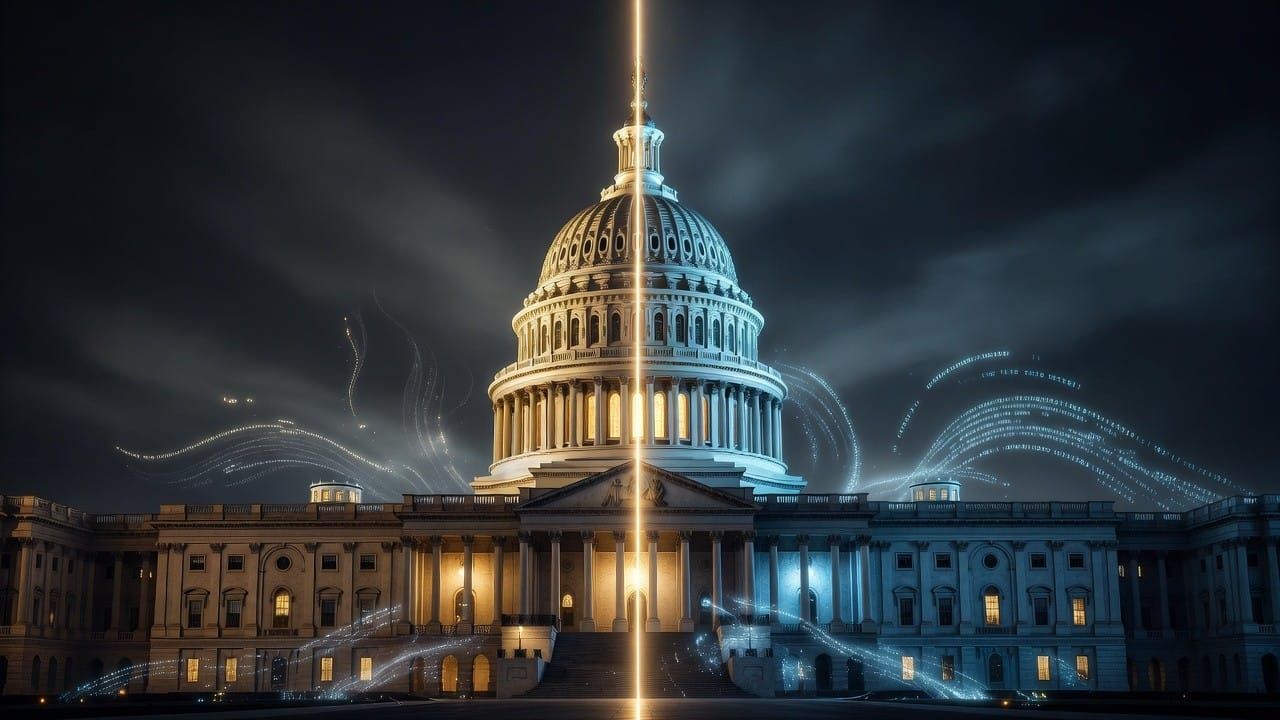
The United States Senate has three working weeks left before the August recess. Somewhere in that window sits a floor vote that will decide the most consequential question in American crypto policy — not whether digital assets are legal, but who gets to govern them. And after a two-month slide that took bitcoin from above $80,000 to its 2026 lows, the market has quietly stopped pricing the answer in.
The bill is the Digital Asset Market Clarity Act — H.R. 3633, universally shortened to the Clarity Act. It passed the House 294-134 a year ago with 78 Democrats on board. The Senate Banking Committee approved its own version 15-9 in May, with two Democrats crossing over. It has been sitting on the Senate calendar since June 1, one scheduling decision away from a floor vote. Majority Leader John Thune says he wants it done this work period. President Trump summoned negotiating senators to the White House on Tuesday and wants a bill on his desk by early August.
None of that guarantees anything, and that is precisely what makes the next three weeks interesting.
The law that splits the market in two
The GENIUS Act, passed last year, answered one question: stablecoins are now regulated payment instruments under banking supervision. We covered what that did to the reserve business — it turned dollar tokens into a government-protected float operation.
The Clarity Act answers everything else, and it does it with a cleaver. The bill draws a statutory line through the middle of the asset class:
- Digital commodities — tokens running on blockchains that qualify as "mature": decentralized, functional, not controlled by any single entity — go to the CFTC, which for the first time gets direct authority over spot markets, not just derivatives. Bitcoin and ether anchor this category, and drafts circulating this spring extended fast-track commodity treatment to tokens with existing ETF listings — a list reported to include XRP, Solana, Litecoin, Dogecoin, Hedera, and Chainlink.
- Investment contract assets — tokens sold as fundraising instruments, or chains that flunk the maturity test — stay with the SEC under securities law.
- Payment stablecoins remain with banking regulators under the GENIUS framework.
For a decade, the defining feature of US crypto regulation was that this line did not exist. Every token was a jurisdictional knife fight; every exchange listing was a bet on which agency would sue first. The Clarity Act replaces litigation with registration: exchanges, brokers, and dealers in digital commodities register with the CFTC and operate under federal rules — disclosure, custody segregation, capital requirements, the works.
Washington is not debating whether to legalize crypto. It already did. It is debating who runs the market — and that is a much bigger deal for prices than it sounds, because regulatory perimeter determines which pools of institutional capital are allowed in.
The tell: this bill moves prices violently — when anyone believes it
You do not have to guess whether passage matters. The tape has already run the experiment, twice.
In early May, when Senate negotiators struck a compromise preserving stablecoin reward programs, Circle — the issuer of USDC — jumped roughly 16-20% in a session. Coinbase rose 6%. Custody and trading names like BitGo and Galaxy Digital rallied alongside, and bitcoin pushed above $80,000 amid the optimism. Weeks earlier, a more restrictive draft had sent Circle down 20% and Coinbase down 10%. One bill, two drafts, forty points of round trip in the most levered name.
Then the calendar did what Washington calendars do. Negotiations bogged down over ethics language — Democrats want conflict-of-interest provisions aimed squarely at the first family's crypto ventures — plus illicit-finance rules and the stablecoin yield question. The vote slipped from June to July. The death of Senator Lindsey Graham thinned an already narrow Republican majority in a chamber where this bill needs 60 votes. Handicappers now put 2026 passage at roughly a coin flip.
And the market moved on. Bitcoin trades near $64,000-65,000 this week — close to its lows for the year — with ETF flows unstable and stablecoin supply flat-to-shrinking. Coinbase and Circle have drifted down even on days with constructive headlines. The legislative premium that was in these assets in May has been substantially bled out.
That is the setup. A binary event with coin-flip odds, a demonstrated 15-40% single-name price response, and a market positioned as if the answer is already no. Advocates expect fresh draft text around the week of July 20; the floor window closes August 7. Whichever way it breaks, the current price is wrong for one of the two outcomes.
The question that matters for positioning: which balance sheets reprice in each scenario, in what order, and what is the asymmetry at today's prices?
The rest of this briefing is for paid members: the full winner/loser map across the commodity line — the six tokens drafts fast-track and the exchange, custody, and issuer equities levered to each — the three-scenario framework with what each does to COIN, CRCL, and bitcoin from today's prices, and the catalyst calendar through August 7.
AlphaBriefing Paid gets you every investment thesis, scenario framework, and catalyst brief we publish — the analysis private intel clients pay four figures for, at a fraction of that.