What Does a Pension Fund Want With a Fusion Reactor?
Commonwealth Fusion's latest $1 billion came from pension funds, sovereign wealth, and infrastructure investors — the most conservative money in finance. The fusion race is no longer about physics. It's about who gets paid building the machine.

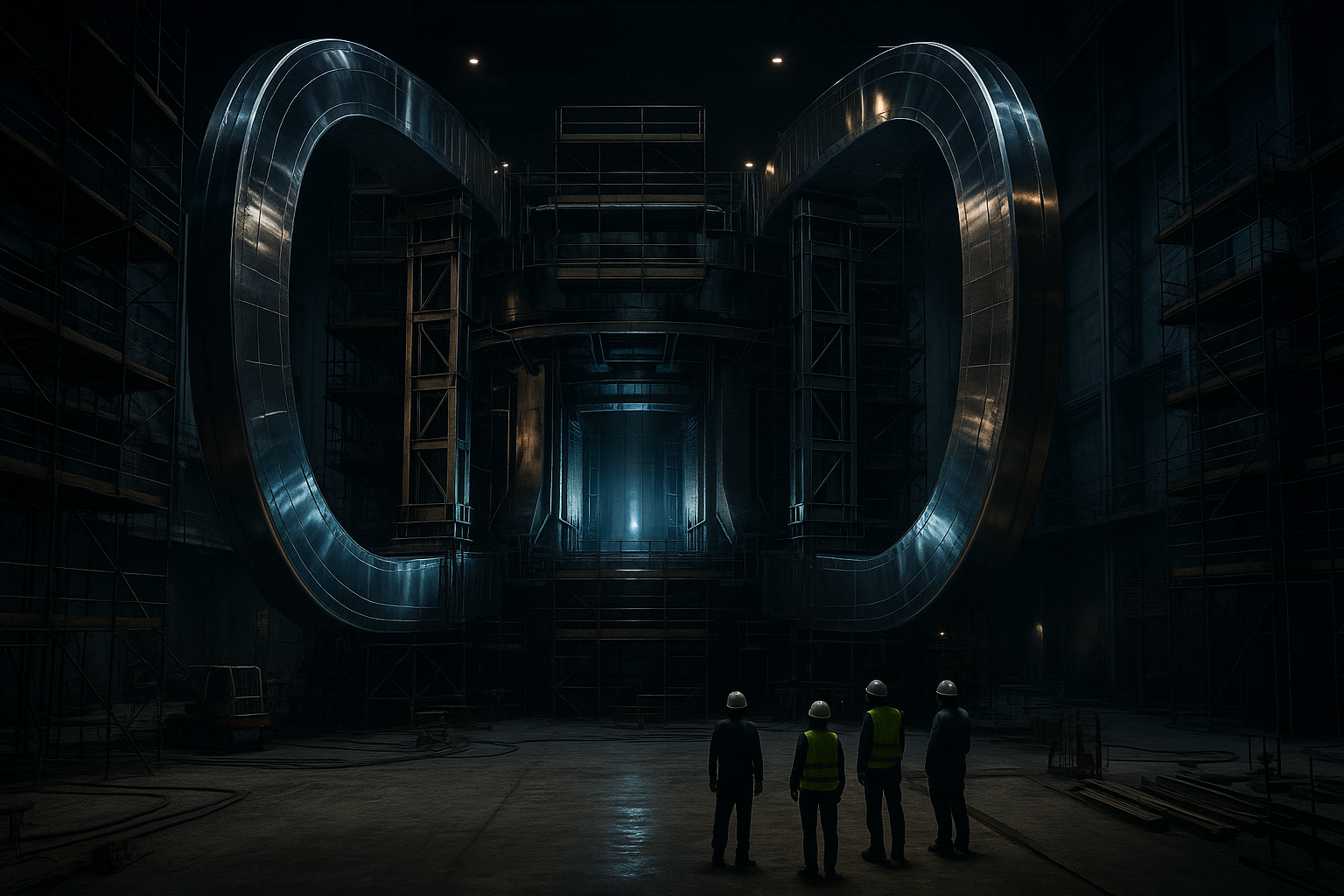
On July 30, Commonwealth Fusion Systems announced it had raised another $1 billion — the largest single round in the fusion industry since CFS's own $1.8 billion Series B in 2021, and enough to push the company's total funding to roughly $4 billion. In a sector that has been setting funding records all year, the headline number is almost routine.
The cap table is not. CFS says the round was anchored by "significant institutional investors, such as pension funds, sovereign wealth funds, and infrastructure and industrial corporate partners."
Read that list again. Pension funds do not buy science experiments. Sovereign wealth funds do not fund optionality for its own sake. Infrastructure capital exists to own boring, contracted, long-duration cash flows — toll roads, transmission lines, LNG terminals. For that class of money to show up in a fusion equity round, diligence teams at some of the most conservative institutions in finance had to conclude that a fusion power plant is now an underwritable asset with a plausible revenue schedule — not a physics lottery ticket.
That is a different claim than "fusion is exciting." And it is the single most important thing that happened to the industry this year.
The record year behind the round
The Fusion Industry Association's 2026 survey, published in July, puts numbers on the shift. The industry raised $4.48 billion in the twelve months to July 2026 — the largest annual haul since the survey began — bringing cumulative private investment to $14.24 billion since 2021. Fifty-six companies were surveyed, up from 23 five years ago. The sector now employs more than 16,000 people.
And the money is concentrating in companies with dates attached. Helion raised $465 million in June. Germany's Proxima Fusion closed $518 million in July, Europe's largest fusion round. Inertia Enterprises raised a $450 million Series A in February. CFS raised $863 million in August 2025 and another $1 billion eleven months later.
What separates this cycle from every previous fusion funding wave is that revenue now exists on paper. Google has contracted for 200 megawatts — half the planned output — of ARC, the commercial plant CFS intends to build at a Dominion Energy site in Chesterfield County, Virginia, for grid delivery in the early 2030s. Italy's Eni has contracted for more than $1 billion of ARC's electricity. Those power purchase agreements are the connective tissue between venture-stage fusion and infrastructure-grade fusion: contracted offtake is precisely what lets a project be financed like an LNG terminal instead of a moonshot.
First, though, the physics has to cooperate. SPARC, the demonstration machine CFS is commissioning in Massachusetts, is expected to attempt scientific breakeven — more energy out of the plasma than in — in 2027. Only one facility on Earth, the National Ignition Facility at Lawrence Livermore, has ever crossed that line, and it did so with a laser shot in a lab, not a machine designed to run as a power plant.
Meanwhile, in Hefei
While Western fusion was raising money, China was bending steel. On June 27, the Institute of Plasma Physics in Hefei completed full-performance testing of a D-shaped toroidal field coil that is, by a wide margin, the largest superconducting magnet ever built for a fusion reactor: 21 meters tall, 12 meters wide, 582 metric tons, carrying a stable current of 60,000 amps. It has 1.3 times the volume and three times the stored energy of the equivalent coil built for ITER, the 35-nation reactor project in France. It took six years to build — and every input that matters, from the specialty steel to the insulation to the superconducting wire itself, was manufactured in China.
The magnet's destination is BEST — the Burning Plasma Experimental Superconducting Tokamak — which China is targeting for completion around 2027 on the same Hefei campus. The timeline is worth sitting with: China's burning-plasma machine and America's privately funded breakeven attempt are now aimed at the same year.
The deeper signal is industrial, not scientific. China just demonstrated that it can produce ITER-class fusion hardware at record scale from an entirely domestic supply chain. The fusion race has quietly stopped being a physics competition and become a contest of manufacturing throughput and financing capacity — the two things great powers are actually good at.
Which reframes the investor's question. If the most conservative capital in the world has decided fusion is financeable, the question is no longer "will fusion work?" It is: where in this buildout does public-market money actually get paid — and when? Two Nasdaq listings, one supply-chain bottleneck, and a very specific date answer that.
The rest of this briefing is for paid members: the two fusion companies preparing Nasdaq listings this year, the superconducting-tape bottleneck every magnet-based reactor design has to buy through, the milestone calendar from SPARC's 2027 breakeven attempt to BEST's completion in Hefei, and the bottom-line positioning framework.
AlphaBriefing Paid gets you every investment thesis, scenario framework, and catalyst brief we publish — the analysis private intel clients pay four figures for, at a fraction of that.