"WE GOT HIM!" — Inside the Most Daring US Rescue Operation Since the Iran Hostage Crisis
On April 3, a US F-15E was shot down over the Zagros Mountains. For 48 hours, America watched as SEAL Team Six, A-10 gunships, and a CIA disinformation campaign raced to save a Colonel hiding in a mountain crevice 7,000 feet up — while Iran hunted him with a $60,000 bounty.

"WE GOT HIM!" — Inside the Most Daring US Rescue Operation Since the Iran Hostage Crisis
On the morning of April 3, 2026, an American F-15E Strike Eagle went down over the Zagros Mountains of southwestern Iran. Forty-eight hours later, Trump posted two words to Truth Social: "WE GOT HIM!"
What happened in between is one of the most extraordinary special operations in American military history.
Day One: The Shoot-Down
The F-15E went down in Kohgiluyeh and Boyer-Ahmad province, a rugged, thinly populated stretch of the Zagros mountain range that had seen little direct conflict before that morning. The exact nature of the shoot-down has not been officially confirmed — Iranian surface-to-air missiles, a manpad strike by an IRGC-aligned tribal unit, or some combination — but the outcome was unambiguous: both crew members ejected successfully.
The pilot was recovered quickly. Combat search and rescue assets — already pre-positioned in the theater in anticipation of exactly this kind of contingency — had him within hours. The weapon systems officer (WSO), a Colonel, was another matter.
He had come down in worse terrain, further from the aircraft's last known position. And the Iranians knew an American airman was loose in their mountains.
The Hunt
Iran's response was swift. The Islamic Revolutionary Guard Corps (IRGC) activated its provincial networks, coordinating with local Bakhtiari tribal leaders who know the Zagros terrain intimately. Iran offered a $60,000 reward — a significant sum in a province where median incomes are a fraction of that.
What the Iranians didn't know — and what would prove decisive — is that the Colonel had been here before. Not literally. But in training.
SERE — Survival, Evasion, Resistance, and Escape — is the military's most demanding survival training program. It is designed to simulate exactly this scenario: shot down, alone, in hostile territory, with enemy forces actively hunting you. The Colonel had been through it. He knew what to do.
He climbed. Rather than shelter in the lowlands where searchers would concentrate, he moved upward along a 7,000-foot ridgeline into terrain that was nearly impassable in April — snow-patched, rocky, exposed to wind that made it brutally cold at altitude but that also masked noise and movement. He found a crevice in the rock face and went to ground.
He activated his emergency beacon only intermittently — enough for US assets to get a fix, not enough to give the Iranians a continuous signal to track.
The CIA's Move
While the Colonel evaded, American intelligence was running a parallel operation.
CIA disinformation assets began circulating claims through Iranian media channels and social networks that the WSO had already been recovered. The message was calibrated: the search was over, the Americans had already extracted their man.
It was a lie, but it was a tactically brilliant one. For a period of hours, IRGC commanders in the province scaled back the search. Checkpoints that had been established at valley exits were thinned out. The tribal reward network was told to stand down.
The disinformation campaign bought time. Not much — the Iranians figured it out, or became suspicious enough to resume operations — but enough.
The Rescue
By April 5, the Colonel had been evading for more than 24 hours. He was cold, injured — the ejection had not been clean — and running low on the emergency rations and water purification tablets carried in a standard survival vest.
The US response was, by any measure, enormous.
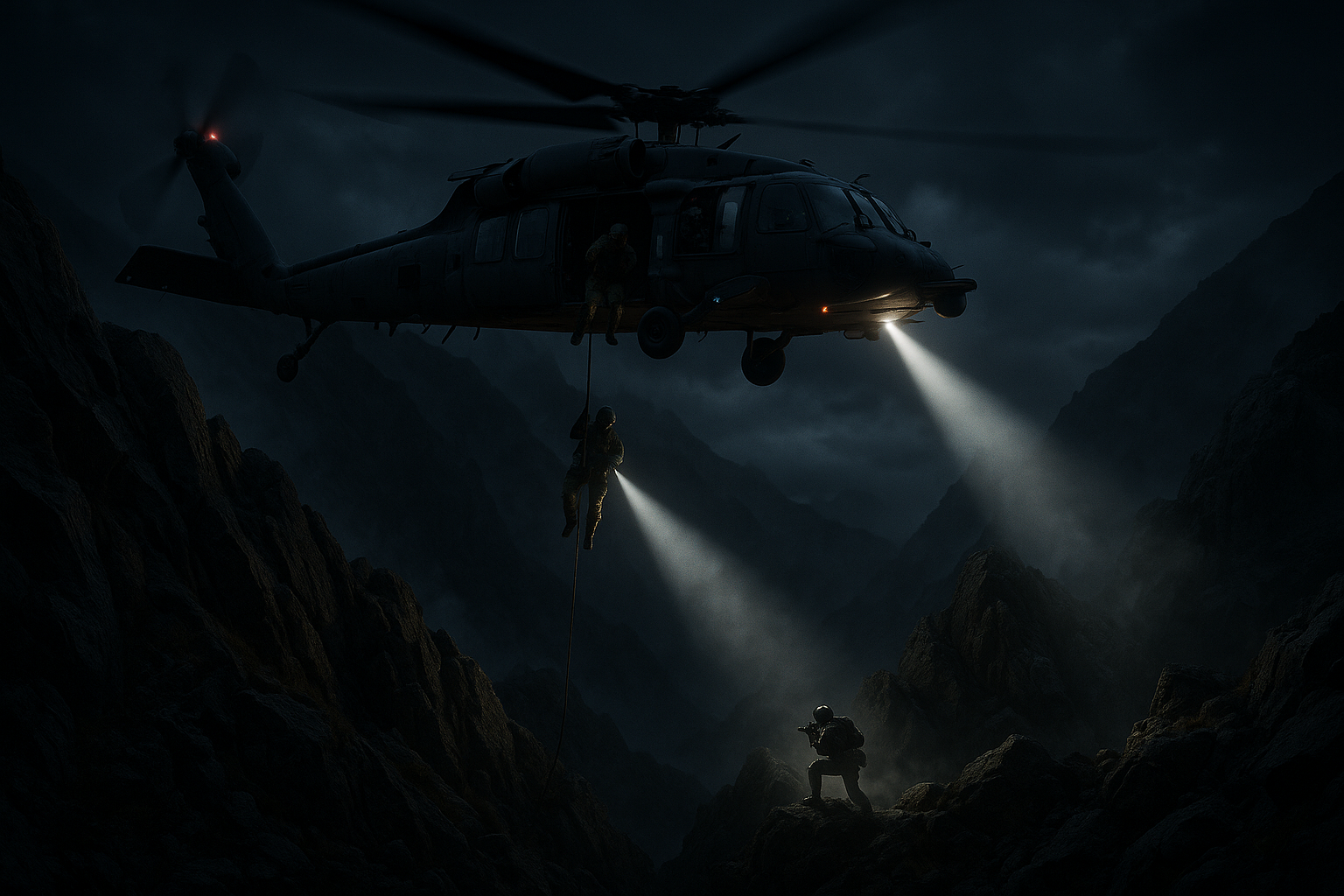
SEAL Team Six — the Naval Special Warfare Development Group, the military's most elite direct action unit — had been staging. UH-60 Black Hawks and MH-6 Little Birds, the small agile helicopters favored by SOF units for operations in tight terrain. A-10 Thunderbolts — the Air Force's legendarily survivable close air support aircraft — providing overwatch and suppression.
When Iranian convoys began moving toward the Colonel's last known position, the A-10s didn't wait. They struck the convoys from the air, destroying the vehicles before they could close the distance.
Two US helicopters took small arms fire during the extraction. Both were hit. Both remained flyable — a testament to the damage tolerance that makes US rotary-wing SOF aircraft uniquely survivable. One A-10 was not so lucky. It went down — the pilot ejected and was subsequently recovered.
At the forward staging base, US commanders made a decision that underscores the seriousness with which the military treats the imperative never to leave usable equipment to the enemy. Before withdrawing, they destroyed two C-130 transport aircraft and four MH-6 Little Birds. The aircraft were rendered inoperable and burned. Better to lose the hardware than hand Iranian intelligence engineers a working example of American special operations capability.
The Colonel was pulled from his mountain crevice alive. Injured, hypothermic, but alive.
Trump's post followed within hours.
What This Reveals About US SOF Capability
The Iran Rescue operation is a demonstration of several things that matter strategically.
Depth of pre-positioning. The speed with which SEAL Team Six, A-10s, and dedicated SOF rotary-wing assets were assembled and deployed speaks to a level of pre-positioning in the theater that goes beyond what has been publicly acknowledged. You don't spin up that kind of package in hours from bases thousands of miles away.
Integration of ISR and direct action. The Colonel's intermittent beacon activations were sufficient for US intelligence, surveillance, and reconnaissance assets to maintain a rough fix on his position. That requires continuous airborne ISR presence over the search area — probably a combination of high-altitude assets and signals collection — coordinated in real time with the ground rescue plan.
Joint CIA-military operations. The disinformation campaign required intelligence community assets working in sync with military planning. The timing — buying hours when the Iranians stood down — was not accidental.
Risk tolerance. The decision to send SEAL Team Six into active IRGC-controlled territory, with hundreds of personnel and dozens of aircraft, after a publicly acknowledged shoot-down signals something about the broader strategic posture in this war.
The Iranian Picture: A Failure Analysis
For the IRGC, this operation is a humiliation that will reverberate for years.
The IRGC had a colonel-level American officer loose in Iranian territory for more than 24 hours. They had $60,000 in reward money circulating through tribal networks that know the terrain better than any external force. They had the home-field advantage.
They lost him anyway.
Three explanations, likely operating in combination:
Intelligence penetration. The CIA disinformation campaign was too well-timed to have been purely opportunistic. Someone in or adjacent to the IRGC provincial command structure was feeding information — or was susceptible to manipulation — in ways that suggest deeper American intelligence penetration of Iranian forces in the region than either side has acknowledged.
Tribal network limitations. The Bakhtiari are a complex tribal confederation. Their relationship with the IRGC and the Tehran government is transactional, not ideological. A $60,000 reward is real money — but loyalty to the IRGC is not unconditional.
Terrain advantage reversed. The Colonel's decision to climb — counterintuitive as it was — appears to have put him above the elevation zone where the IRGC concentrated its search.
Strategic Implications
This rescue does not change the military situation in Iran. It does not affect territory held, force ratios, or the underlying political dynamics of the conflict.
But it matters, for reasons that are partly morale, partly deterrence, and partly domestic political.
Morale and force protection. American military personnel flying missions over Iran now have evidence — not just doctrine — that the US will go to extraordinary lengths to bring them home.
Deterrence signaling. The operation signals to Iran that the US has deeper intelligence penetration, more pre-positioned assets, and a higher risk tolerance than Tehran may have assumed.
Domestic political impact. In a conflict that has cost 13 American lives to date, the rescue of the Colonel is the kind of tangible success that sustains public support. The administration will use it.
Escalation dynamics. What does Iran do next? A humiliation of this magnitude creates pressure for a response. The IRGC cannot appear impotent. Watch for elevated risk of asymmetric responses in the near term: proxy attacks in Iraq or Syria, cyber operations, or targeted actions against US intelligence assets in the region.
A Strategic Inflection Point
Wars have moments that define them. Not the largest battles, or the highest casualty days — but the moments that demonstrate something essential about one side's capability or will.
The Iran rescue is one of those moments. It demonstrates that the US is willing to commit its most capable forces, accept significant risk, and absorb losses in the defense of its people — even when those people are behind enemy lines, in hostile terrain, with a hostile nation actively hunting them.
Thirteen American service members have died in this conflict. The Colonel is not among them — and that matters in ways that go beyond the individual.
For Washington, the message is: we can operate inside Iran, at will, with capability and integration the Iranians cannot match.
For Tehran, the message is equally clear. The war has now produced a moment of visible IRGC failure that will be studied in every special operations school on the planet.
The clock is running. What comes next will tell us whether Iran reads this as a reason to de-escalate — or as a humiliation that demands a dangerous response.
Sources & Further Reading
- Reuters — US military operations in Iran theater
- Stars & Stripes — SEAL Team Six deployed in Iran rescue operation
- Washington Post — Inside the 48-hour rescue of the American colonel in Iran
- BBC News — Iran rescue: what we know about the operation
- AP News — Trump celebrates rescue of downed US airman from Iran
- The War Zone — A-10s and SOF assets deployed in Iran theater
Disclaimer
AlphaBriefing is an independent intelligence publication. The content in this article is produced for informational and educational purposes only. Nothing published by AlphaBriefing constitutes financial, investment, legal, tax, or regulatory advice, nor should it be construed as a solicitation or recommendation to buy, sell, or hold any security, asset, or financial instrument.
All views expressed are those of the author at the time of writing and are subject to change without notice. Markets are volatile and unpredictable; past performance is not indicative of future results. Any investment involves risk, including the possible loss of principal.
AlphaBriefing and its principals, employees, or contributors may hold positions in securities or assets mentioned in this article. This should be considered a potential conflict of interest. No material relationship with any company referenced exists unless explicitly disclosed. Readers should conduct their own due diligence and consult qualified financial, legal, and tax advisors before making any investment decisions.
Information in this article is drawn from public sources believed to be reliable at the time of publication. AlphaBriefing makes no warranty, express or implied, as to the accuracy, completeness, or timeliness of any information herein. AlphaBriefing accepts no liability for any loss or damage arising from reliance on this content.
© AlphaBriefing. All rights reserved. Unauthorized reproduction or distribution is prohibited.