$VSAT: Viasat Spent a Decade Building the Wrong Network. The Stock Rose Tenfold Anyway.
Viasat just completed the satellite constellation it spent a decade building — years late, one satellite crippled, and aimed at a market Starlink already took. The stock is up tenfold anyway. Here's what the market is actually paying for.

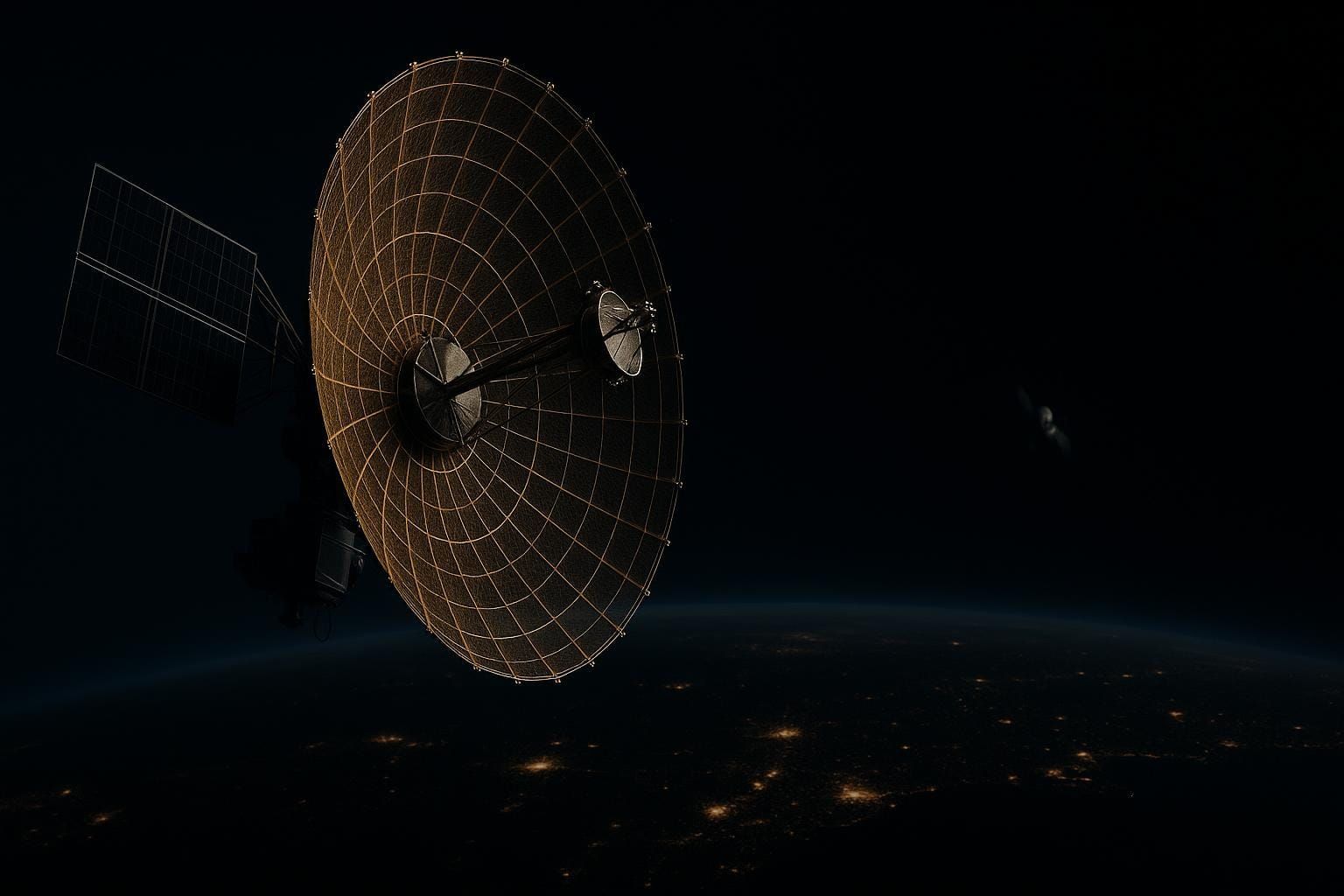
Last Thursday, September 17, Viasat announced that ViaSat-3 F2 had entered service over the Americas. It was the kind of press release that gets skimmed and forgotten — another satellite switched on. But F2 was the last piece of a three-satellite constellation the company has been building since the mid-2010s, and its activation closed one of the strangest chapters in the space economy: a program that arrived years late, watched its flagship satellite get crippled by a stuck antenna, and finally reached completion just in time to serve a consumer market that no longer wants it.
Here is the strange part. Viasat stock (NASDAQ: VSAT) traded below $8 in November 2024. Today it trades around $76 — up more than 150% in the past twelve months alone, and roughly tenfold off those 2024 lows, touching nearly $90 at its summer peak. The market cap now sits at about $10.5 billion.
A company whose signature project was a decade-long, failure-plagued bet on the wrong technology for the wrong market has been one of the best-performing communications stocks in America. That is not an accident, and it is not irrational. But understanding what the market is actually paying for — because it is mostly not the satellites — is the difference between chasing this move and evaluating it.
The decade of building
The ViaSat-3 program was conceived in the mid-2010s with straightforward logic: build three of the highest-capacity geostationary satellites ever flown — each designed for around a terabit per second of throughput — and blanket the Americas, EMEA, and Asia-Pacific with cheap satellite bandwidth from three fixed points 36,000 kilometers up.
Almost nothing went to plan.
The first satellite, F1, launched on a Falcon Heavy on May 1, 2023. Weeks later, its huge Ka-band reflector antenna failed to deploy properly. The satellite works — but at less than 10% of its designed capacity. Viasat confirmed $420 million of insurance coverage on F1 and filed a claim of roughly that amount, one of the largest space-insurance losses in history. It chose not to build a replacement.
The second and third satellites carried different antenna hardware — F3's reflector comes from a different supplier entirely, a change Viasat has said directly addresses the F1 failure mode. F3 launched on April 27, 2026, and entered service over Asia-Pacific on August 31. F2 followed over the Americas on September 17. Boeing, which built all three spacecraft buses, notes that the two new satellites roughly tripled the bandwidth available across Viasat's entire global fleet.
So the constellation is finally whole — a decade of engineering, billions of dollars, one insurance write-off, and more than a terabit of new capacity. The problem is what happened on the ground while it was being built.
The market it was built for is gone
ViaSat-3 was designed in an era when Viasat's core business was selling satellite internet to rural American homes. Starlink ended that era. SpaceX's low-Earth-orbit constellation — closer to the ground, lower latency, mass-produced — redefined what consumer satellite broadband could be, and Viasat's fixed-broadband subscriber base has been shrinking for years. The company's own shareholder letter now describes "expected declines" in fixed services with each passing quarter. The US consumer business ViaSat-3 was conceived to supercharge is in managed decline.
Viasat saw this coming, which is why in May 2023 — the same month F1 launched — it closed the $7.3 billion acquisition of Inmarsat ($815 million in cash, $3.1 billion in stock, plus assumed debt) and pivoted the whole company toward mobility: connecting airplanes, ships, and governments rather than houses. That deal also loaded the balance sheet with debt the company is still working down — net debt stood at $4.8 billion as of June 30, 2026.
Which brings us back to the puzzle. A capital-intensive company with a melting legacy business, negative net income, and nearly $5 billion of net debt does not rise tenfold because it finished a late constellation. The re-rating has three specific engines — and each one has a number attached.
Get the next briefing free in your inbox: Join AlphaBriefing
The rest of this briefing is for paid members: the three re-ratings driving the stock — the defense backlog numbers behind the Space Force's new satellite program, the spectrum asset the market repriced after $36 billion in copycat deals, and the free-cash-flow inflection now guided for this fiscal year — plus the bear case at 11x EBITDA and the specific catalysts to watch into the November earnings print.
AlphaBriefing Paid gets you every investment thesis, scenario framework, and catalyst brief we publish — the analysis private intel clients pay four figures for, at a fraction of that.