Trump Is Accidentally Turbocharging China's Reserve Currency Ambitions

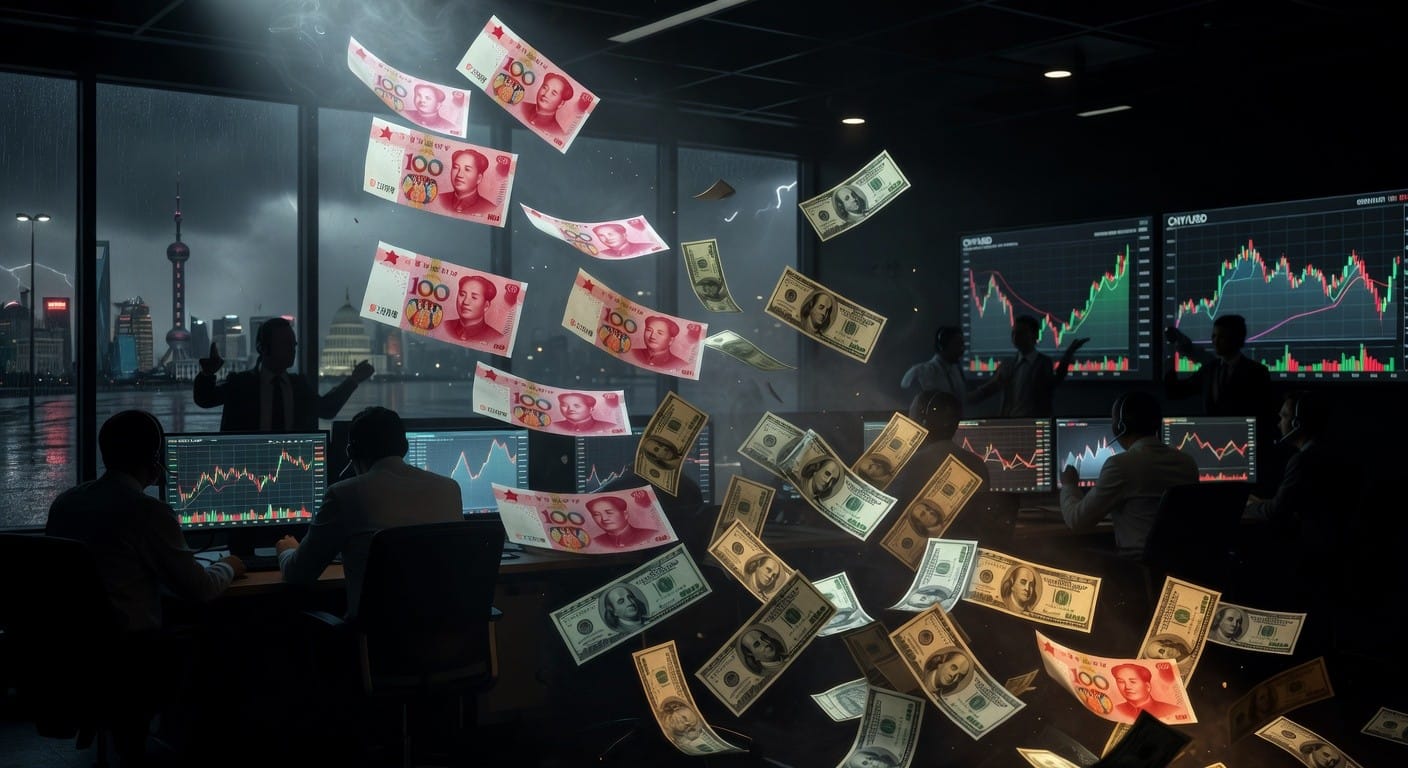
The Iran war was supposed to prove dollar dominance. It's doing the opposite.
When U.S. and Israeli forces struck Iranian nuclear and military facilities in early March 2026, most analysts expected the traditional playbook to hold: global crisis → flight to safety → stronger dollar. And for a brief moment, it did. The greenback spiked as oil markets buckled and traders sought cover.
Then something unexpected happened. The dollar started to fade — and the Chinese yuan started to climb.
The Crisis That Changed the Calculus
The U.S.-Iran war has cost Washington more than $12.7 billion in direct military expenditures so far, with no clear end in sight. Iran's partial closure of the Strait of Hormuz — through which roughly 20% of global oil supply transits — sent crude prices spiraling toward $120 per barrel. The OECD is now forecasting U.S. headline inflation at 4.2% for 2026.
For oil-importing economies in Asia and Europe, the shock is devastating. But here's the counterintuitive twist: China, the world's largest oil importer, has weathered the storm better than almost anyone else. Chinese equities outperformed global peers during the sharpest Iran-driven selloffs. The yuan hit 35-month highs against the dollar in February 2026 — up roughly 7% since April 2025.
Economists at Asia Times put it bluntly: "Iran's Hormuz pain is China's yuan gain."
Xi's Explicit Bet
In early February 2026, Xi Jinping made something explicit that Beijing had long kept ambiguous. In a state media-circulated commentary drawing from a Party journal speech, Xi called for building a "powerful currency" widely used in international trade, investment, and global reserves — a direct challenge to the dollar's structural dominance.
It was the clearest public declaration yet. And the timing wasn't coincidental.
China's strategy is multi-layered:
CIPS expansion. China's Cross-Border Interbank Payment System — its SWIFT alternative — has been quietly growing its transaction volumes, processing more trade settlements with Russia, Iran, and Belt and Road partners. It's still a fraction of SWIFT's scale, but its trajectory is up.
The petroyuan push. Saudi Aramco pilot programs, Russian energy settlements post-sanctions, and now Iranian oil deals are slowly shifting the marginal barrel of oil away from dollar denomination. The petrodollar still dominates — roughly 80% of oil trade — but the direction of travel is unmistakable.
Digital yuan infrastructure. China's e-CNY trials are expanding into cross-border applications, with particular focus on building infrastructure across Southeast Asia and the Gulf. This is the long game: positioning RMB payment rails before the network effects lock in.
The Dollar's Structural Problem
The Iran war hasn't created the dollar's vulnerabilities. It's exposed them.
The U.S. fiscal deficit was already on a deteriorating trajectory before the first strike on Natanz. The war has accelerated that burn rate while simultaneously highlighting a paradox: America's energy export advantage under the current administration means Washington can absorb the oil shock domestically, but the geopolitical costs — the military expenditure, the coalition management, the reputational weight of another Middle East entanglement — accumulate in ways that don't show up in oil futures.
Reuters described the dynamic succinctly in a late March report: the "war-driven dollar rebound" is fading, with "broad safe-haven appeal eroding" as de-escalation hopes rise and war expenses mount.
Goldman Sachs' FX research team noted in January 2026 — before the war — that reduced U.S. economic outperformance and policy shifts favoring a weaker dollar pointed to a structural downside trend. The war has layered geopolitical risk onto that structural deterioration.
What Investors Need to Understand
The yuan is not replacing the dollar. Not this year. Probably not this decade in any comprehensive sense. Capital controls remain the fundamental constraint: without full convertibility, the RMB cannot function as a true global reserve currency. Its current share of global reserves sits around 2% versus the dollar's ~58%.
But that framing misses the actual investment thesis.
The question isn't whether the yuan dethrones the dollar. The question is whether the dollar's structural dominance is eroding at the margin — and whether that erosion creates asymmetric opportunities in specific asset classes.
Consider what a sustained shift looks like:
- Asian trade settlement: Growing portions of intra-Asian trade are settling in RMB, bypassing the dollar entirely. Companies with significant Asia-Pacific exposure increasingly face a currency decision their predecessors didn't.
- Commodity pricing: A world where even 10-15% of oil trades in yuan is a different hedging environment than today's. The marginal shift matters for commodity-linked equities and currency exposure.
- U.S. Treasury demand: Every sovereign that builds RMB reserves is, by definition, building fewer dollar reserves. The direction of central bank reserve diversification is a multi-year tailwind for yields.
- Gold: In a world of contested reserve currency credibility, gold becomes more attractive to sovereigns holding neither dollars nor yuan. Central bank gold buying — at record levels for three consecutive years — is the most concrete expression of this thesis playing out in real-time.
The Honest Assessment
Xi's RMB ambitions face genuine obstacles: capital controls, political risk, lack of deep and liquid bond markets, and the inertia of dollar-denominated global contracts. Analysts like Harvard's Kenneth Rogoff who see yuan reserve status as possible "in the next five years" are outliers. The consensus view is that full parity is decades away.
But "decades away from parity" is not the same as "irrelevant to current positioning." The arc of RMB internationalization — CIPS growth, petroyuan expansion, digital yuan infrastructure, and now an explicit political mandate from Xi — is a slow-moving structural story that's starting to move faster under the pressure of U.S. geopolitical overextension.
The Iran war didn't create this dynamic. But it may have compressed the timeline.
Get this level of intelligence every day. Subscribe to AlphaBriefing — free, member, and paid tiers available.
Sources & Further Reading
- Asia Times — Iran's Hormuz Pain Is China's Yuan Gain
- War on the Rocks — Xi Has Made China's Currency Ambition Explicit
- Reuters — War-Driven Dollar Rebound to Fade as Broad Safe-Haven Appeal Erodes
- Bloomberg — Chinese Stocks Fare Better Than Global Peers in Iran-Driven Rout
- Semafor — Xi Spells Out Yuan Reserve Currency Goal
- Forbes — How Renminbi Internationalization Is Changing
- Asia Times — Iran War Shows Dollar's Grip Starting to Slip on Asia
- Reuters — Euro, Yuan Global Ambitions Hasten Dollar Drop
Disclaimer
AlphaBriefing is an independent intelligence publication. The content in this article is produced for informational and educational purposes only. Nothing published by AlphaBriefing constitutes financial, investment, legal, tax, or regulatory advice, nor should it be construed as a solicitation or recommendation to buy, sell, or hold any security, asset, or financial instrument.
All views expressed are those of the author at the time of writing and are subject to change without notice. Markets are volatile and unpredictable; past performance is not indicative of future results. Any investment involves risk, including the possible loss of principal.
AlphaBriefing and its principals, employees, or contributors may hold positions in securities or assets mentioned in this article. This should be considered a potential conflict of interest. No material relationship with any company referenced exists unless explicitly disclosed. Readers should conduct their own due diligence and consult qualified financial, legal, and tax advisors before making any investment decisions.
Information in this article is drawn from public sources believed to be reliable at the time of publication. AlphaBriefing makes no warranty, express or implied, as to the accuracy, completeness, or timeliness of any information herein. AlphaBriefing accepts no liability for any loss or damage arising from reliance on this content.
© AlphaBriefing. All rights reserved. Unauthorized reproduction or distribution is prohibited.