The Winter Gas Trade Runs Through Louisiana
Qatar's LNG has been locked out of the market since June. Europe enters winter 15 points short on storage. The only swing supplier left is the US Gulf Coast — and the trade has several legs.

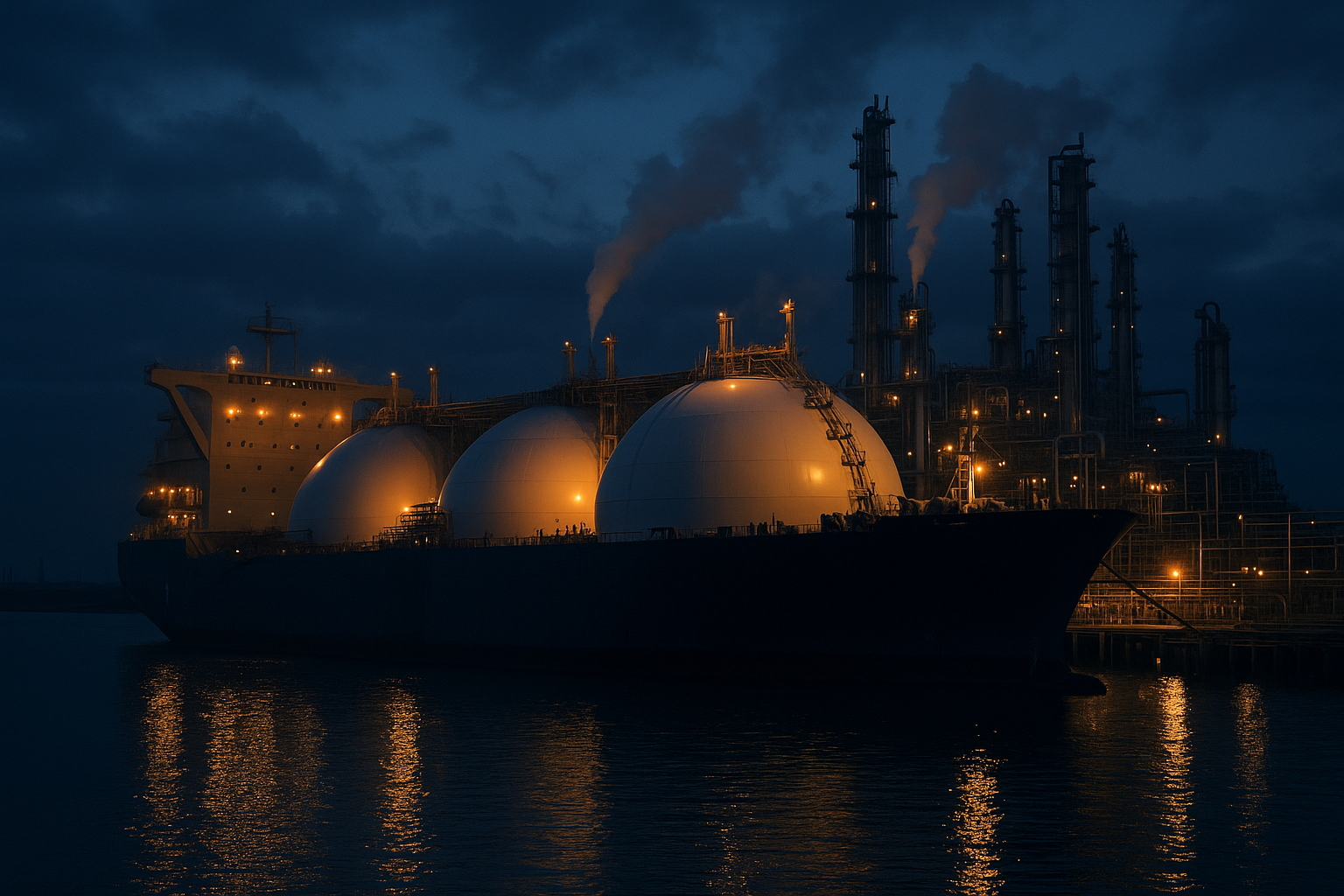
Since late June, one of the world's largest LNG exporters has been unable to deliver its gas. QatarEnergy has now extended force majeure on cargo deliveries into early November as the Strait of Hormuz remains closed to LNG traffic — Italy's Edison alone says roughly 24 of its contracted cargoes, about 3 billion cubic meters of gas, have been scrapped since April, with five more canceled through early November.
Crude oil found workarounds. Tankers can shuttle through contested water and transfer cargo ship-to-ship outside the Gulf. LNG cannot: the specialized carriers, cryogenic cargo, and insurance math don't allow it. Roughly 20% of global LNG supply normally transits Hormuz, and for three months the market has simply lived without most of it.
Europe is the buyer feeling it. And with a little over two months until meteorological winter, the only meaningful swing supplier left on Earth is a stretch of the US Gulf Coast between Corpus Christi and Plaquemines Parish.
Europe's Storage Math Doesn't Work
Europe came out of last winter with its storage at the lowest level since 2018 — about 31 billion cubic meters, per Columbia's Center on Global Energy Policy. It then spent the injection season competing for spot cargoes against Asian buyers in a heatwave, without Qatari volumes, and through autumn maintenance on Norwegian infrastructure.
The result: as of mid-September, EU storage was just under 69% full. A year earlier it was 81%. The five-year seasonal average is 84%. Germany, the bloc's biggest gas consumer, is sitting materially below even that headline number.
Prices say the market has noticed. Benchmark Dutch TTF futures averaged about €45 per megawatt-hour in June. They touched €82.50 on September 14 and trade near €72 today — down from the peak, but still roughly 60% above early summer. Morgan Stanley's base case for the winter average is €85, with a move above €100 if a cold winter overlaps with continued Qatari disruption. That is not a crisis price like 2022's €300 — but it is a level that keeps every LNG terminal on the planet running flat out.
The Machine That Fills the Gap
The United States is now the supplier of last resort, and the machine has never been bigger. Nine export terminals are operating. US LNG exports averaged 17.4 billion cubic feet per day in the first half of 2026, up 23% from a year earlier, per the EIA — and two of the newest plants are still ramping.
Venture Global's Plaquemines terminal in Louisiana went from first production to full first-phase throughput in about seven months — the fastest ramp in the industry's history — and by late last year was already accounting for roughly a fifth of all US exports. Golden Pass, the QatarEnergy-ExxonMobil joint venture in Texas, became terminal number nine when it shipped its first cargo in April; its second train was cleared to begin commissioning in late June, targeting startup this fall — in other words, arriving almost exactly when Europe needs it.
Here is the part the headlines skip: every incremental cargo that leaves the Gulf Coast is a cargo of gas that no longer supplies the American market. The pull is showing up in US prices this week, and the spread between what gas costs in Louisiana and what it fetches in Rotterdam has become one of the widest structural arbitrages in any commodity market.
Who captures that spread — and what it does to US gas prices, producers, and pipeline owners this winter — is where the trade actually lives.
Get the next briefing free in your inbox: Join AlphaBriefing
The rest of this briefing is for paid members: the $21-per-MMBtu arbitrage math and who actually captures it, the live read on US storage and this week's Henry Hub move, the six tickers positioned across the chain — including the one that's falling while the trade gets stronger — and the five-date catalyst calendar through November.
AlphaBriefing Paid gets you every investment thesis, scenario framework, and catalyst brief we publish — the analysis private intel clients pay four figures for, at a fraction of that.