The War's First Working Ceasefire Is One City Wide
Russia and Ukraine's first ceasefire that has actually held covers one starving town of 2,000 people. The market's non-reaction is the real story — and November's talks calendar prices the next move.

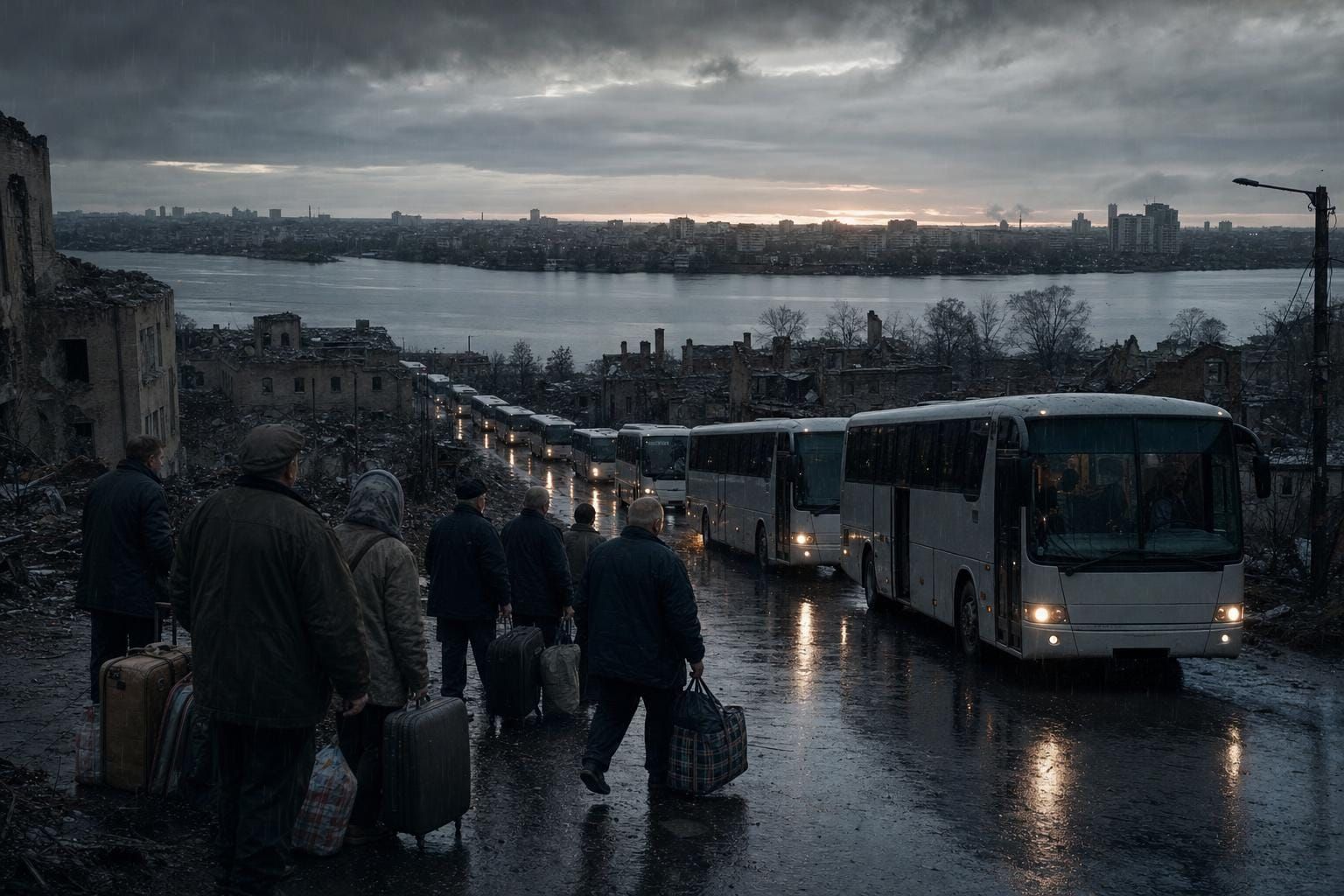
Before dawn on Tuesday, October 27, the guns around one town in southern Ukraine went quiet. Not along the front. Not in the skies over Kyiv or Kharkiv. In Oleshky — a Russian-occupied town across the Dnipro River from Kherson, where the White House says somewhere between 1,700 and 2,000 residents remain of the 24,000 who lived there before the invasion.
Localized truces have been announced before in this war, and their implementation has been patchy at best. This one is different: a written bilateral agreement, negotiated through a formal US intermediary, publicly committed to by both general staffs — and actually holding. It covers a single municipality. As of this writing, Ukraine's human rights ombudsman Dmytro Lubinets said Friday morning the truce had been in effect for more than 80 hours, demining of the access roads was complete, and 25 buses with capacity for 750 evacuees had rolled in. Russia's lead negotiator, Yana Lantratova, says the ceasefire runs until 10:59 p.m. on November 1, according to Belarusian state media.
A ceasefire one city wide sounds like a footnote. It isn't. The same Friday the deal was announced, President Volodymyr Zelensky said negotiators from Ukraine, Russia, and the United States would meet for technical-level talks in the first half of November in Abu Dhabi — and that he hoped a leaders' meeting would follow. The last US-led attempt at talks stalled in February with no progress. This time, there's a working precedent on the ground: the two sides agreed terms, executed them jointly, and — so far — have kept them.
For investors, that makes Oleshky the most important data point of the war's fifth year. Not because of what it is, but because of what the market did with it. Which was, almost perfectly: nothing.
How a Starving Town Got the War's First Truce
Oleshky has been occupied since the first weeks of the 2022 invasion and effectively blockaded for months. Residents reported a deepening food crisis; the roads out were mined, and civilians attempting to flee were frequently targeted by drones. Ukraine resorted to flying food into the town by drone. The humanitarian picture — elderly residents without medicine, food, or clean water — drew the attention of Pope Leo XIV, who raised the town with Vladimir Putin by phone on October 16, and of US First Lady Melania Trump, who brokered the final agreement in what the White House calls her role as "Exclusive Intermediary."
The deal, announced October 23, is narrow by design: both militaries halt operations in and around the town, humanitarian cargo gets in, and residents who want out get a protected corridor. Negotiations were led by Lubinets on the Ukrainian side and Lantratova on the Russian side. The same day, the two countries swapped 270 prisoners of war each — the first exchange since August.
Execution began this week. Aid was delivered Friday, and the first evacuees boarded buses — some bound for Russia, others for Ukrainian-controlled territory via a remarkable detour: south to Anapa in Russia's Krasnodar region, a flight to Belarus, then buses across the border into Ukraine. Ukraine's prime minister told lawmakers Friday that 527 residents planned to return to Ukrainian-held territory, then walked the number back as premature.
It is far from clean. A Ukrainian evacuation volunteer alleges Russia began moving residents out before the agreed date, outside the agreed terms. The Institute for the Study of War, which assessed both sides as adhering to the ceasefire as of October 29, flags concerns over how Russia is conducting the evacuations — and Ukrainian volunteers warn that a corridor routed through Russia will deter many from using it. Kyiv's own officials concede the operation is "extremely difficult." More than 19,000 Ukrainian civilians, including 762 children, have been killed since the full-scale invasion began, according to Ukraine's acting prosecutor.
The Road to Abu Dhabi
The ceasefire landed in the middle of the most active — and strangest — diplomatic stretch since the war began. US envoy Steve Witkoff met Zelensky in Norway, then Putin in St. Petersburg, in the week before the announcement. Washington and Kyiv are simultaneously at odds over speed restrictions on Starlink terminals that Ukraine's military depends on (in place since October 13) and over a US deal to import Russian diesel — the first three tankers were already en route to North America as the ceasefire was announced.
The structural obstacles haven't moved: Russia still demands Ukraine cede the entire Donbas, including territory it has never captured; Kyiv refuses to surrender land it holds. Zelensky's conditions for any deal — hard security guarantees and ten years of committed funding for the Ukrainian army — are themselves a signal that Kyiv expects to keep arming regardless of what gets signed.
So the honest frame for Oleshky is a test: can these two sides execute any agreement at all? More than 80 hours in, the answer has been a qualified yes. And that raises the question that actually matters for your portfolio — because European defense equities and Ukrainian sovereign debt have spent all of 2026 trading on exactly this possibility, and their reaction to the first real ceasefire of the war was not what the headlines would suggest.
A free membership gets you access to every free article at AlphaBriefing.com: Join AlphaBriefing
The rest of this briefing is free — it just requires a free AlphaBriefing account: the live repricing math on Rheinmetall and the European defense complex, where the peace trade actually lives in Ukraine's restructured bonds, and the November signpost calendar that tells you which scenario is winning.
Create your free account → — 30 seconds, no card.