The Students Won Serbia. The First Deadline Is Friday.
A student-led movement just ended 14 years of one-party rule in Belgrade — and inherited a sanctioned Russian-owned oil company whose US waiver runs out Friday, Europe's most contested lithium project, and a stack of state megacontracts it has promised to reopen.

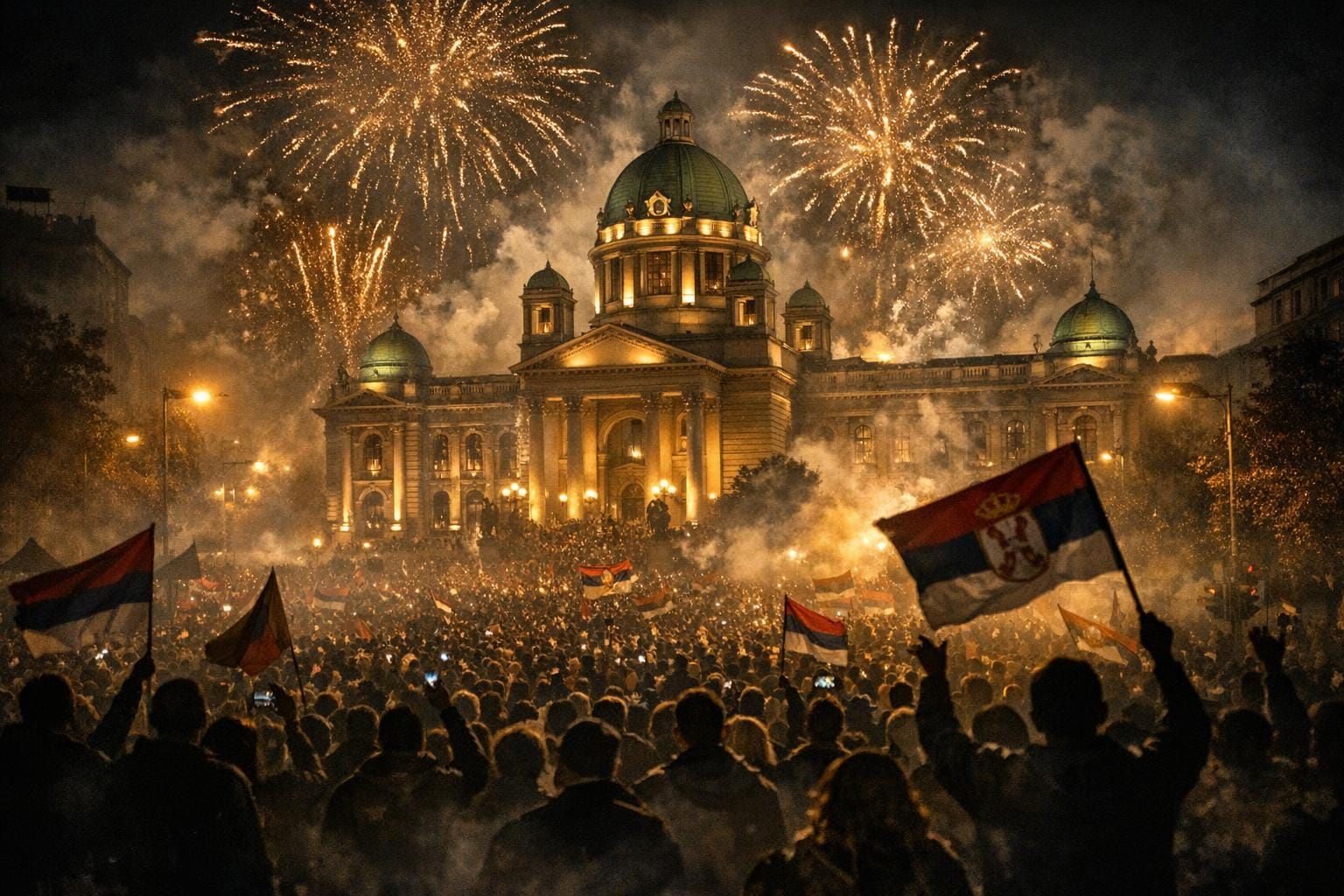
Fireworks were still bursting over Belgrade after midnight on Sunday when the tents started coming down — the ones Aleksandar Vučić's loyalists had kept pitched in a park in central Belgrade for more than a year. Serbia's ruling party had just lost a snap parliamentary election, and the man who has dominated the country's politics for over a decade stood in front of cameras and said the words almost nobody in the region expected to hear: "It is clear that we have lost these elections."
The numbers, by Vučić's own estimate from early vote samples: the Student List — a slate of doctors, professors, and engineers, many of whom have never held office — is on track for 135 to 140 seats in Serbia's 250-seat parliament, against roughly 105 for his Serbian Progressive Party (SNS) list. Turnout had reached 64.9 percent by early evening, the highest in any Serbian election since the breakup of Yugoslavia in 1992. By Monday, Balkan Insight reported that the latest preliminary figures confirmed an outright majority — the end of 14 years of SNS rule.
The movement that just took power was born in a train station. In November 2024, a concrete canopy at the freshly renovated Novi Sad railway station — rebuilt as part of a Chinese-led rail modernization — collapsed and killed 16 people. Demands for accountability hardened into the largest protest movement in modern Serbian history. Vučić resigned the presidency in September to run for prime minister, betting that he could personally drag his party across the line one more time. He lost the bet. Election watchdog CRTA still recorded pressure on voters or election workers at nearly a third of the 500 polling stations it monitored; the students won anyway.
Western capitals reacted within hours. European Commission President Ursula von der Leyen congratulated the Student List and said the EU stands "ready to support reforms on the rule of law, media freedom, the fight against corruption and strong democratic institutions, and to work together to advance Serbia's future in the European Union."
For investors, this is more than a democracy story. Serbia is the place where EU accession money, Russian energy assets, Chinese infrastructure credit, and Gulf real estate capital all intersect, and Vučić's entire operating model was to take all four at once and play them against each other. That model just lost its operator. Three files land on the new government's desk immediately — and the first one has a deadline this Friday.
Briefings like this are free to read with a free AlphaBriefing membership. Join free →
The refinery with a countdown
NIS — Naftna Industrija Srbije — operates Serbia's only oil refinery, at Pančevo outside Belgrade, a legacy of the 2008 sale of the company to Russia's Gazprom Neft. Gazprom Neft's stake stands at 56.15 percent. In January 2025, Washington sanctioned NIS as part of a broad action against Russia's oil industry, and the company has survived ever since on a chain of US Treasury waivers. The most recently reported relief — an OFAC license covering both NIS's operations and Hungary's negotiations to buy the Russians out — runs through October 30, according to Serbian state media and the outgoing energy ministry. That is this Friday.
The exit plan, as announced: Hungarian energy group MOL buys the Russian stake. On October 21 — four days before the vote — caretaker finance minister Siniša Mali told Bloomberg Adria TV that the contract had been signed, that Serbia would raise its own stake in NIS from 30 to 35 percent, and that only competition-authority approvals in Serbia and Bosnia and Herzegovina remained.
There are two problems with that tidy story. MOL itself declined to confirm it, saying it had no new disclosure to make. And on October 1, Forbes Serbia reported — citing unofficial sources — that the talks had "practically failed," because Gazprom does not actually want to sell and has been signing extensions to buy time.
So in its first week, the incoming government inherits: a sanctioned company running the country's only refinery heading into winter, a politically explosive sale announced by the losing side days before an election, a buyer that will not confirm the deal, a seller that reportedly does not want to sell, and a US license clock that expires before a new parliament is even seated. How Washington treats Belgrade's next waiver request — now that a pro-EU government is incoming instead of a Kremlin-balancing one — is the first real test of whether this election changes how Serbia is priced.
And the oil file may be the smallest of the three.
The rest of this briefing is free — it just requires a free AlphaBriefing account: what a student-led government means for Rio Tinto's $2.4 billion lithium project that just went into mothballs, which state megacontracts the promised procurement audit reaches first, and the EU convergence scenario with the catalyst calendar through 2027.
Create your free account → — 30 seconds, no card.