The Strip Mall Is Now the Best Real Estate in America
Everyone declared American retail dead a decade ago. Instead, open-air shopping centers just hit record-low vacancy while dead malls get bulldozed into data centers. The collapse was in new supply, not demand — and that scarcity is the most overlooked income trade in real estate.

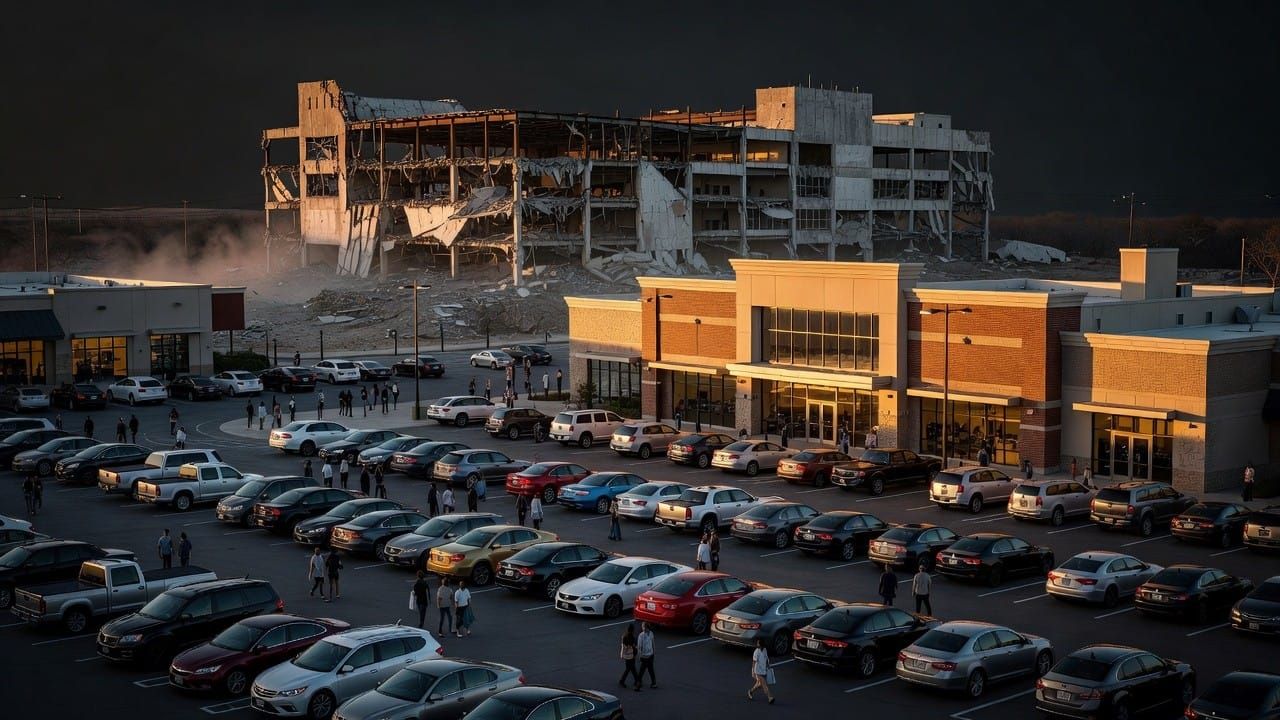
For fifteen years, the smart money had a one-word answer for American retail real estate: dead. Amazon killed it. The enclosed mall was a fossil. Brick-and-mortar was a melting ice cube, and any investor who owned a shopping center was holding a liability dressed up as an asset.
That story is now wrong — spectacularly, measurably wrong. American retail real estate just posted the tightest occupancy in a generation. The national availability rate has fallen to a record-low 4.8%, the lowest in two decades. Neighborhood, community, and strip centers — the unglamorous open-air retail that lines every American suburb — hit a record-low 6.7% availability. In Texas, statewide retail vacancy sits at 4.6%, the lowest since the early 2000s.
Here is the part nobody priced in: retail didn't die. The construction of new retail died. And that distinction is now one of the most overlooked income trades in real estate.
The collapse was in supply, not demand
Go back to the panic. Between roughly 2017 and 2020, "retail apocalypse" was the consensus. Toys "R" Us, Sears, Payless, hundreds of chains liquidated. The headlines were real. But developers and lenders drew the obvious conclusion — stop building retail — and they never restarted.
The result is a supply picture that looks nothing like the demand picture. New shopping-center construction is running near multi-cycle lows, the thinnest pipeline in 25 years. At the same time, weak centers are being actively demolished and removed from inventory. So even flat demand runs into a shrinking pool of usable space.
When supply shrinks faster than demand, you get pricing power. That is exactly what is showing up in the numbers. The grocery-anchored shopping-center landlords — the companies that own the strip center with your supermarket, your nail salon, your urgent care, and your taco place — just posted the strongest leasing economics in their public-market history:
- Kimco Realty pushed portfolio occupancy to an all-time high of 96.4%, with a record backlog of signed-but-not-yet-open leases.
- Brixmor hit 95.1% occupancy and booked a record year of new rent.
- Regency Centers closed its strongest operational year as a public company, with same-property net operating income up 5.3%.
These are not distressed assets. These are landlords with waiting lists.
Why the open-air strip center won
The counterintuitive truth is that the format everyone mocked — the boring suburban strip with a parking lot — turned out to be the most internet-proof real estate in the country.
You cannot download a haircut. You cannot stream a dentist appointment, a workout, a coffee with a friend, or a prescription pickup. The tenants that fill today's strip centers are services and necessities: grocery, medical, fitness, quick-serve food, banking, beauty. These are the categories e-commerce never managed to eat. And increasingly, the strip center is where online retail gets fulfilled — the buy-online-pick-up-in-store model turned the suburban storefront into a free, pre-paid distribution node.
Grocery anchors are the keystone. A full-service supermarket drags foot traffic past every other tenant in the center, several times a week, in every economy. That reliability is why grocery-anchored centers are trading at sub-7% cap rates — pricing usually reserved for assets investors consider safe.
Meanwhile, the dead malls are being bulldozed
The flip side of this story is what is happening to the format that actually died: the enclosed regional mall. And here the value isn't in the retail — it's in the dirt.
A dead mall is, in real-estate terms, a large, well-located, already-zoned, power-rich parcel sitting next to a highway. That description happens to match exactly what the two hungriest industries of the decade need.
- Data centers. A shuttered mall in the Dallas area was acquired by data-center operator QTS and converted — the existing power infrastructure and footprint made it cheaper than building from scratch. Maryland's Landover Mall is slated to become a data-center campus.
- Warehouses and logistics. The former Eastland Mall in Columbus is being eyed as a logistics hub feeding e-commerce — the same online shopping that helped kill it.
- Housing. Of 135 mall-redevelopment projects studied by JLL, more than half incorporated residential. At Pennsylvania's Neshaminy Mall, developers expect to demolish roughly 55% of the enclosed structure and build a mixed-use town center in its place.
This is the great sorting of American retail real estate. The in-between — the mediocre enclosed mall, the dying anchor box — is being torn down and repriced as land. The open-air, service-oriented, grocery-anchored center is being repriced as scarce income. The "death of retail" was never one story. It was two opposite stories wearing the same headline.
What it means for your money
Three takeaways for anyone trying to read the geography of American capital:
1. Scarcity is the trade. The bullish case for open-air retail isn't a demand boom — it's a supply drought that takes years to fix. You can't conjure a grocery-anchored center overnight; entitlement, anchor commitments, and construction run long. That gives existing owners durable pricing power "well into the back half of the decade," in the words of one market read. The publicly traded grocery-anchored REITs are the cleanest expression of it.
2. The bifurcation is the whole game. Don't think "retail real estate" as one asset. Think two: scarce, internet-proof open-air centers (income) versus obsolete enclosed malls (land plays / redevelopment optionality). They are moving in opposite directions, and lumping them together is how investors misread the entire sector for a decade.
3. Watch the consumer signal underneath it. A strip center full of urgent cares, discount grocers, nail salons, and quick-serve food is a portrait of how Americans actually spend now — on services and necessities close to home, not on discretionary stuff at the mall. The real estate is telling you something about the consumer that the "retail apocalypse" narrative missed entirely. The diner on the dying main street closed. The grocery-anchored center three miles away has a waiting list.
The lesson isn't that retail came back from the dead. It's that the market spent a decade pricing a story instead of pricing the asset. The asset was hiding in plain sight — in the parking lot you drove past a thousand times without looking up.
Get this level of intelligence every day. Subscribe to AlphaBriefing — free, member, and paid tiers available.
Sources & Further Reading
- CRE Daily — U.S. Retail Vacancy Rate Hits Lowest Level in 20 Years
- Retail Dive — Retail rents rise in Q2 as availability tightens: CBRE
- Cushman & Wakefield — U.S. Shopping Center MarketBeat
- Schuckman Realty — Shopping Centers Hit Record Pricing as Leasing Notches a Two-Decade High
- CBRE — U.S. Real Estate Market Outlook 2026: Retail
- Urban Land / ULI — Turning Malls into Neighborhoods
- BizBlog — How Dead Malls Are Being Reborn as Data Centers and Warehouses
Disclaimer
AlphaBriefing is an independent intelligence publication. The content in this article is produced for informational and educational purposes only. Nothing published by AlphaBriefing constitutes financial, investment, legal, tax, or regulatory advice, nor should it be construed as a solicitation or recommendation to buy, sell, or hold any security, asset, or financial instrument.
All views expressed are those of the author at the time of writing and are subject to change without notice. Markets are volatile and unpredictable; past performance is not indicative of future results. Any investment involves risk, including the possible loss of principal.
AlphaBriefing and its principals, employees, or contributors may hold positions in securities or assets mentioned in this article. This should be considered a potential conflict of interest. No material relationship with any company referenced exists unless explicitly disclosed. Readers should conduct their own due diligence and consult qualified financial, legal, and tax advisors before making any investment decisions.
Information in this article is drawn from public sources believed to be reliable at the time of publication. AlphaBriefing makes no warranty, express or implied, as to the accuracy, completeness, or timeliness of any information herein. AlphaBriefing accepts no liability for any loss or damage arising from reliance on this content.
© AlphaBriefing. All rights reserved. Unauthorised reproduction or distribution is prohibited.