The Royal Rescue Mission: King Charles Is in Washington to Save the Most Important Alliance in the World
King Charles III is addressing Congress today as US-UK relations face their deepest crisis in decades. The Iran war has fractured the special relationship — and billions in defense contracts, trade deals, and investment flows are quietly at stake.

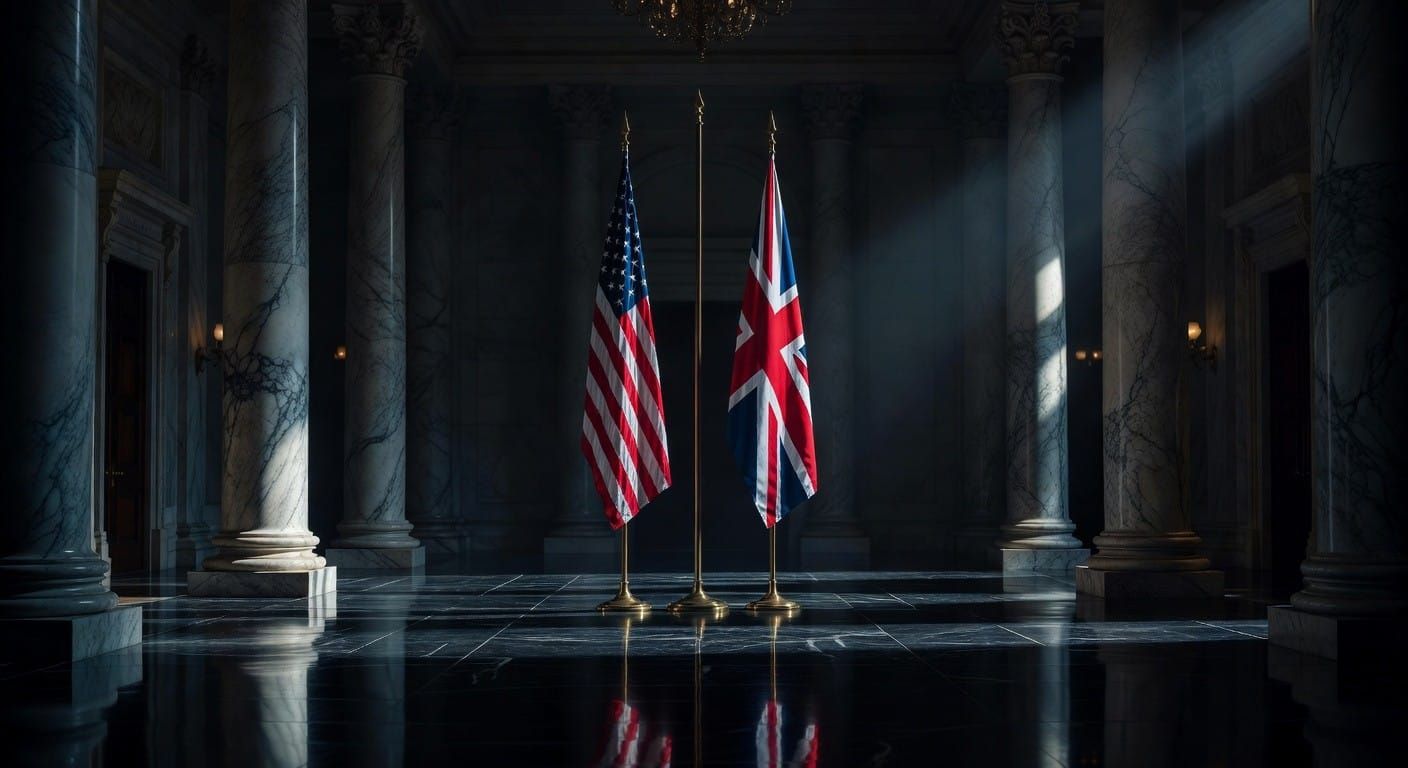
King Charles III touched down in Washington on April 27 for a four-day state visit — shaking hands with President Trump, dining at the White House, and addressing a joint session of Congress. On paper, it's a celebration of the 250th anniversary of American independence and a reaffirmation of the so-called "special relationship."
In reality, it's a diplomatic rescue mission. And the stakes extend far beyond royal pageantry.
The Fracture
The immediate cause of the strain is simple: the Iran war. Since the US and Israel launched strikes on February 28, Prime Minister Keir Starmer has refused to commit British forces. "The UK will not be dragged into this conflict," Starmer told Parliament in March — a position that has drawn sharp public criticism from Trump and exposed the deepest rift between Washington and London in at least two decades.
Trump's frustration goes beyond rhetoric. Senior US officials have privately questioned whether the UK can be counted on as a serious security partner, and some voices in Washington — particularly within the Republican caucus — have openly suggested that NATO allies who refuse to share the military burden should face consequences on trade.
For his part, Starmer faces immense domestic pressure. UK public opinion polls show roughly two-thirds of Britons oppose involvement in the Iran war. The Labour government, barely a year old, cannot afford to lose its base over a conflict most Britons see as an American choice, not a British obligation.
This is the impossible diplomatic gap Charles has been dispatched to bridge.
Why Charles, Not Starmer?
The decision to deploy the King rather than the Prime Minister is itself telling. Starmer and Trump have no personal rapport — their only bilateral meeting, in March, reportedly lasted just 20 minutes and produced no joint statement. A prime ministerial visit risked becoming a public confrontation over Iran.
Charles, by contrast, offers something rarer in diplomacy: a politically neutral figure who can engage personally without negotiating policy. Trump has spoken warmly of the King in public, calling him "a tremendous man" and praising the monarchy as "one of the great institutions in the world." The White House framed the visit as a mutual celebration, not a negotiation — giving both sides diplomatic cover.
But the subtext is obvious. British officials have been candid in background briefings: the visit is a "soft power stabilization effort." The goal is to prevent the Iran disagreement from metastasizing into a broader breakdown of the bilateral relationship — one that could affect everything from intelligence sharing to defense procurement to financial regulation.
The Money on the Table
This is where the story stops being about flags and ceremonies and starts being about capital flows.
The US-UK economic relationship is one of the largest bilateral investment corridors in the world. The UK is the single largest foreign direct investor in the United States, with over $800 billion in cumulative FDI. American companies, in turn, hold more than $1.1 trillion in assets in the UK. The City of London and Wall Street are deeply intertwined — more so than any other two financial centers on earth.
That interdependence is now under quiet stress:
Defense contracts. The UK is a major buyer of American defense systems and a partner in co-development programs worth tens of billions. The F-35 program alone — in which British firms supply roughly 15% of every jet built — is worth an estimated $40 billion in contracts through 2035. A deterioration in the political relationship could slow procurement, redirect orders, or complicate joint development of next-generation platforms. BAE Systems, Rolls-Royce, and Raytheon Technologies all have significant exposure.
Trade policy. The long-promised US-UK free trade agreement, shelved during the Biden years, was expected to resurface under Trump. That prospect is now clouded. Congressional allies of the administration have floated the idea of conditioning trade terms on security commitments — an implicit threat that the UK's refusal to join the Iran campaign could carry an economic price tag.
Financial regulation. Post-Brexit, London's ability to compete as a global financial center depends partly on regulatory equivalence agreements with the US. British regulators have been negotiating expanded access for UK-based clearinghouses and asset managers. Those talks, while technical, are politically sensitive — and vulnerable to the broader relationship temperature.
Intelligence sharing. The Five Eyes alliance — the US, UK, Canada, Australia, and New Zealand — is the most important intelligence-sharing partnership in the world. No one expects it to formally collapse, but the texture of cooperation can shift. If Washington begins to view London as an unreliable partner in its most important military operation, the flow of signals intelligence, early warnings, and operational coordination could narrow in ways that are invisible to the public but consequential for policymakers and defense planners.
The European Context
The UK's position is not unique. Germany's Chancellor Friedrich Merz has been equally critical of American Iran policy, warning of energy market shocks across Europe. France has quietly distanced itself. The NATO alliance that held together through the Ukraine crisis is visibly fracturing over Iran.
But the UK occupies a special position. It is the one European power that consistently positioned itself as Washington's closest ally — the one that joined Iraq, Afghanistan, and every major US-led military operation for three decades. Its refusal to join this one is, for many in Washington, a different kind of betrayal than European skepticism.
Charles's Congress address today is expected to focus on shared values and historical ties — democracy, rule of law, the wartime alliance that defined the 20th century. It will be eloquent and carefully calibrated. It will also be, in diplomatic terms, an attempt to remind Washington that the relationship is bigger than any single war.
Whether Washington agrees is the open question.
What to Watch
Three things will determine whether this visit succeeds or fails — and what the trajectory of US-UK relations looks like for the rest of 2026:
1. The state dinner communiqué. Joint statements at these events are negotiated word by word. Watch for language on "shared security commitments" or "mutual defense obligations." If it's absent, the rift is deeper than either side wants to admit.
2. Defense procurement signals. Any announcements on joint defense projects, new contracts, or expanded cooperation would signal that the economic dimension of the relationship is being protected even as the political dimension frays. Silence would be ominous.
3. Congressional reception. Charles is addressing Congress — a rare honor. The warmth or coolness of the reception, particularly from Republican members who have been most vocal about allied burden-sharing, will be a leading indicator. A standing ovation means the relationship has breathing room. Polite applause means trouble.
The Bottom Line
King Charles is not in Washington to save the special relationship. He's in Washington to buy it time.
The US-UK alliance has survived disagreements before — Suez in 1956, Iraq war skepticism in 2003, Brexit tensions under Obama. But it has never faced a combination of active military divergence, trade uncertainty, and a fundamental disagreement about the use of force in the Middle East — all at once, and all while the global order is fragmenting.
For investors, the signal is clear: the political infrastructure underlying the largest bilateral investment relationship in the world is under strain. That doesn't mean it breaks. But it means the risk premium on that assumption just went up.
Get this level of intelligence every day. Subscribe to AlphaBriefing — free, member, and paid tiers available.
Sources & Further Reading
- Reuters — King Charles Jets to US Trip Overshadowed by Iran Quarrel
- CNBC — US-UK Special Relationship Under Strain Over Iran War
- The Atlantic Council — Can King Charles's State Visit Help Mend the Special Relationship?
- New York Times — King Charles US Visit Amid Strained UK Relations
- BBC News — Trump and King Charles Meeting
- Time — UK Lawmakers Called for Canceling Charles's US Visit
- NPR — Trump's Embrace of King Charles Comes at a Fraught Time
Disclaimer
AlphaBriefing is an independent intelligence publication. The content in this article is produced for informational and educational purposes only. Nothing published by AlphaBriefing constitutes financial, investment, legal, tax, or regulatory advice, nor should it be construed as a solicitation or recommendation to buy, sell, or hold any security, asset, or financial instrument.
All views expressed are those of the author at the time of writing and are subject to change without notice. Markets are volatile and unpredictable; past performance is not indicative of future results. Any investment involves risk, including the possible loss of principal.
AlphaBriefing and its principals, employees, or contributors may hold positions in securities or assets mentioned in this article. This should be considered a potential conflict of interest. No material relationship with any company referenced exists unless explicitly disclosed. Readers should conduct their own due diligence and consult qualified financial, legal, and tax advisors before making any investment decisions.
Information in this article is drawn from public sources believed to be reliable at the time of publication. AlphaBriefing makes no warranty, express or implied, as to the accuracy, completeness, or timeliness of any information herein. AlphaBriefing accepts no liability for any loss or damage arising from reliance on this content.
© AlphaBriefing. All rights reserved. Unauthorized reproduction or distribution is prohibited.