The Pentagon Just Made Palantir the Operating System of the US Military
On March 9, Deputy Secretary of Defense Steve Feinberg issued a memo that changed the trajectory of American warfare. Three words: program of record. Here's what that means.

On March 9, 2026, Deputy Secretary of Defense Steve Feinberg sent a memo to the Pentagon's senior leadership. It was quiet. It was brief. And it changed the trajectory of American warfare.
Three words mattered most: program of record.
Palantir's Maven Smart System had just been elevated from a powerful contract to permanent military infrastructure. This isn't a pilot program waiting for a budget review. It isn't a proof-of-concept awaiting extension. It is now, formally and irrevocably, part of how the United States military fights.
What "Program of Record" Actually Means
The term is Pentagon jargon, but the implications are anything but bureaucratic.
A program of record is a system that has been formally adopted into the DoD's acquisition framework. It receives stable, multi-year funding. It is deployed across all military branches without requiring constant re-approval. It becomes, in the truest sense, infrastructure — as permanent and foundational as GPS, as embedded as encrypted radio communications.
When something becomes a program of record, it stops being a vendor relationship. It becomes doctrine.
That is what just happened to Maven.
What Maven Actually Does
Project Maven began in 2017 as a modest initiative: use AI to label drone imagery faster than human analysts. The problem it solved was real — the US military was drowning in footage it couldn't process. Maven automated the labeling. Humans reviewed the output.
That was then.
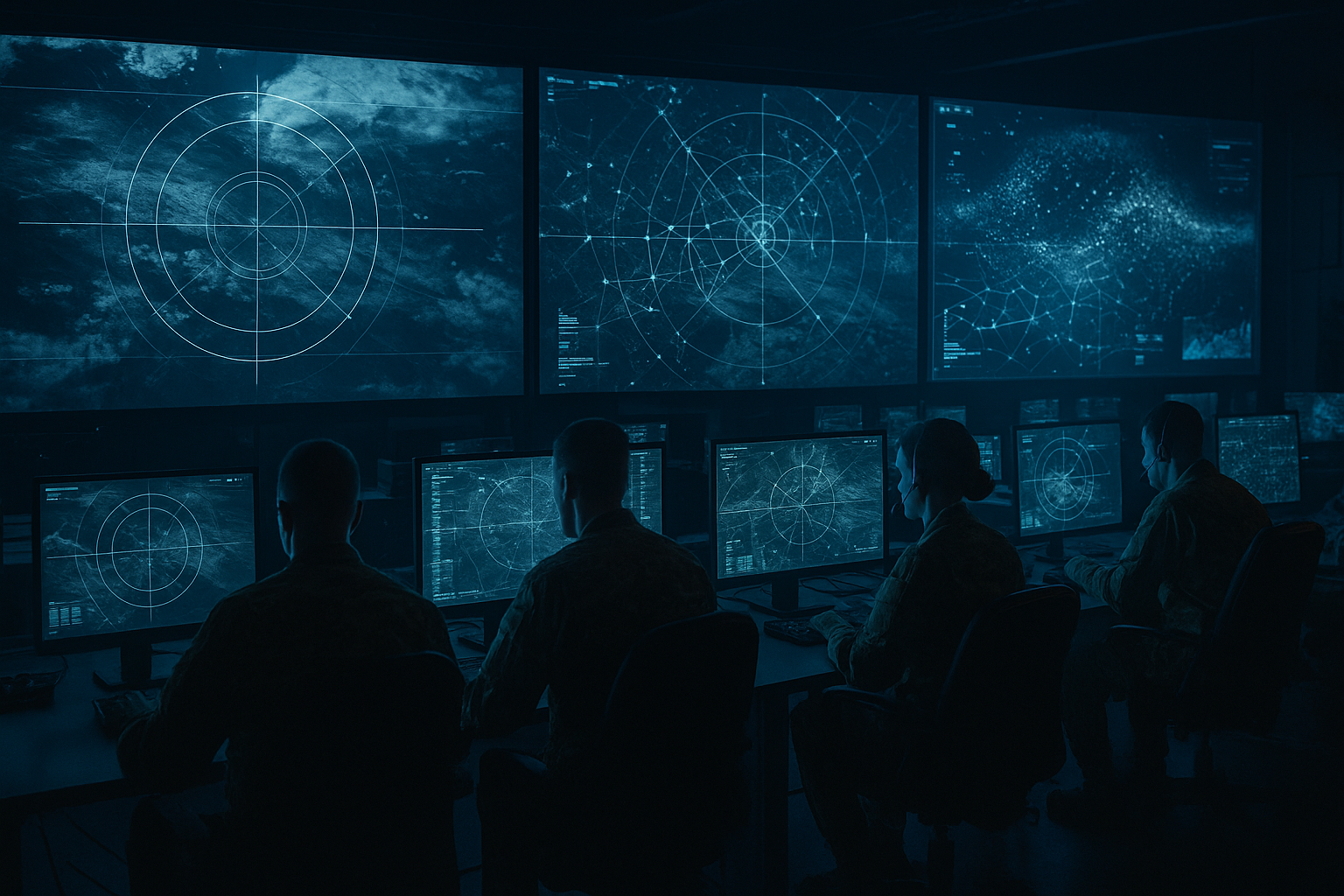
Today, Maven processes satellite imagery, drone feeds, radar returns, signals intelligence, and sensor data at a scale no human analyst team could match. It doesn't just label. It identifies. It prioritizes. It recommends.
The Feinberg memo states Maven will provide warfighters "with the latest tools necessary to detect, deter, and dominate our adversaries in all domains."
In the three weeks preceding the memo, Maven was used to support thousands of targeted strikes against Iran. The AI identifies the target. The human pulls the trigger. That distinction — human approval, AI selection — is the official line. It is also, in the fog of active combat, a distinction that compresses with every passing engagement.
Tens of thousands of users across the Department of Defense now operate on Maven. It has moved from experiment to operating system.
The Memo — Mechanics and Timeline
The March 9 memo sets a clear timeline:
- By April 8, 2026: Oversight transfers from the National Geospatial-Intelligence Agency (NGA) to the Pentagon's Chief Digital and Artificial Intelligence Office (CDAO)
- By September 30, 2026: Maven designated program of record (end of FY2026)
- Going forward: All future Maven contracting managed by the US Army
That last point matters. The Army's existing enterprise agreement with Palantir — signed in August 2025, with a ceiling value of $10 billion over ten years — now becomes the funding vehicle for Maven's expansion. The $10B ceiling is not guaranteed spend. But it is the channel through which Maven's growth will flow.
The memo's framing is explicit: AI-enabled decision-making must become "the cornerstone of our strategy." This is not aspirational language. This is operational instruction.
The Contract Stack
Understanding the money requires unpacking several overlapping agreements:
$480M (2024): Initial Maven contract, expanded to $1.3B in May 2025. This funded Maven's deployment to tens of thousands of military users.
$10B Army Enterprise Agreement (August 2025): A ceiling-value contract consolidating approximately 75 prior Army contracts under a single Palantir framework. Volume purchasing, flexible drawdown. This is now the primary vehicle for Maven funding under program of record status.
Market cap ~$360B (March 2026): PLTR's valuation reflects its SaaS-like revenue multiples, not traditional defence contractor pricing. Program of record status changes the fundamental nature of that revenue — it becomes recurring, embedded, and structurally protected from year-to-year budget uncertainty.
Palantir's backlog stands at approximately $11.2B as of Q1 2026. The Maven designation adds a different category of value: certainty.
The Competitive Landscape
No competitor has Maven's battlefield deployment record. That matters.
Anduril builds autonomous systems and hardware-software stacks for the kill chain — complementary to Maven, not a direct competitor. Alex Karp and Palmer Luckey are building different parts of the same future.
Shield AI develops autonomous fighter jet platforms — again, a different lane. Vikram Nair's company is solving a different problem.
Legacy primes — L3Harris, Northrop Grumman, Lockheed Martin — are being disrupted at the software and AI layer, but they retain hardware dominance. They will be Maven's integration partners, not its competitors.
The real competitive risk is not another US company. It is a Chinese equivalent. And that gap is narrowing, not widening.
The Anthropic Wrinkle
Maven integrates Anthropic's Claude AI for certain analytical functions. The Pentagon, in the same period as the program of record designation, flagged Anthropic as a potential supply chain risk. The reason: Anthropic's public commitments to AI safety orthodoxy create friction with military deployment requirements.
This is a real tension. Palantir's advantage — and one Karp has made explicit in shareholder letters — is that the company does not moralize about the use of its technology. Palantir builds tools for Western democracies to win conflicts. It does not hedge with safety frameworks that constrain operational utility.
Whether Maven will eventually replace Anthropic's components with more mission-aligned AI is an open question. What is not open is which posture the Pentagon prefers.
What America's Adversaries Should Know
China is the peer competitor. The People's Liberation Army has active battlefield AI programs. Its investments in autonomous systems, data fusion, and AI-enabled targeting are significant. But the PLA has not deployed these systems in live combat at scale. Maven has. That experiential gap — the difference between simulation and operational deployment — is real and growing.
Russia has been degraded by three years of attrition warfare in Ukraine. Its AI integration is far behind. The military that entered Ukraine in February 2022 was not a software-defined force.
Iran has already been on the receiving end of Maven-assisted targeting in the current conflict. The AI that helped identify targets for thousands of US-Israeli strikes over three weeks was Palantir's.
The gap between the United States and its adversaries in AI-enabled warfare is widening. The program of record designation ensures that gap widens further, faster.
The Investment Angle
PLTR trades like a SaaS company. Its price-to-sales multiple is not what you pay for a defence contractor — it's what you pay for a platform with a structural moat and durable recurring revenue.
Program of record status validates that premium. It transforms Maven's revenue from contract-dependent to infrastructure-grade. The comparison that matters: when Amazon Web Services became the backbone of the US intelligence community through the C2E contract, AWS didn't just win a deal. It became the operating layer. Contracts followed, year after year, because the infrastructure was already embedded.
Palantir is doing the same thing in the kill chain.
The risks are real: a future administration could deprioritize AI in defense, political pressure from European allies uncomfortable with autonomous targeting, and technical competition from Chinese equivalents. None of these risks are near-term. All of them are worth monitoring.
But the baseline is this: Maven is now infrastructure. And Palantir built it.
The Long View
The Feinberg memo is a document that will be studied. Not because of its length — it is brief. Not because of its novelty — the trajectory was visible. But because of what it represents: the formal, institutional, permanent decision by the United States military that AI is how it fights wars.
Maven is the platform. Palantir is the company that won. The program of record is the moment the outcome became permanent.
For investors, that changes the revenue equation. For geopolitical analysts, that changes the balance of force. For anyone trying to understand what 21st-century warfare looks like: it looks like this.
AlphaBriefing is an independent intelligence publication. Nothing in this article constitutes financial advice. © AlphaBriefing. All rights reserved.