The Orbital Economy: Why AI's Next Battleground Is 40,000 Feet Up
The $690 billion AI infrastructure buildout is going orbital. As hyperscalers race to plant servers in space and satellite constellations become data highways, a new investment thesis is taking shape — one that could reshape capital flows across defence, tech, and energy sectors for a decade.

The numbers are already staggering on the ground. In 2026, Microsoft, Alphabet, Amazon, Meta, and Oracle are collectively projected to spend between $660 billion and $690 billion on AI data infrastructure — nearly double the $380 billion deployed in 2025. Goldman Sachs forecasts global AI infrastructure investment will breach $500 billion this year alone, with Morgan Stanley projecting cumulative spend approaching $3 trillion by 2028.
But the more interesting story — and the one most investors are still sleeping on — is what happens when that buildout goes vertical.
The Orbital Turn
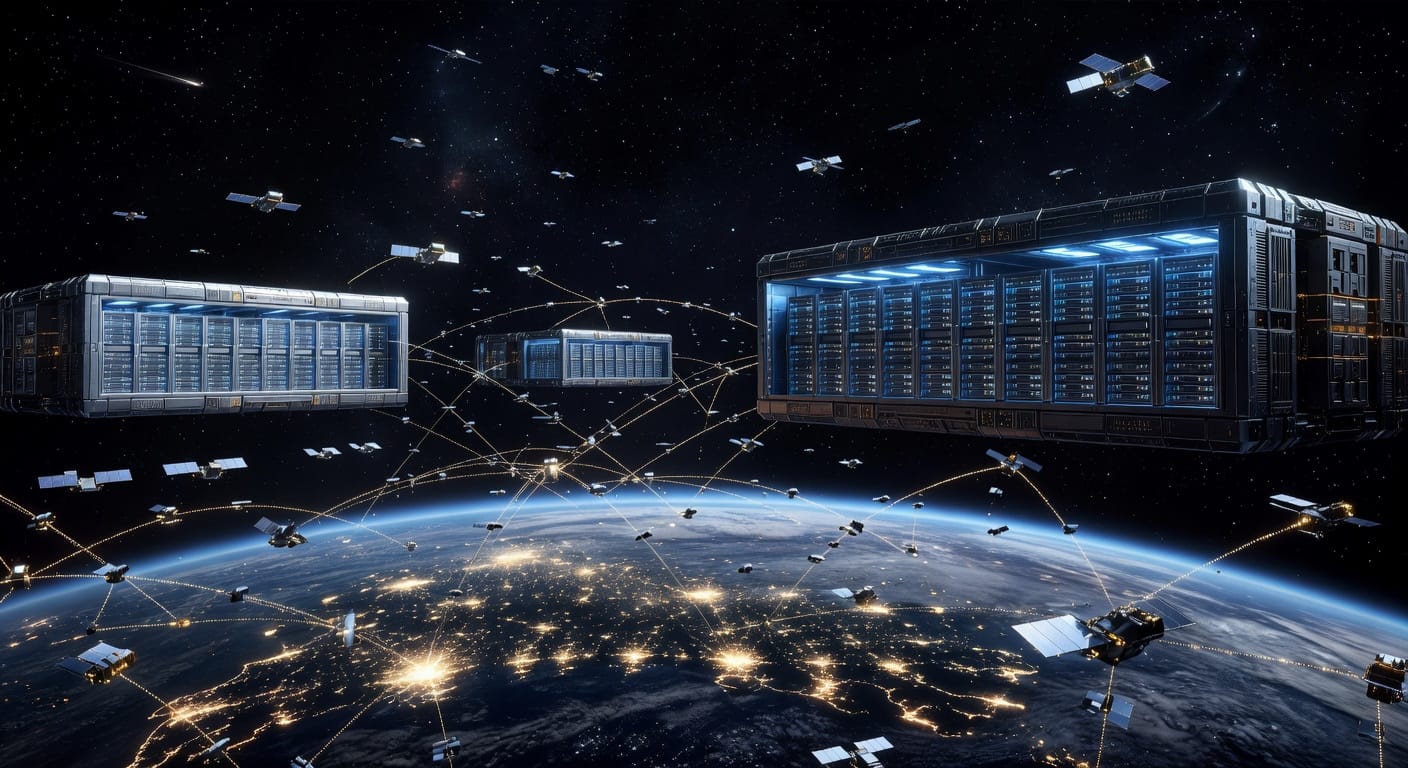
SpaceX's Starlink constellation, now comprising more than 7,000 satellites in low-Earth orbit, was never just about rural broadband. The V3 generation, currently in development, includes designs for orbital data centres — server infrastructure hosted in space, capable of performing compute tasks before data ever touches the ground. The implications for latency, sovereignty, and AI inference at the edge are significant.
Amazon is moving fast too. Project Kuiper — quietly rebranded to Amazon Leo in late 2025 — is targeting a constellation of more than 3,200 LEO satellites, tightly integrated with AWS. The pitch to enterprise customers is simple: seamless hybrid cloud-satellite networking, with AWS workloads reachable anywhere on Earth, and edge compute pushed to the satellite layer itself.
Google is taking a longer-bet approach. Project Suncatcher envisions solar-powered satellites equipped with TPU chips and optical data links — essentially AI inference nodes in geostationary orbit — with prototypes targeted for 2027.
This is not speculative. It is infrastructure capex, with balance sheets behind it.
Why Space Solves an AI Problem
The core bottleneck for AI at scale isn't compute anymore — it's data movement. Training large models requires massive datasets to flow between storage and GPU clusters with minimal latency. Inference, increasingly distributed to end-users and IoT devices, demands compute as close to the data source as possible.
Terrestrial data centres solve this in dense urban corridors. They cannot solve it in the ocean, in conflict zones, at 35,000 feet, or across the 60% of Earth's surface that lacks reliable fibre connectivity.
Space infrastructure does. That's the structural thesis.
The space cloud computing market was valued at $6.1 billion in 2025. Projections place it at nearly $25 billion by 2035 — a 15% compound annual growth rate in a sector that barely existed five years ago.