The Navy's Dream Fleet Just Got Its Real Price Tag
The CBO priced the Navy's 30-year shipbuilding plan at $1.47 trillion — $250 billion above the Navy's own math. The shipbuilders who would collect it are trading near 52-week lows. Someone is wrong.

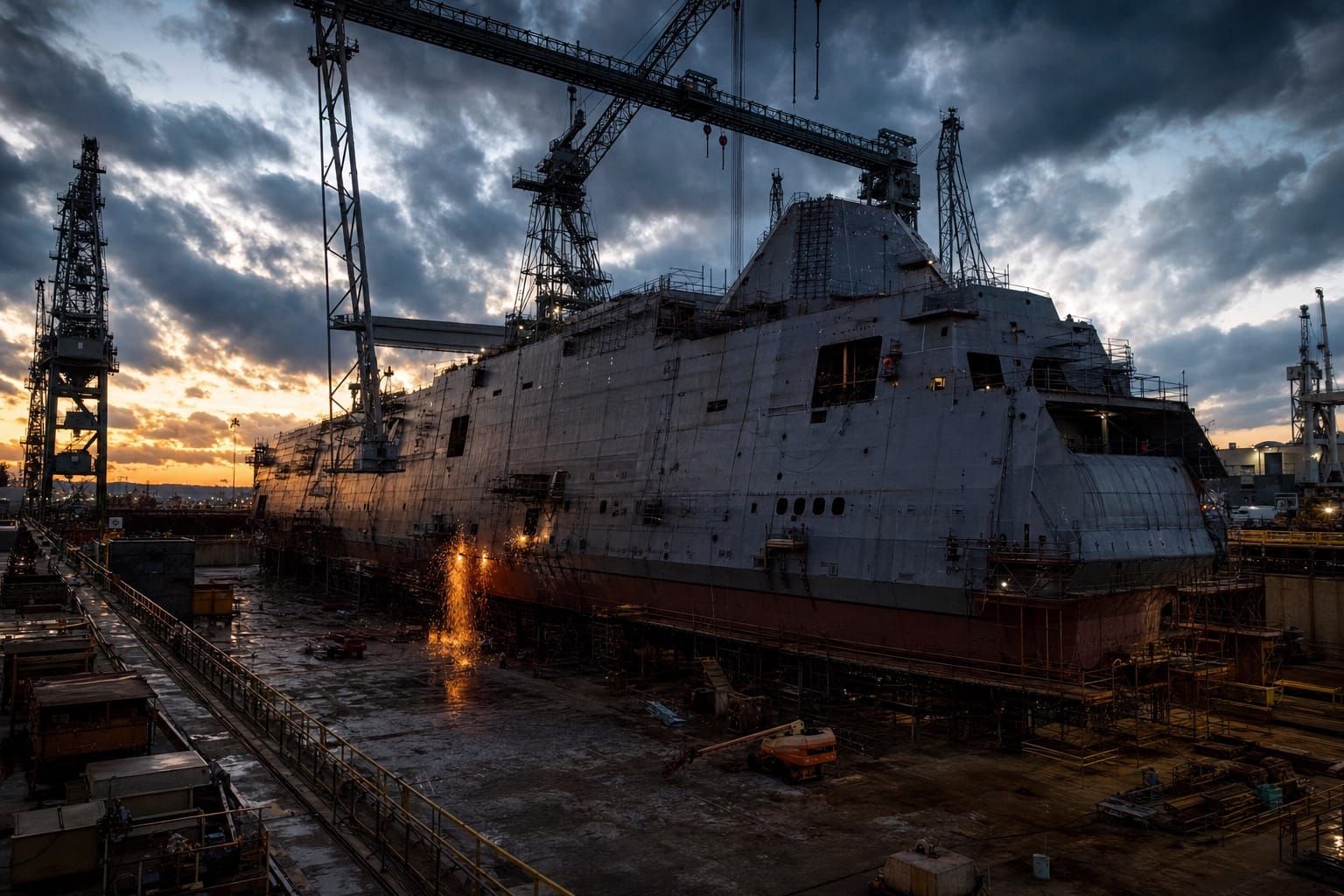
On Thursday, November 19, the Congressional Budget Office handed Congress its annual review of the Navy's 30-year shipbuilding plan. The verdict, stripped of the actuarial politeness: the fleet the Navy says it needs costs about $250 billion more than the Navy says it does — and even the most generous shipbuilding budgets since the Reagan era wouldn't cover it.
The plan itself, submitted to Congress on May 11, is the most ambitious since the Cold War. It would grow the battle force from 286 ships today to 398 by 2056 — per Navy Times, the largest American fleet since 2001. Getting there means buying 371 new combat, logistics, and support ships, 58 new and 29 used auxiliaries, 72 medium unmanned surface vessels, and the plan's most expensive new idea: 15 nuclear-powered Trump-class guided-missile battleships.
The CBO prices all of that at an average of $53.8 billion a year, in 2026 dollars, every year through 2056. That is 41 percent more in real terms than Congress has actually appropriated for shipbuilding on average over the past five years — a half-decade the CBO itself notes was the most generous since the 1980s.
The $250 Billion Disagreement
The headline gap is between what the Navy thinks new ships will cost and what the CBO does. For new-ship construction alone, the Navy projects about $41.1 billion a year; the CBO says $48.9 billion. Compounded over three decades, that is roughly $1.47 trillion against the Navy's $1.2 trillion — an 18 percent difference, about $250 billion.
Two estimates, and only one of them has a track record. The CBO builds its numbers from what ships have actually cost — real labor rates, real schedule slippage, real inflation in specialized materials. The Navy builds its numbers from what ships are supposed to cost. Every major Navy shipbuilding program is currently over budget to some degree. In its August analysis of the industrial base, the CBO found that Arleigh Burke-class destroyers — a design the country has been building since the late 1980s — now take an average of about 11 years from order to delivery, up from roughly five in the early 2000s.
Briefings like this are free to read with a free AlphaBriefing membership. Join free →
The Battleship Problem
The single biggest reason this year's plan costs 21 percent more per year than last year's is the Trump-class battleship program, unveiled in December 2025 and confirmed as nuclear-powered in May. The CBO's August estimate put the lead ship, USS Defiant, at about $23 billion — against an initial Navy figure of roughly $15 billion for a conventionally powered version — with follow-on hulls averaging just over $18 billion and the full 15-ship program at about $275 billion in 2026 dollars. That would make it the most expensive class of surface warships the United States has ever attempted, and reporting already suggests the program is likely to slip in the fiscal 2027 budget.
And construction is not even the whole bill. The CBO adds another $4.6 billion a year for work outside the battle-force plan — nuclear refuelings, outfitting, smaller craft. The Government Accountability Office separately estimates that modernizing the Navy's own public shipyards, which maintain the existing fleet, will cost about $200 billion over the coming decades. Fold in operations, aircraft, weapons, and the Marine Corps, and the CBO projects the Navy's total annual budget would have to climb from about $310 billion today to $415 billion in 2026 dollars by 2056.
The report's bluntest sentence is the one Congress will quote: even if shipbuilding funding stayed at the level of the past five years for the next thirty, the Navy still could not afford all the ships in its own plan.
Which raises the question this report doesn't answer but the market has to: if Washington is about to argue over the largest naval construction bill in American history, why are the companies that would collect it trading like the cycle is over?
The rest of this briefing is free — it just requires a free AlphaBriefing account: which three listed companies stand between the Navy and its 398-ship fleet, why their shares are sitting near 52-week lows despite a $1.47 trillion pipeline, and the three decision points over the next year that determine which version of this plan survives.
Create your free account → — 30 seconds, no card.