The Navy Bought 14 Submarines It Can't Build Fast Enough
The Navy just signed its biggest-ever submarine contract — $76.6 billion for 14 boats. It's also an admission the yards can't build fast enough to meet what America has already promised. The real number isn't $76.6 billion. It's 1.1.

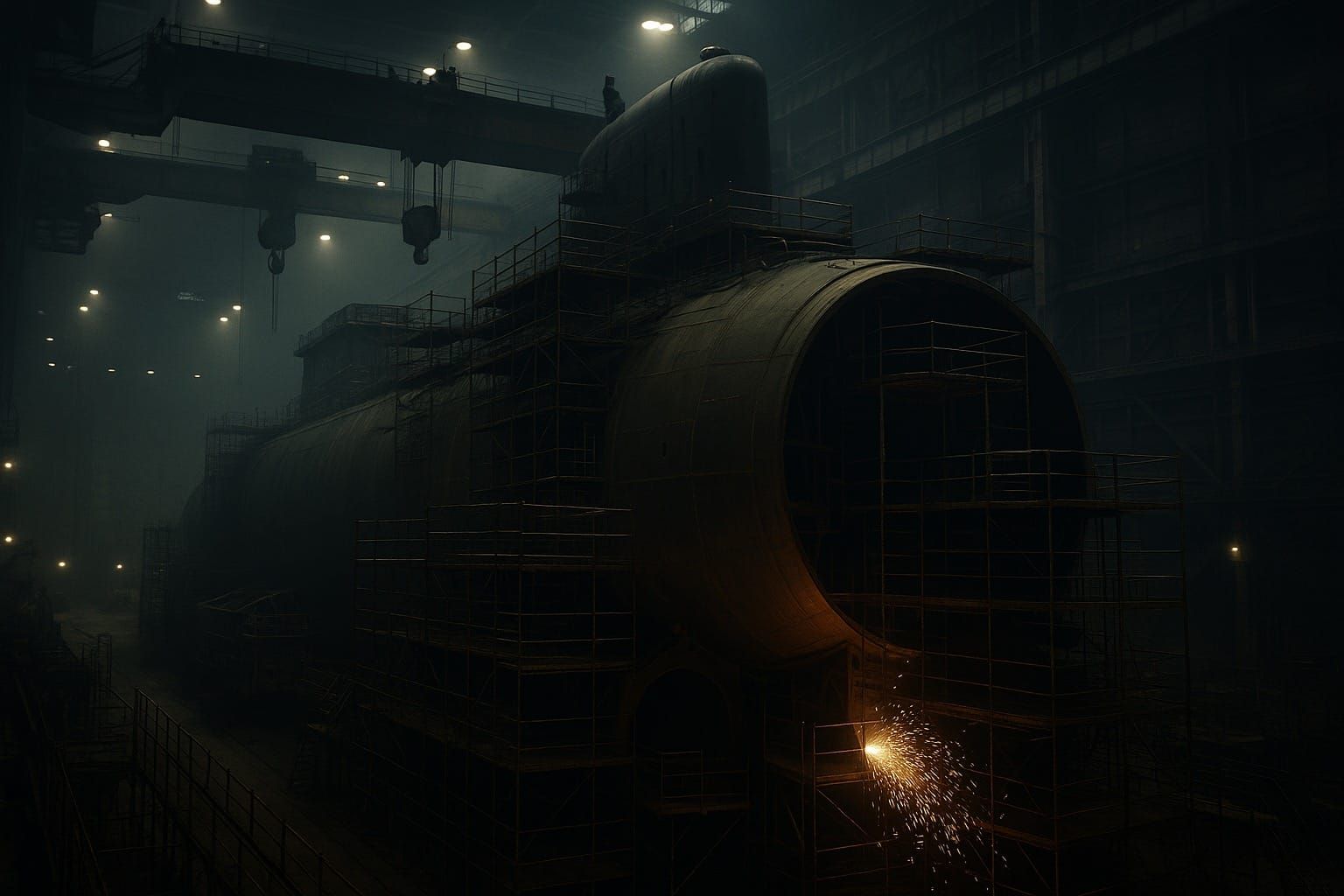
The U.S. Navy signed the biggest submarine contract in its history in July 2026 — $76.6 billion to General Dynamics Electric Boat and HII's Newport News Shipbuilding for fourteen nuclear-powered boats. Nine are Block VI Virginia-class attack submarines. Five are Build II Columbia-class ballistic missile submarines that will carry the sea-based leg of America's nuclear deterrent into the 2080s.
It is a staggering demand signal. It is also, in a way nobody at the podium wanted to dwell on, an admission of the problem.
Because the two yards that just booked $76.6 billion in work cannot build submarines fast enough to meet the commitments the United States has already made. Not close. And no amount of money fixes that on the timeline the Navy needs.
The Number That Matters Isn't $76.6 Billion. It's 1.1.
The Virginia-class program is supposed to deliver two attack submarines a year. It has never hit that rate. Since 2022 it has been stuck at roughly 1.1 to 1.2 boats per year — barely half the target. Individual boats are running an average of four years late against the delivery dates written into contracts signed up to a decade ago.
In May 2026, Chief of Naval Operations Admiral Daryl Caudle told Congress the two-a-year rate would not arrive until around 2032. That is not a typo. The milestone that former Navy Secretary Carlos Del Toro targeted for 2028 has slipped four years to the right — and 2032 is an estimate, not a guarantee, contingent on industrial-base investment and workforce expansion that is still ramping.
Briefings like this are free to read with a free AlphaBriefing membership. Join free →
The gap between 1.1 and 2.0 sounds small. It isn't. Every fraction of a boat per year compounds across a fleet plan that assumes the yards are producing at rate. The Navy's attack-submarine force is projected to dip below its requirement through the 2030s precisely because deliveries keep sliding while retirements keep coming.
The AUKUS Math Makes It Worse
Here is where the arithmetic turns brutal. Under AUKUS Pillar I, the United States has committed to selling Australia three to five in-service Virginia-class boats, with the first transfers penciled in for 2032, 2035, and a newly built boat in 2038.
To do that and grow its own fleet, the U.S. industrial base needs to build not two but 2.33 Virginia-class attack boats per year — on top of one Columbia-class boomer annually. The Navy is currently producing slightly more than one. It has committed to selling away boats it is not yet building at the rate required to replace them.
That is the box Washington is in: it has written checks — to its own fleet plan, to a treaty ally, to a nuclear-deterrent recapitalization — that all draw on the same two shipyards, the same welders, the same choked supplier base. The $76.6 billion contract funds the demand. It does not manufacture the capacity.
The rest of this briefing is for paid members: the two publicly traded names with the most direct leverage to the submarine buildout and how their backlogs actually convert to revenue, the supplier-tier bottleneck that determines whether 2032 holds, the specific figure to watch each quarter that tells you if the ramp is real, and the bottom-line positioning framework.
AlphaBriefing Paid gets you every investment thesis, scenario framework, and catalyst brief we publish — the analysis private intel clients pay four figures for, at a fraction of that.