The Kill Chain Revolution: How AI Autonomy Is Minting the Next Defense Giants
Autonomous weapons, AI targeting, and kill chains that operate faster than human decision-making. The Pentagon's Maven designation was just the beginning. Here's what the next wave of AI autonomy means for investors in defense tech.

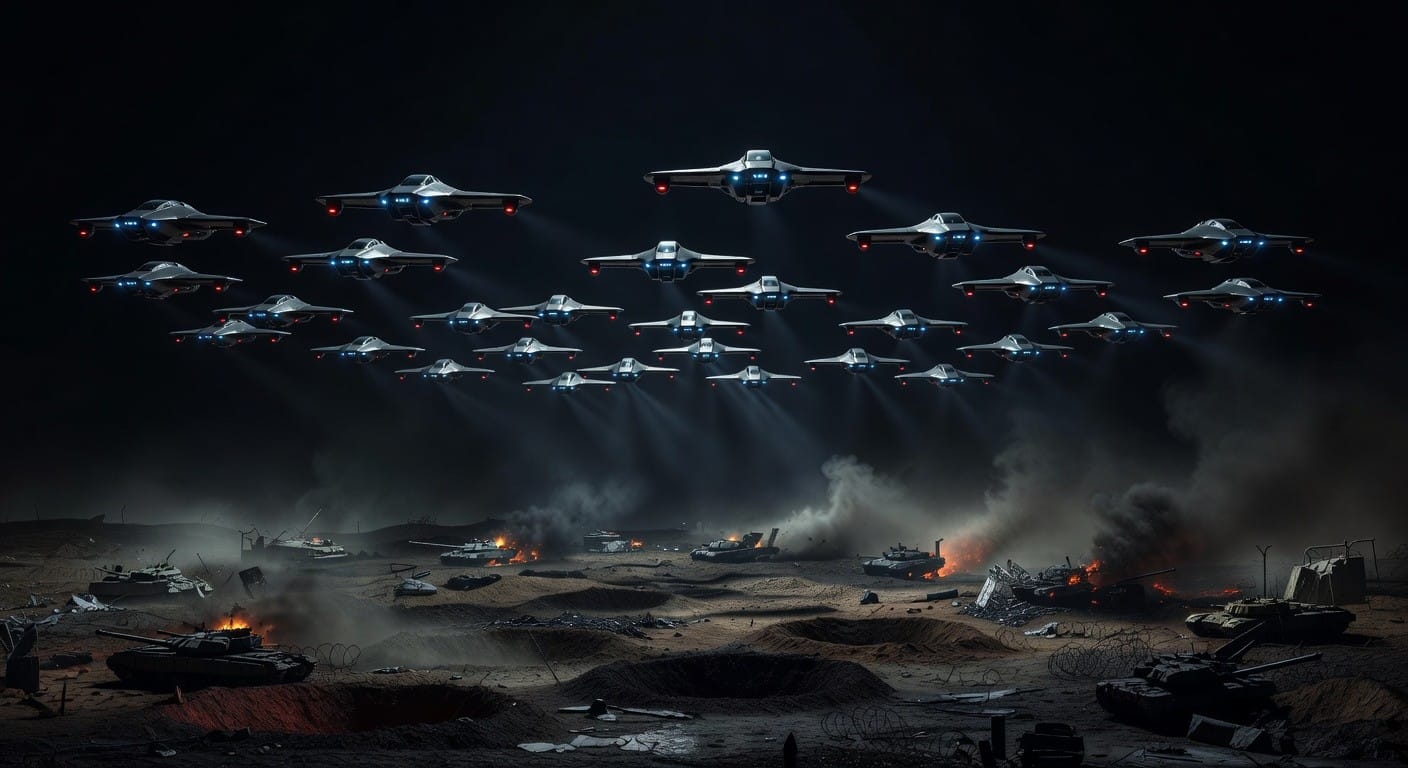
The wars of the future won't be fought primarily by soldiers. They'll be decided in milliseconds, by AI systems processing sensor data and executing kill chains faster than any human can react. And the companies building that infrastructure are, right now, raising some of the largest private funding rounds in defense history.
In March 2026 alone, two relative newcomers pulled in a combined $6 billion in private capital: Anduril Industries at a targeted $60 billion valuation, and Shield AI at $12.7 billion. For context, Anduril was founded in 2017. Shield AI in 2015. Neither is publicly traded. Both are now worth more than many legacy defense contractors that have existed for decades.
This is not hype. It is the market pricing in a structural shift — from platform-centric warfare built around expensive, exquisite systems to software-defined autonomy built around mass, speed, and AI decision-making. The Pentagon has finally accepted that the future of conflict looks more like a software release cycle than a battleship procurement.
The Two Companies Defining Autonomous Warfare
Anduril Industries is the most closely watched weapons company in America right now. Founded by Palmer Luckey — the entrepreneur who sold Oculus to Facebook and was subsequently pushed out — Anduril has built a vertically integrated defense platform that combines AI software (the Lattice command-and-control system), autonomous drones (including the YFQ-44A Fury collaborative combat aircraft), and counter-drone systems.
In March 2026, the U.S. Army awarded Anduril a $20 billion contract for drone threat countermeasures. The same month, Anduril secured a new $4 billion funding round led by Thrive Capital and Andreessen Horowitz, targeting a $60 billion post-money valuation — double its $30.5 billion Series G from just nine months earlier. The company is projecting over $4 billion in 2026 revenue, while simultaneously constructing Arsenal-1: a five-million-square-foot manufacturing facility in Ohio designed to mass-produce autonomous weapons systems by mid-year.
Palmer Luckey has been explicit: Anduril will never go public while he runs it. He wants the company to remain agile, classified-capable, and outside the scrutiny of quarterly earnings. That makes it inaccessible to most investors — but it also means the private market is the only game in town for direct exposure.
Shield AI operates differently, but with equal ambition. The company's core product is Hivemind — an AI autonomy stack that enables drones to fly, navigate, and execute missions in GPS-denied and high-threat environments where traditional communications are jammed or severed. In late March, Shield raised $2 billion at a $12.7 billion valuation, more than doubling from $5.3 billion just a year prior. Investors included Advent International, JPMorgan's Security and Resiliency Initiative, and Andreessen Horowitz.
The catalytic event: the U.S. Air Force selected Shield's Hivemind as the mission autonomy provider for the Collaborative Combat Aircraft program — pilotless wingman jets designed to fly alongside manned fighters. In a milestone demonstration, the YFQ-44A Fury flew with both Anduril's Lattice and Shield's Hivemind running simultaneously, demonstrating interoperable AI autonomy across platforms. These aren't concept demonstrators. They are under contract, in production, being funded by the U.S. Department of Defense.
Why the Pentagon Has Finally Opened the Checkbook
The shift didn't happen in a boardroom. It happened on the battlefield.
Ukraine demonstrated — in real-time, in front of every major military in the world — that cheap, autonomous, attritable drones can neutralize expensive armored formations. A $500 FPV drone destroying a $3 million tank isn't a fringe event anymore; it's the defining image of 21st-century land warfare. The U.S. military watched, drew conclusions, and moved.
The Pentagon's Replicator Initiative — launched in 2023 and significantly expanded since — is explicitly designed to field thousands of autonomous systems across multiple domains within 18 to 24 months. The directive is clear: America cannot fight the next peer conflict with the acquisition timelines and unit economics of the Cold War era. The F-35 cost $400 billion to develop. An attritable autonomous combat drone costs a fraction of that, can be produced at scale, and is expendable by design.
Defense budgets are following. The FY2026 Pentagon request allocated more than $1.8 billion specifically for autonomous systems and AI-enabled warfare — a figure that has more than tripled in three years. Allied nations, particularly those in Europe now racing to rebuild military capacity, are adding their own procurement pipelines on top of U.S. demand.
This is where the analysis gets actionable. AlphaBriefing members get the full investment framework — scenarios, positioning, and the bottom line.
Subscribe to AlphaBriefing — Free, Member, and Paid tiers available.