The IRGC Junta: What Comes After the Iran War — And What It Means for Your Portfolio

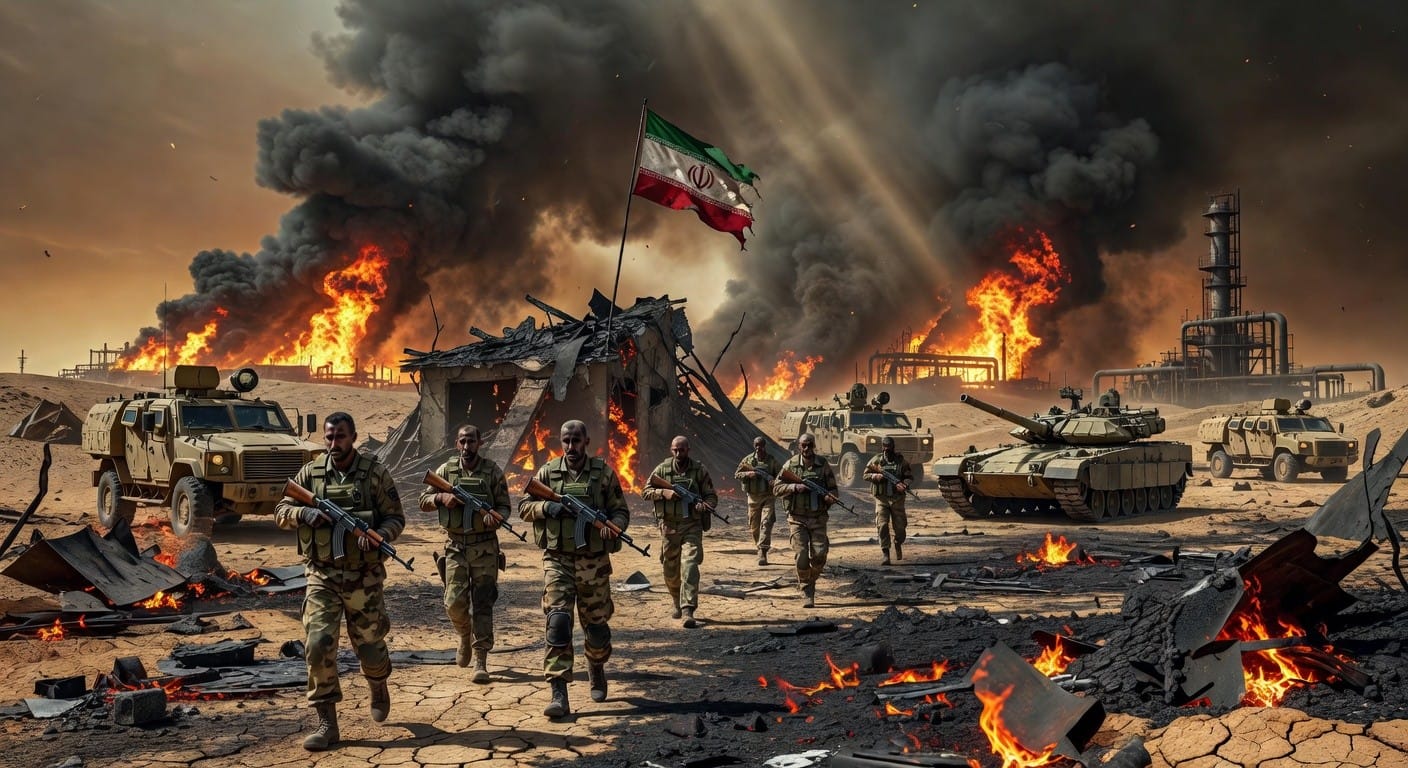
After 34 days of relentless airstrikes, the Iran that existed on February 27, 2026 is gone. The question now isn't whether America and Israel achieved their military objectives — it's what comes next. And that question may be the most consequential one in geopolitics for the next decade.
What Just Happened
On February 28, 2026, the United States and Israel launched Operation Epic Fury — a coordinated air campaign that within its first 72 hours struck over 1,700 targets across Iran. Supreme Leader Ali Khamenei was killed in the opening strikes. Over a dozen senior IRGC commanders died alongside him. Iran's navy was largely neutralized. Key enrichment facilities at Natanz and Fordow were struck. The Khondab heavy water plant is now non-operational.
By April 2 — Day 34 — the strikes have hit more than 12,300 targets. Trump told reporters the objectives are "nearing completion" and that he expects to wind down the campaign within two to three weeks, leaving behind a smaller footprint for "spot hits" if needed.
But wind-down is not the same as resolution. And investors who think the endgame is near are making a dangerous assumption.
The Power Vacuum Nobody Is Talking About
When you decapitate a regime mid-war, you don't get stability. You get a scramble.
On March 9, the Assembly of Experts elected Mojtaba Khamenei — Ali Khamenei's son, a mid-level cleric and former IRGC officer — as Supreme Leader in a rushed wartime vote. The IRGC pushed hard for the selection, seeing in Mojtaba a pliant figurehead they could control. But Mojtaba has not made a public appearance since. His location is unknown. Reports suggest he may have been wounded.
In practice, Iran is now governed by a military council of IRGC senior officers. The clerical state that existed since 1979 has been replaced — not by reformers or democrats — but by a junta.
This matters enormously for what comes next.
The IRGC as a governing body is more transactional and less ideologically constrained than the theocracy it replaced. It controls Iran's vast shadow economy: the smuggling networks, the petrochemical front companies, the construction monopolies. It will want to survive. And survival means finding leverage — not necessarily by shooting more missiles, but by managing what Iran still controls: oil infrastructure access, Strait of Hormuz navigation rights, and proxy networks in Lebanon, Iraq, and Yemen.
The Oil Market Is Pricing in the Wrong Scenario
Brent crude surged sharply after Trump's speech, with fears of $180/barrel circulating if Strait disruptions persist into late April. Goldman Sachs and JPMorgan have both warned of 1970s-style supply shocks if the Hormuz chokepoint is interfered with.
But here's the paradox the market is missing: an IRGC-led Iran may actually be more interested in reopening oil flows than the theocracy was.
Under Khamenei, oil was an ideological weapon — production levels were managed partly around geopolitical messaging. The IRGC's calculus is different. Revenue is oxygen. A junta that can't pay its troops doesn't last. Iran's economy has been devastated by a month of war and years of sanctions. The fastest path to IRGC survival runs through re-monetizing Iran's 160+ billion barrel reserve base.
This opens a scenario most analysts aren't yet modeling: a relatively rapid, transactional post-war settlement in which the IRGC trades Hormuz guarantees and nuclear file concessions for sanctions relief. Not out of goodwill — out of desperation.
What the Endgame Actually Looks Like
Three scenarios are now on the table, and they carry radically different implications for markets and portfolios:
Scenario 1: Managed IRGC Transition (40% probability)
The IRGC consolidates power, Mojtaba provides nominal legitimacy, and back-channel talks emerge within 6–12 months. Iran accepts degraded nuclear status in exchange for partial sanctions relief. Oil flows resume gradually. Brent settles in the $75–90 range. Defense stocks pull back from peak wartime premiums. Gulf reconstruction and Iranian oil infrastructure investment become the next big opportunity.
Scenario 2: Prolonged Fragmentation (40% probability)
The IRGC fractures along factional lines. Regional commanders act independently. Iran's proxy network becomes a loose confederation of armed groups with overlapping but competing interests — a Hezbollah that negotiates separately from Baghdad militias, Houthis that continue Red Sea operations without central coordination. Oil markets remain volatile for 12–24 months. The $100+ oil environment persists, creating sustained upside for energy equities and inflationary pressure on everything else.
Scenario 3: Regime Collapse and External Intervention (20% probability)
A popular uprising exploits IRGC weakness. External powers — Turkey, Saudi Arabia, Russia — begin positioning in Iranian border regions. The country fragments along ethnic and tribal lines. This is the worst-case for markets: it's Iraq 2003 in a country three times the size, with a GDP and energy infrastructure that matters globally. Prolonged chaos, no production normalization, and a new multi-decade engagement for US forces.
The Geopolitical Architecture Is Being Rewritten
Beyond the immediate conflict, Operation Epic Fury has restructured the Middle East's strategic map in ways that will take years to fully understand.
Saudi Arabia and the Gulf states are the clearest near-term winners. Iranian deterrence — the missile threat that kept Riyadh cautious — has been significantly degraded. MBS now operates in a neighborhood where his only serious regional rival is wounded and leaderless. Saudi Aramco's production capacity looks even more strategically critical.
Israel has achieved what its security establishment spent 30 years arguing for: the degradation of Iran's nuclear and missile programs. But Netanyahu's government and the IRGC-led junta in Tehran may actually have compatible interests in a frozen, managed conflict — neither wants full Iranian collapse. A destabilized, fragmented Iran with loose nukes is not in Israel's interest.
Russia is watching closely. Iranian proxy networks were a key component of Russia's own strategic toolkit — shared weapons pipelines, sanctions evasion infrastructure, energy pricing leverage. A weakened Iran is a weakened Russia, even if Moscow hasn't fired a single shot.
China faces its most complex dilemma. It was Iran's largest oil customer and had signed a 25-year strategic partnership. That partnership is now in limbo. Beijing must now decide whether to engage the new IRGC-led government — potentially rebuilding its Iran relationship on purely transactional terms — or to use the crisis as leverage to accelerate energy diversification away from the Gulf entirely.
The Bottom Line
The Iran war is not over. But its second phase — the political and economic one — is about to begin.
The IRGC junta is a new actor. It has different incentives than the theocracy it replaced. The nuclear file is not resolved — it is suspended, with an unknown quantity of enriched uranium somewhere below the Iranian desert. Oil markets are pricing a supply shock that may not fully materialize, while underpricing the 12-month political risk of Iranian fragmentation.
For investors, the most important number right now isn't the oil price. It's who controls the Strait of Hormuz in 90 days. Everything else flows from that.
Get this level of intelligence every day. Subscribe to AlphaBriefing — free, member, and paid tiers available.
Sources & Further Reading
- Al Jazeera — Iran War: What Is Happening on Day 34 of US-Israel Attacks
- CSIS — Operation Epic Fury and the Remnants of Iran's Nuclear Program
- RAND Corporation — Who or What Will Replace Iran's Supreme Leader
- IranIntl — IRGC Military Council Dominates Post-Khamenei Iran
- Reuters — US to Leave Iran 'Pretty Quickly,' Return If Needed, Trump Says
- Arms Control Association — US War on Iran: New and Lingering Nuclear Risks
- CNBC — Oil Demand Destruction: Trump, Energy Prices, and Gasoline Rationing
- Understanding War — Iran Update Special Report April 1, 2026
Disclaimer
AlphaBriefing is an independent intelligence publication. The content in this article is produced for informational and educational purposes only. Nothing published by AlphaBriefing constitutes financial, investment, legal, tax, or regulatory advice, nor should it be construed as a solicitation or recommendation to buy, sell, or hold any security, asset, or financial instrument.
All views expressed are those of the author at the time of writing and are subject to change without notice. Markets are volatile and unpredictable; past performance is not indicative of future results. Any investment involves risk, including the possible loss of principal.
AlphaBriefing and its principals, employees, or contributors may hold positions in securities or assets mentioned in this article. This should be considered a potential conflict of interest. No material relationship with any company referenced exists unless explicitly disclosed. Readers should conduct their own due diligence and consult qualified financial, legal, and tax advisors before making any investment decisions.
Information in this article is drawn from public sources believed to be reliable at the time of publication. AlphaBriefing makes no warranty, express or implied, as to the accuracy, completeness, or timeliness of any information herein. AlphaBriefing accepts no liability for any loss or damage arising from reliance on this content.
© AlphaBriefing. All rights reserved. Unauthorised reproduction or distribution is prohibited.