The Gateway Is Dead. NASA Is Building a Base on the Moon.
On March 24, NASA canceled its lunar orbital station and committed $20 billion to build a permanent base on the Moon's surface. This is not a pivot in direction. It is a reclassification of the mission itself — and it changes the geopolitics of space.

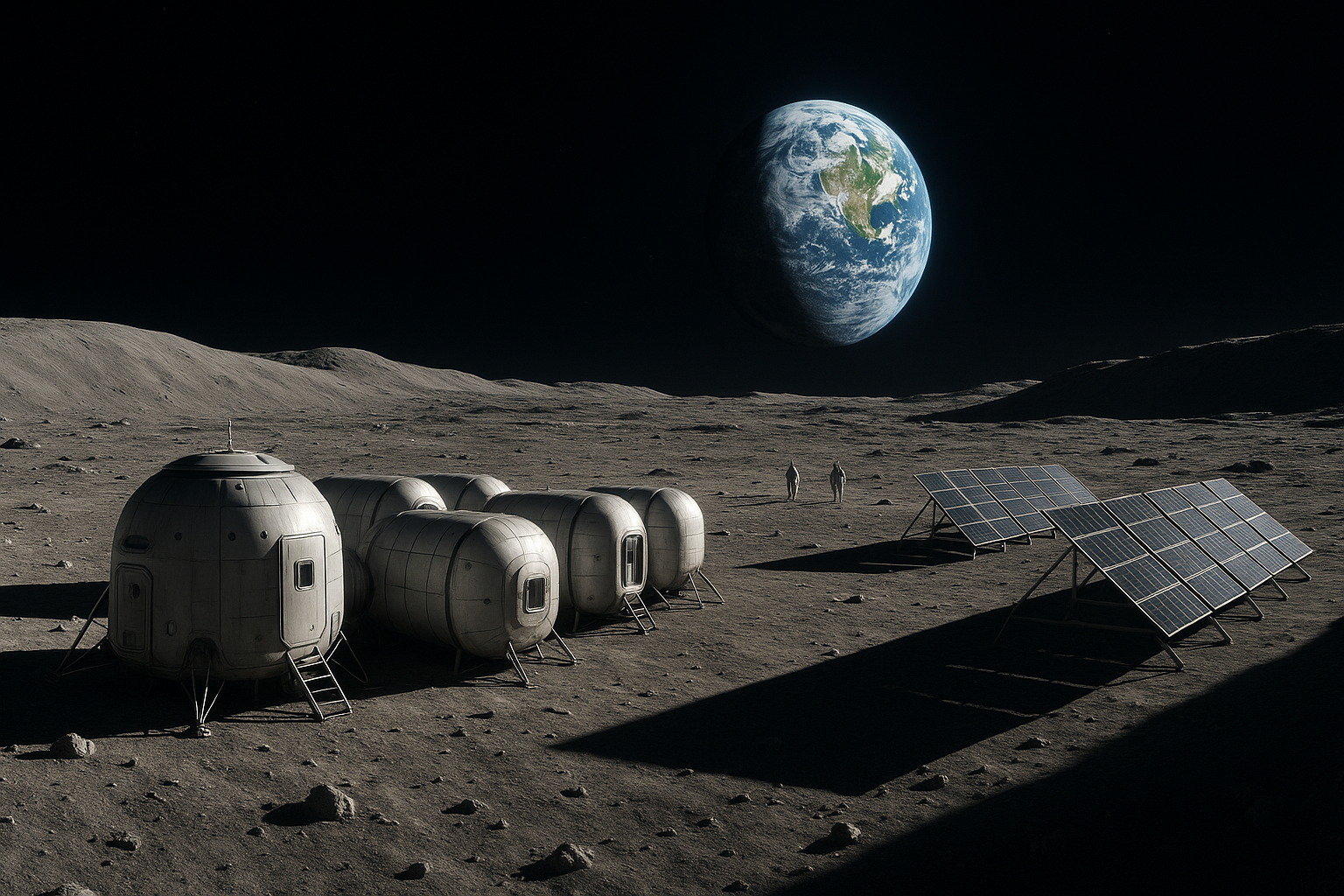
NASA just changed the architecture of American space exploration.
On March 24, 2026, Administrator Jared Isaacman announced that the Lunar Gateway — a planned space station in lunar orbit, years in development, already partially contracted and built — is effectively canceled. The hardware won't be scrapped. But the mission has changed entirely.
Instead of an orbiting outpost, the United States will build a permanent base on the surface of the Moon. $20 billion. Seven years. Dozens of missions. The most ambitious infrastructure project in American history since the Interstate Highway System.
This is not a pivot in direction. It is a reclassification of the mission itself.
What Was the Gateway — and Why Did It Die?
The Lunar Gateway was the centerpiece of the Artemis program's second phase: a small space station orbiting the Moon that would serve as a waypoint for surface missions. Astronauts would rendezvous there, transfer to lunar landers, descend to the surface, and return to the station before the long journey home.
The concept had logic. It reduced the complexity of individual missions. It gave NASA a permanent orbital presence. And it provided a staging ground for eventual Mars missions.
But it had problems — fundamental ones.
Cost. The Gateway's HALO module alone cost over $1.2 billion. The full station was projected to run well beyond initial estimates, at a time when NASA's budget was under severe political pressure from the Trump administration's DOGE-era spending reviews.
Utility. Critics — including many within NASA — argued that the Gateway added risk and complexity without proportionate value. Every mission would require an extra rendezvous and docking procedure. Every crew would spend additional time in deep space radiation. And crucially, the Gateway itself couldn't do anything that a surface base could do — it just floated above the Moon, at distance.
China. This is the factor that changed the calculus. The China National Space Administration (CNSA) has publicly stated its intent to establish a permanent lunar research station by 2035-2040, with significant infrastructure in place by 2030. Russia is a junior partner in that program. Both nations have expressed interest in the Moon's south polar region — the same territory NASA's Artemis missions are targeting. The south pole matters because of confirmed water ice deposits, which can be split into hydrogen and oxygen: rocket propellant. Whoever controls the south pole's water controls future deep space operations.
Orbiting the Moon was never going to stake a territorial or operational claim. Planting boots and equipment on the surface — permanently — might.
What the Moon Base Actually Means
The $20 billion lunar surface base will be constructed in phases over seven years. Existing Gateway components — including the HALO module already built by Northrop Grumman — will be repurposed for surface use where applicable.
Artemis III (targeted for 2027) will proceed as planned: first crewed lunar landing since Apollo 17 in 1972. Subsequent Artemis missions will begin laying the groundwork for permanent infrastructure. Think power generation, pressurized habitats, communication arrays, and resource extraction capability.
Administrator Isaacman was explicit: the goal is "infrastructure that enables sustained surface operations." Not visits. Not symbolic footprints. Sustained presence.
The strategic implications extend far beyond science:
Resource extraction. Lunar regolith contains ilmenite, a mineral rich in titanium and iron. The south polar ice, if extractable at scale, becomes the first off-Earth propellant depot — a refueling stop for missions to Mars and beyond. Whoever builds that infrastructure first controls the economics of deep space transit.
Helium-3. The Moon's surface has been collecting helium-3 from the solar wind for billions of years. Helium-3 is the theoretical fuel for fusion reactors — nearly absent on Earth, potentially abundant on the Moon. Whether fusion energy becomes practical in the relevant timeframe is uncertain. But the option value of a helium-3 reserve is real.
Strategic presence. The Outer Space Treaty of 1967 prohibits national sovereignty claims over celestial bodies. But it does not prohibit use. Infrastructure, operational presence, and resource extraction rights will be determined by who shows up and stays. The Moon base is, in part, a flag planted in concrete.
The Geopolitical Dimension
China's Chang'e program has been methodical and successful. Chang'e 4 landed on the far side of the Moon — a first. Chang'e 5 returned lunar samples. Chang'e 6 brought back samples from the south polar region specifically. The CNSA is not conducting science for science's sake. It is conducting site reconnaissance.
The Russia-China International Lunar Research Station (ILRS) agreement commits both nations to a joint base by the late 2030s. The US-led Artemis Accords — signed by 45 countries — represent a competing framework for lunar operations. The Moon is becoming a theatre of great power competition.
The United States now has a choice: engage with that reality or cede ground. The Gateway cancellation and surface base commitment is, at its core, an answer to that question.
Who Builds It — and Who Invests
The contractor ecosystem for a lunar surface base overlaps heavily with existing Artemis suppliers:
Northrop Grumman ($NOC) — already built the HALO module. Likely to remain central to habitat construction and repurposed components.
SpaceX — the Human Landing System contractor for Artemis III. Starship's massive payload capacity (100+ metric tons to lunar surface) makes it the only realistic heavy-lift option for large base components.
Lockheed Martin ($LMT) — built the Orion crew vehicle. Likely involved in life support and crew systems for the surface base.
Axiom Space — building the next-generation Artemis lunar spacesuits. Surface infrastructure requires suits; sustained presence requires a lot of them.
Intuitive Machines ($LUNR) — delivered the first American lunar lander since 1972 in 2024. Positioned for continued commercial lunar surface delivery contracts.
The $20 billion will flow through NASA's commercial contracting framework. That means established primes plus a growing class of commercial lunar companies. The surface base program could generate a decade of contract announcements.
What Comes After
The Moon base is not the endpoint. It is infrastructure for the endpoint: Mars.
The Artemis surface base provides the operational experience, the propellant infrastructure, and the political legitimacy to argue for deeper investment in deep space. If the base demonstrates that sustained off-Earth human presence is achievable and economically manageable, the Mars case becomes orders of magnitude stronger.
NASA's FY2026 budget, submitted under the Trump administration, signals a clear ideological preference: bold human exploration over robotic science. Dozens of science missions were cut or delayed. The Mars Sample Return mission was restructured. But human lunar presence was funded.
That is a political choice. It is also, arguably, the right strategic choice if the goal is long-term American dominance in space — because presence begets precedent, and precedent begets control.
The Gateway is dead. Long live the Moon.
This is the beginning of the most significant chapter in American space policy since Apollo. AlphaBriefing will track every major development — contractor awards, geopolitical responses from China and Russia, budget battles in Congress, and the investment implications at each stage.
Subscribe to AlphaBriefing — Free, Member, and Paid tiers available. Join the investors and analysts who read AlphaBriefing first.
Sources & Further Reading
- Reuters — NASA to cancel orbiting lunar station, build Moon base instead
- CNBC — NASA to spend $20 billion on Moon base, cancel orbiting lunar station
- SpaceNews — NASA halts work on Gateway to develop a lunar base
- NASA — President Trump's FY26 budget revitalizes human space exploration
- The Register — Goodbye, Lunar Gateway: NASA ditches orbital station
- Science Alert — NASA abandons lunar space station in major shake-up
- CBC — NASA lunar Gateway update
AlphaBriefing is an independent intelligence publication. The content in this article is produced for informational and educational purposes only. Nothing published by AlphaBriefing constitutes financial, investment, legal, tax, or regulatory advice, nor should it be construed as a solicitation or recommendation to buy, sell, or hold any security, asset, or financial instrument. All views expressed are those of the author at the time of writing and are subject to change without notice. AlphaBriefing and its principals, employees, or contributors may hold positions in securities or assets mentioned in this article. Readers should conduct their own due diligence and consult qualified financial, legal, and tax advisors before making any investment decisions. © AlphaBriefing. All rights reserved. Unauthorised reproduction or distribution is prohibited.