The First Thanksgiving Without Spirit Airlines Will Be the Most Expensive in a Decade
Thanksgiving airfare is at a decade high and bookings are falling. Crude just crashed 15% on peace talks - and airlines say your ticket won't follow it down. What Spirit's collapse in May really took out of the market.

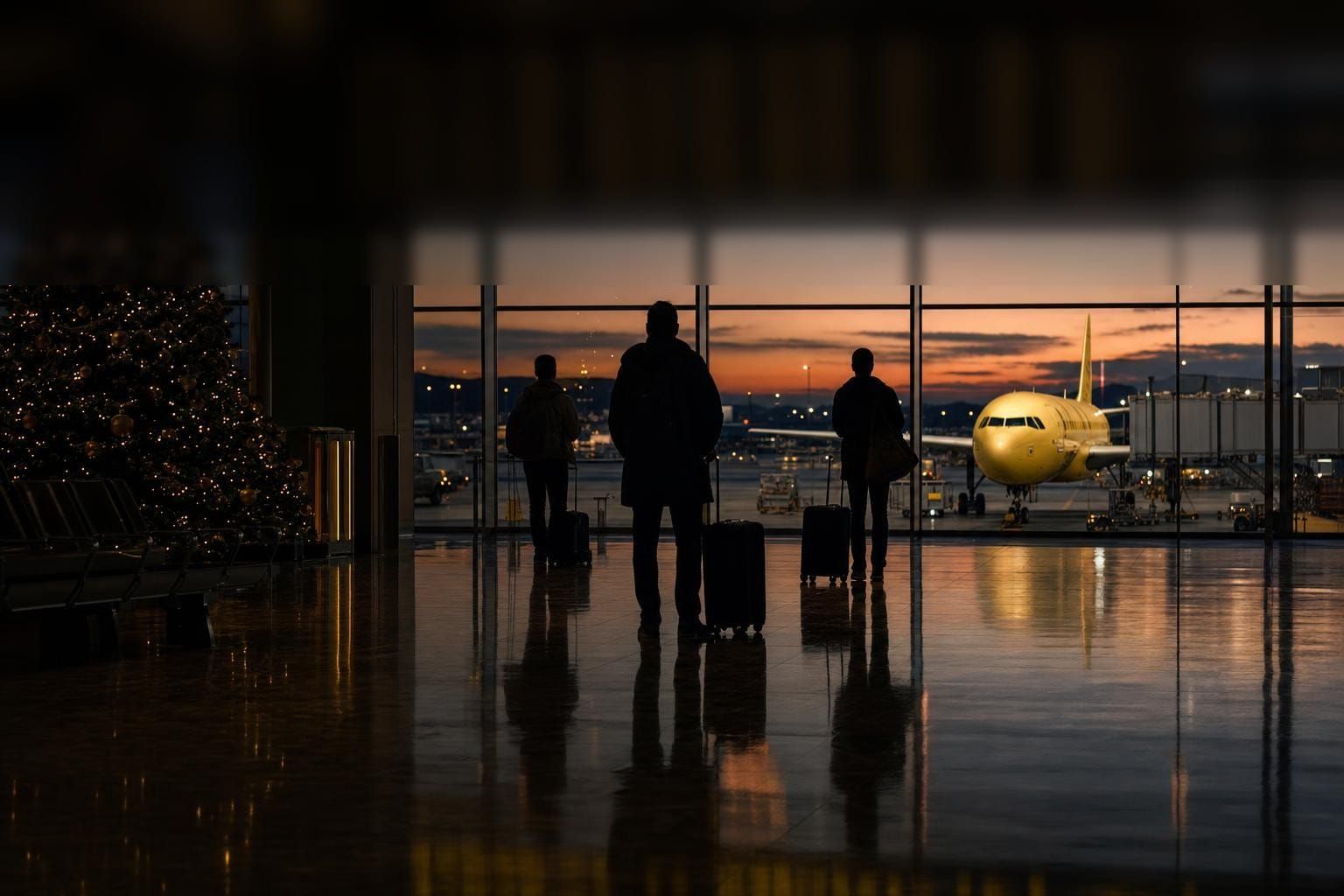
Thanksgiving falls on November 26 this year, and the price of getting home for it has become its own economic story. Average airfares for the holiday period were running 31% above last year in the most recent analysis from aviation analytics firm Cirium — a spike steep enough that bookings for the period have actually fallen, down 1.6% at a time of year when demand almost never goes backward. Several fare trackers now put holiday airfare at its highest level in roughly a decade.
Some of that is the war. Jet fuel is an airline's second-largest cost after labor, and fuel prices roughly doubled in some markets after the United States and Israel struck Iran on February 28, according to industry reporting. But there is a second, quieter reason this is the most expensive Thanksgiving in memory, and it has a name: Spirit Airlines.
This is America's first Thanksgiving in more than three decades without the yellow planes. The airline that spent 30 years dragging everyone else's fares down died in May — and the discount it enforced on the entire U.S. domestic market died with it.
What Died in May
Spirit ceased operations before dawn on Saturday, May 2, 2026, mid-way through its second bankruptcy in less than two years. The proximate cause was an eleventh-hour rescue that fell apart: the Trump administration had offered a $500 million loan — one that could have handed the government up to a 90% stake in the airline — but Spirit's board could not reach agreement with bondholders, and the money never arrived. The company's lawyer had told a New York bankruptcy court on April 23 that Spirit's cash was "not going to last for very much longer." Nine days later it was gone.
"The sudden and sustained rise in fuel prices in recent weeks ultimately has left us with no alternative but to pursue an orderly wind-down of the Company," chief executive Dave Davis said in the shutdown announcement. Spirit said 17,000 direct and indirect employees lost their jobs. Its final flight, NK1833 from Detroit to Dallas–Fort Worth, touched down shortly after midnight; the airline said it carried more than 50,000 passengers on its last day of existence.
Spirit had been the country's biggest ultra-low-cost carrier — the pioneer of the unbundled rock-bottom base fare with a fee for everything else. The model was a punchline, but it did something economists could measure: when Spirit entered a route, incumbent carriers cut fares to compete. When it left, they raised them. For thirty years, Spirit was a price floor enforcement mechanism with wings.
Now the floor is gone, at exactly the moment fuel made every seat more expensive to fly.
Briefings like this are free to read with a free AlphaBriefing membership. Join free →
The Booking Map Tells the Story
Cirium's data shows where the squeeze is biting. Thanksgiving bookings are down 24.6% to Newark, 15.3% to Seattle, 13.2% to Miami, 12.6% to Dallas, 11.7% to San Francisco, and 11.6% to Denver. Those are not random cities — they are big, competitive markets where cheap seats used to be a given, and where their disappearance has moved prices most.
The remaining discounters are in no position to backfill. Even before Spirit's final weekend, Frontier and Avelo had gone to Washington seeking $2.5 billion in federal relief from fuel costs — the budget model simply does not clear at war-economy fuel prices, because its customers are the most price-sensitive in the market and cannot absorb surcharges the way corporate travelers can. Industry analysts now describe Frontier as the last true national ultra-low-cost carrier still flying. Some of Spirit's orphaned routes have been picked up by smaller carriers; many have not, and schedule data reported through the fall showed several of Spirit's old strongholds entering November with fewer seats than a year ago even as national capacity grew.
Fewer seats, fewer discounters, costlier fuel. Every part of the fare equation points the same direction — up.
Cheap Oil Won't Rescue Your Ticket
Here is the twist that makes this more than a travel story. The fuel argument just collapsed — and fares are not following it down.
Crude oil has crashed this week. Brent, which closed above $117 a barrel on October 30, settled at $94.62 on Wednesday — a decline of more than 15% in three trading sessions, including the biggest one-day drop since July. West Texas Intermediate is back below $90. The trigger was real diplomatic progress: U.S.–Iran negotiations advanced through mediators in Doha, and markets began pricing out the Middle East supply-disruption premium that had been embedded in every barrel since February.
If airfares were purely a fuel story, that would be the setup for cheaper spring travel. The airlines are telling you not to expect it. Carriers have said publicly they expect fares to remain elevated even if the Middle East conflict subsides, pointing out that fuel is still far above year-ago levels and that recently renegotiated pilot and flight-attendant contracts have permanently raised their labor costs. "It's expensive to fly airplanes," United CEO Scott Kirby told analysts in late October. "I think the tide has to rise for everyone or those airlines simply won't exist."
Translate that from CEO: the industry has pricing power for the first time in years, and it intends to keep it. Fuel hedges and jet-fuel refining spreads mean crude's crash reaches airline cost lines slowly. Capacity discipline means it may never fully reach your ticket. The competitive mechanism that historically forced airlines to hand fuel savings back to passengers — a hungry ultra-low-cost sector adding seats — no longer exists at scale.
The market has noticed. As of this week, Delta's stock trades roughly 29% above where it was a year ago, and Frontier — the last discounter standing, suddenly without its biggest rival — is up roughly 50% over the same period. Investors are not pricing a fare war. They are pricing its absence.
The Bottom Line
The 2026 holiday fare spike is being sold as a war story, and the war matters. But wars end — this one may be ending now, if the Doha track holds — and fare structures outlive them. What happened in May was structural: the U.S. domestic market lost its price disciplinarian, 17,000 aviation workers, and the better part of a fleet's worth of low-cost capacity in a single weekend. The passengers who are skipping Thanksgiving this year are the first visible consequence. The more durable one is an industry that gets to decide, for the first time in three decades, what a seat is worth without Spirit Airlines on the route map arguing it down.
Watch three things from here: whether crude's peace-talk slide holds and how little of it shows up in spring fares; whether Frontier uses its inherited monopoly on the budget model to grow aggressively or to price like everyone else; and what the new Congress — elected Tuesday on cost-of-living anger — decides to do about an industry that just told Wall Street, out loud, that the tide has to rise for everyone.
If this analysis was useful, this is what AlphaBriefing does every day — geopolitics and markets, connected to what it means for your money. A free membership gets you access to every free article on AlphaBriefing.com; paid members get the investment frameworks, scenario pricing, and catalyst calendars behind the paywall.
Sign up free → — upgrade whenever it earns it.
Get this level of intelligence every day. Subscribe to AlphaBriefing — free, member, and paid tiers available. A free membership gets you access to every free article at AlphaBriefing.com: Join AlphaBriefing
Sources & Further Reading
- CNBC — Spirit Airlines shuts down after failing to reach a bailout deal, ending discount travel era
- CBS News — Thanksgiving airfares are soaring, driving down flight bookings for the holiday
- CBS News — Airlines cut routes as Iran war drives up jet fuel costs
- Airways Magazine — Shutdown: Spirit Airlines Ends Operations as Rescue Talks Collapse
- Business Traveller — Spirit Airlines Shuts Down After 34 Years
Disclaimer
AlphaBriefing is an independent intelligence publication. The content in this article is produced for informational and educational purposes only. Nothing published by AlphaBriefing constitutes financial, investment, legal, tax, or regulatory advice, nor should it be construed as a solicitation or recommendation to buy, sell, or hold any security, asset, or financial instrument.
All views expressed are those of the author at the time of writing and are subject to change without notice. Markets are volatile and unpredictable; past performance is not indicative of future results. Any investment involves risk, including the possible loss of principal.
AlphaBriefing and its principals, employees, or contributors may hold positions in securities or assets mentioned in this article. This should be considered a potential conflict of interest. No material relationship with any company referenced exists unless explicitly disclosed. Readers should conduct their own due diligence and consult qualified financial, legal, and tax advisors before making any investment decisions.
Information in this article is drawn from public sources believed to be reliable at the time of publication. AlphaBriefing makes no warranty, express or implied, as to the accuracy, completeness, or timeliness of any information herein. AlphaBriefing accepts no liability for any loss or damage arising from reliance on this content.
© AlphaBriefing. All rights reserved. Unauthorised reproduction or distribution is prohibited.