The $588 Billion Bet: How Smart Money Is Positioning for Ukraine's Reconstruction

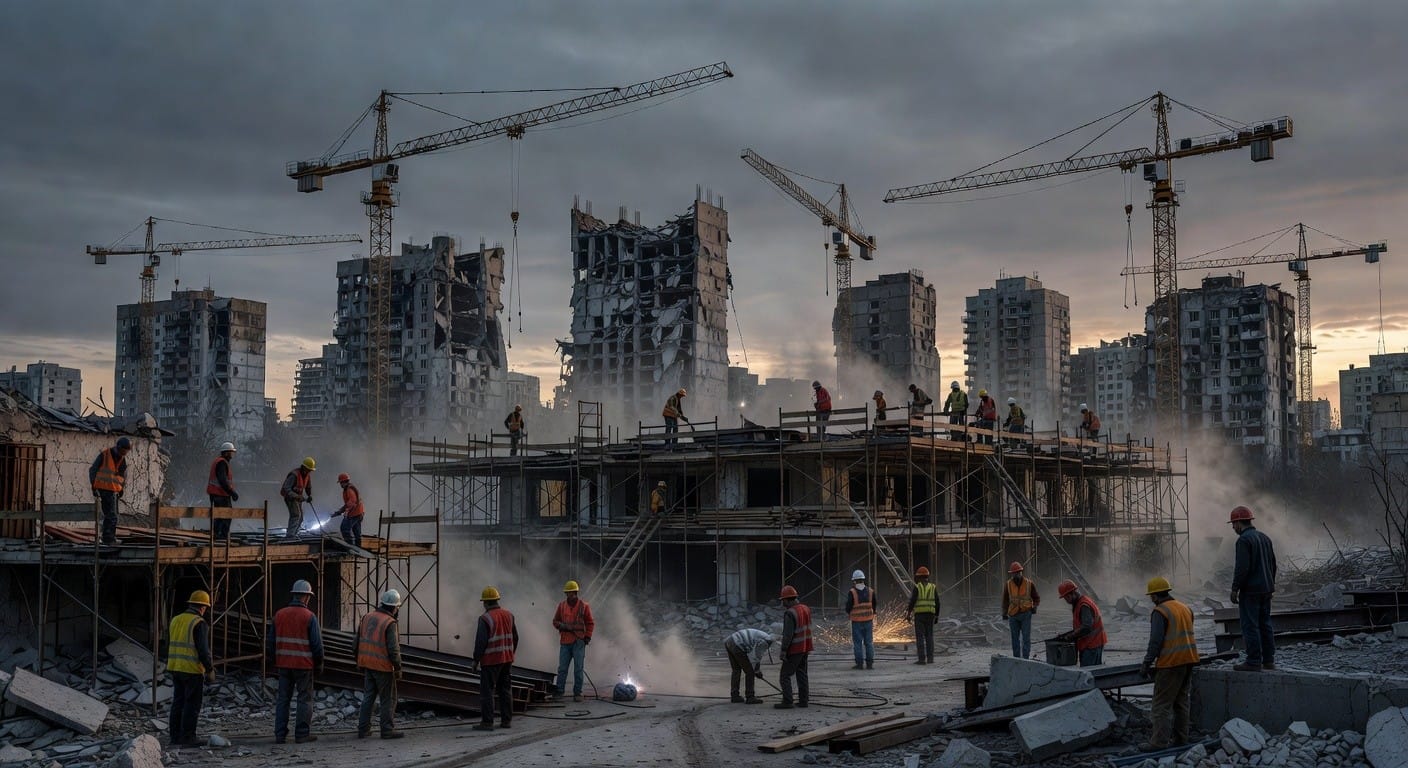
The War Isn't Over. The Trade Has Already Started.
On February 23, 2026, the World Bank released its fifth Rapid Damage and Needs Assessment for Ukraine — and the number stopped the market cold: $588 billion. That's what it will cost to rebuild Ukraine over the next decade. Up 12% from the previous estimate. Nearly three times Ukraine's entire annual GDP. And it doesn't include the costs still accumulating as Russia's spring offensive presses on.
The diplomatic picture is grim. US-brokered talks collapsed after two hours in Geneva in February. A subsequent round in Florida on March 22 produced no breakthrough. As of today, Finland's president is describing the negotiations as "at a dead end," and prediction markets put the odds of a ceasefire before year-end at just 34%.
And yet — capital isn't waiting.
Reuters called Ukraine reconstruction "the top European investment theme for 2026" back in January. Since then, the EU has unveiled a €1.5 billion investment package under its Ukraine Investment Framework, structured to mobilize up to €40 billion via guarantees. The Ukraine Recovery Conference (URC 2026) is already scheduled for June 25-26 in Gdańsk, with delegations from nearly 100 countries expected. And Ukraine's own government has restructured $2.6 billion in GDP-linked warrants into conventional Eurobonds — a sophisticated debt management move designed to reduce post-war payout exposure and attract conventional bond investors.
This is the paradox that defines the Ukraine trade: the reconstruction investment thesis is maturing while the war continues. The smart money isn't betting on when peace arrives — it's positioning for the certainty that $588 billion of capital will flow regardless of who signs what.
Why the Capital Is Moving Now
Three structural forces are driving early positioning, despite the ongoing conflict.
First, the damage assessment is directionally stable. The World Bank's number keeps going up — $524 billion, then $588 billion — but the composition of the damage has been consistent: housing (the largest single category), energy infrastructure, transport, education, and healthcare. Investors can model sector exposure even without a peace date. You don't need to know when the reconstruction starts; you need to know what gets rebuilt first.
Second, the financing architecture is already live. The EU's Ukraine Investment Framework isn't a pledge — it's an operational mechanism. The €200 million in private sector grants announced in late 2025 have already begun flowing. The European Bank for Reconstruction and Development (EBRD), European Investment Bank (EIB), and International Finance Corporation (IFC) are all active. The Gdańsk conference in June will formalize the next tranche of public-private commitments. This isn't aspirational. The plumbing exists.
Third, Ukraine is doing serious macro housekeeping. The GDP-warrant restructuring in December 2025 was a signal — the government is managing its debt profile like a country preparing to re-enter capital markets, not like a country resigned to permanent donor dependence. New Ukrainian Eurobonds have already received positive market ratings. That's a country building credibility ahead of a financing wave.
The war remains brutal — Russia launched nearly 1,000 drones and missiles between March 23-24 in what Ukrainian officials called the largest aerial strike series of the entire conflict, hitting 11 oblasts including Lviv's UNESCO heritage center. But infrastructure destruction is also infrastructure demand. Every bridge blown, every substation hit, every hospital gutted is a line item in the $588 billion figure — and a future contract for someone.
This is where the analysis gets actionable. AlphaBriefing members get the full investment framework — scenarios, positioning, and the bottom line.
Subscribe to AlphaBriefing — Free, Member, and Paid tiers available.