⚠️ 🇨🇳 🇹🇼 The 2027 Cross‑Strait Showdown: China, Taiwan, and the Next Global Shockwave
A potential China–Taiwan conflict in 2027 could reshape global markets. This in-depth guide breaks down the risks, historical parallels, and sectors to watch — from defense to semiconductors — and shows how investors can prepare before the world catches up.

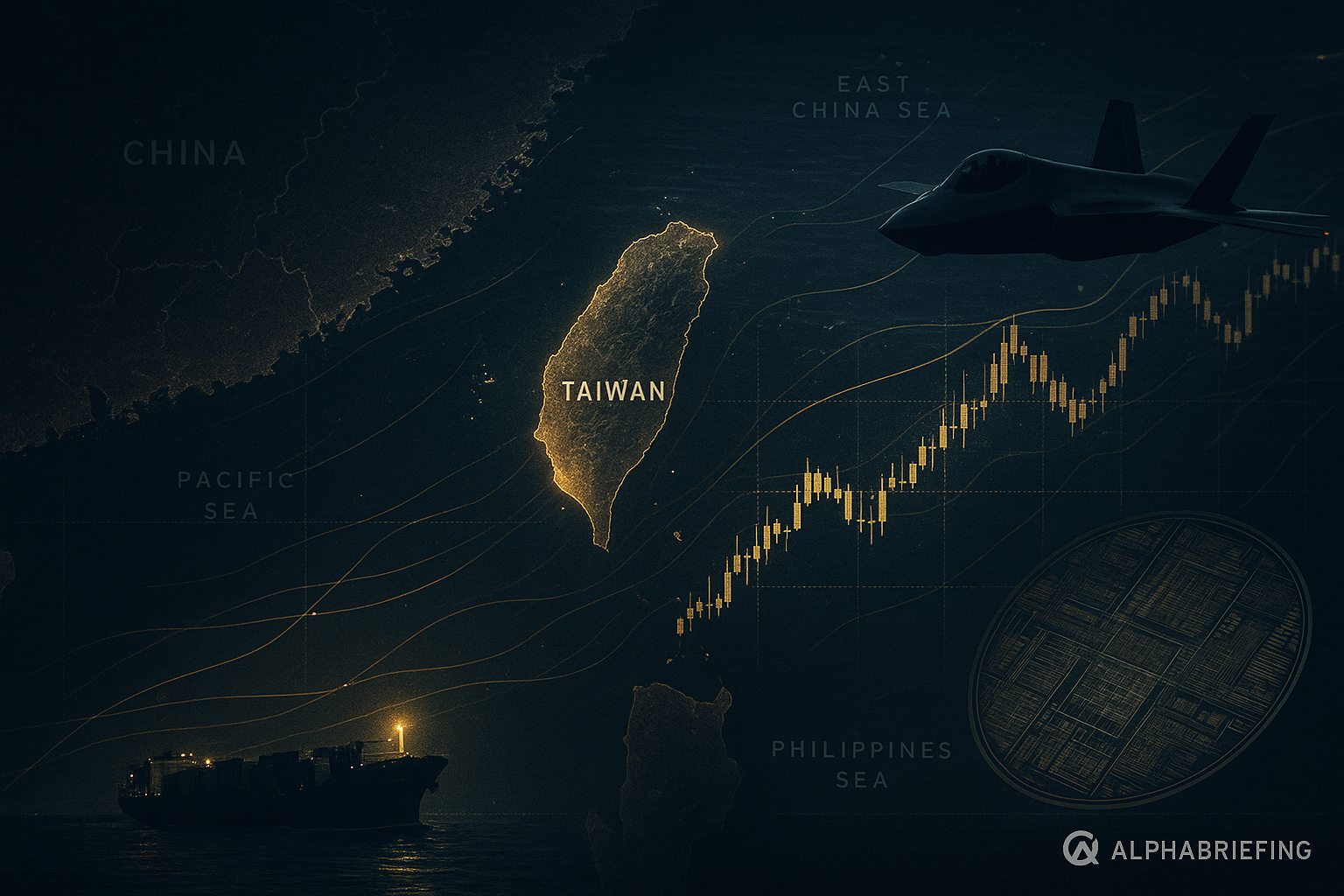
On a warm summer dawn in 2027, oil tankers idle uneasily at the mouth of the Malacca Strait. Traders in London and New York wake up to spiking prices as satellite images show Chinese warships encircling Taiwan. Factories across Europe scramble for semiconductor chips as Taiwan’s ports shut down, while U.S. officials pledge that “freedom of navigation” will be upheld. Investors the world over hold their breath. The world’s next great crisis may be unfolding – and its ripple effects could reshape markets and lives across the globe.
The China–Taiwan conflict has simmered for over seven decades, but new factors are converging to make 2027 a potential breaking point. A clash over Taiwan would not only be a regional military showdown – it could send shockwaves through energy supplies, technology supply chains, and financial markets worldwide. From the origins of the dispute to eerie parallels with past crises like the Cuban Missile standoff and the Suez Crisis, to the modern role of drones and cyber warfare, this report will unpack the full spectrum of risks and insights. We’ll examine why 2027 looms large in Beijing’s plans, how a conflict might play out (from a blockade to an all-out invasion), and what history tells us about market reactions and investment strategies during wars and upheavals.
Buckle up: the stage is set, the historical parallels are alarming, and the next global shockwave may be on the horizon.
📜 Origins of the China–Taiwan Conflict
The roots of the Taiwan dispute trace back to the Chinese Civil War. In 1949, Mao Zedong’s Communists defeated Chiang Kai-shek’s Nationalists (Kuomintang), prompting Chiang’s government and supporters to flee to the island of Taiwan cfr.orgcfr.org. Ever since, two rival entities have existed: the People’s Republic of China (PRC) on the mainland and the Republic of China (ROC) on Taiwan. Beijing’s stance under its “One China” principle is that Taiwan is a renegade province that must eventually reunite with the mainland cfr.orgcfr.org. From the PRC’s perspective, this is an internal matter of sovereignty. Taiwan, however, evolved into a self-governing democracy with its own identity and has never been ruled by the Communist government in Beijing cfr.orgcfr.org.
For decades, the two sides have been locked in a delicate status quo. Beijing insists unification is inevitable and has pointedly never renounced the option of force to achieve it cfr.org. Taiwan’s leaders, for their part, reject Beijing’s claims – noting that the PRC has never governed the island – and assert the island’s democratic right to decide its own future reuters.com. The United States entered the fray in the 1950s, first by interposing the U.S. Seventh Fleet to prevent a Communist invasion during the Korean War, and later by signing a defense treaty with Taiwan (in effect until 1979) and passing the Taiwan Relations Act (1979) to provide Taiwan with defensive arms and implicit support history.state.govhistory.state.gov.
Through the Cold War, the Taiwan Strait saw periodic crises. In 1954–55 and again in 1958, the PRC shelled offshore islands held by Taiwan (Quemoy/Jinmen and Matsu), prompting U.S. intervention. In 1955, President Eisenhower even signaled willingness to use nuclear weapons to stop a Chinese invasion history.state.gov. Both crises eventually eased – Zhou Enlai offered talks in 1955, and U.S. naval escorts in 1958 helped Taiwan resupply the islands, leading the PRC to stand down history.state.govhistory.state.gov. Another flare-up occurred in 1995–96 when China conducted missile tests near Taiwan to protest a Taiwanese president’s U.S. visit; the U.S. responded by deploying aircraft carriers, and Beijing backed off. The pattern has been consistent: China rattles sabers; the U.S. and Taiwan signal resolve; direct conflict is avoided – so far.
Over time, Taiwan transitioned to democracy (free elections in the 1990s) and an increasing share of its people identify primarily as Taiwanese, not Chinese. This trend frustrates Beijing. President Xi Jinping has called unification with Taiwan the “essence” of China’s national rejuvenation, to be achieved by 2049 (the PRC’s 100th anniversary) if not sooner cfr.org. Xi has offered Taiwan the “one country, two systems” model used (contentiously) in Hong Kong, but Taiwan’s public and both major parties firmly reject that – especially after seeing Beijing erode Hong Kong’s autonomy cfr.orgcfr.org. Thus, a tense impasse persists: China feels time is running out to “resolve” Taiwan, while most Taiwanese have little interest in being governed by Beijing. This clashing vision of Taiwan’s status – unresolved from 1949 – lies at the heart of the conflict’s origins.
In summary: The China–Taiwan conflict originated in civil war and has evolved into a complex standoff over identity, democracy, and great-power credibility. Understanding this history is crucial, because it explains why neither side’s core position is easily compromised. For Beijing, Taiwan’s separation is a national humiliation to be undone; for Taiwan, absorption by the PRC would mean the end of its hard-won democratic way of life. These stakes help explain why the situation remains one of the world’s most intractable flashpoints – and why events in the coming few years could move it from stalemate to crisis.
⏳ Why 2027 Matters: The Pivotal Deadline
Why are so many eyes on 2027 as the year Taiwan’s fate could come to a head? Several powerful forces coincide in that timeframe, making it a potential inflection point.
Xi’s Strategic Timeline: Chinese President Xi Jinping has explicitly linked 2027 to military readiness for Taiwan. He has instructed the People’s Liberation Army (PLA) to be prepared to take Taiwan by 2027 if necessary defensenews.comdefensenews.com. This date is not random – 2027 is the 100th anniversary of the PLA’s founding, a symbolic deadline for achieving key modernization goals. In 2021, the Chinese Communist Party set the “2027 centenary goal” for the PLA: by August 1, 2027, the PLA should attain a level of capability sufficient to win a war over Taiwan airuniversity.af.eduairuniversity.af.edu. This is part one of a three-step modernization; by 2035 China aims to basically complete military modernization, and by 2049 to field a “world-class military” airuniversity.af.edu. In short, 2027 is when Xi wants the PLA capable of action, even if the decision to invade is not yet made. U.S. intelligence assessments have echoed this, noting Xi’s order and emphasizing that “ready to invade is different from will invade” defensenews.com. Nonetheless, the PLA’s rapid build-up – the world’s largest navy, advances in missiles and aircraft – is being paced to this 2027 marker.
PLA Modernization Milestone: Meeting the 2027 goal has put pressure on China’s military. In 2024, the PLA’s top general published an essay essentially warning that reforms were behind schedule to meet the “August 2027 deadline to successfully annex Taiwan.” He urged redoubled efforts to accelerate joint operations capability, high-tech weapons, and civilian-military integration airuniversity.af.eduairuniversity.af.edu. This sense of a ticking clock suggests Beijing wants the option to strike by 2027 if peaceful “reunification” remains out of reach. By then, the PLA hopes to have sufficient amphibious lift, modern missiles, airpower, and cyber capabilities to make an invasion feasible airuniversity.af.edu. Notably, the PLA hasn’t fought a war since 1979, so achieving full readiness is a massive undertaking – one they view with urgency.
U.S. and Allied Focus: Washington has picked up on the 2027 fixation in what’s been dubbed the “Davidson window.”In March 2021, Adm. Philip Davidson (then head of U.S. Indo-Pacific Command) warned Congress that the threat of a Chinese move on Taiwan was “manifest in this decade, in fact in the next six years” defensenews.comdefensenews.com. That pointed to 2027 and sent shockwaves through D.C. policy circles. The result? U.S. defense planning and budgets have shifted to prioritize near-term deterrence in the Western Pacific. Billions have been earmarked for the Pacific Deterrence Initiative, new missile defenses, and hardening bases – all with 2027 in mind defensenews.comdefensenews.com. U.S. officials from the CIA Director to the Secretary of State have repeatedly highlighted a “much faster timeline” for a potential Taiwan crisis, underscoring that China is the Pentagon’s “pacing threat.” In effect, 2027 has become a psychological deadline in Washington to bulk up U.S. and Taiwanese defenses, lest Beijing be tempted by a window of opportunity.
Political Timetables: Xi Jinping is likely to secure a fourth term as China’s leader in 2027 (having removed term limits). Some analysts speculate he would want to solve the Taiwan issue during his rule, as part of his legacy. By the late 2020s, Xi will have been in power ~15 years and in his mid-70s – time flies even for strongmen. Domestically, China also faces worsening demographics and economic challenges after 2030 (more on that later), which could make earlier action more appealing than later. Taiwan, for its part, has presidential elections in early 2024 and 2028; Beijing might perceive 2027 as a moment to act before Taiwan’s leadership possibly moves further toward formal independence. In Taiwan’s 2024 election, the more China-skeptic party (the DPP) won again – a trend that could harden Beijing’s sense that time is not on its side.
In sum, 2027 concentrates military, symbolic, and political factors. It’s the year China’s military buildup comes due, and the year U.S. planners are racing against. While not a hard “expiration date” on peace, it is viewed as a moment of peak risk – when Xi might feel confident in the PLA’s capabilities and before shifting dynamics (like stronger U.S. alliances or a weaker Chinese economy) make an attack less viable. As one U.S. general put it, “My gut tells me we will fight in 2025.” Others focus on 2027. The exact year is less important than the reality that the next few years represent the most dangerous phase in the Taiwan Strait in decades. Understanding this timeline helps us prepare for what might come before this decade is over.
🔄 Lessons from History: Crises That Echo in Today’s Tensions
History doesn’t repeat, but it often rhymes. The China–Taiwan brinkmanship in 2027 finds striking echoes in some of the most fraught crises of the past. By examining these historical parallels – from the nuclear stare-downs of the Cold Warto regional wars that rattled markets – we can glean insights (and warnings) about what a Taiwan crisis might entail and how it could be managed or mismanaged.
Cuban Missile Crisis (1962) – Nuclear Brinksmanship: Perhaps the closest parallel to a U.S.–China standoff over Taiwan would be the Cuban Missile Crisis, when the U.S. and Soviet Union went eyeball-to-eyeball over missiles in Cuba. Then, as potentially in a Taiwan blockade/invasion scenario, two nuclear-armed superpowers faced a direct collision of vital interests. The lesson from Cuba was the importance of backdoor communication and face-saving compromises. Kennedy and Khrushchev avoided war through a secret deal (removing U.S. missiles from Turkey in exchange for Soviet withdrawal from Cuba) – all while each side saved face publicly. A Taiwan conflict would similarly require deft diplomatic off-ramps to avert catastrophic escalation. It’s sobering, however, that in 1962 both sides had a relative parity of terror (mutual assured destruction). In a Taiwan clash, the imbalance of stakes (China sees Taiwan as core interest; the U.S. is a defender from afar) could actually raise escalation risks – Beijing might gamble that Washington will blink if nuclear sabers are rattled. The Cuban Crisis also showed how a naval “quarantine” (blockade)can be used as a middle option short of war. We may see a similar approach if China initially blockades Taiwan rather than invades – forcing a high-stakes game of chicken reminiscent of 1962, with global markets just as on edge.
Berlin Blockade & Airlift (1948–49) – Blockade Breaking: When the Soviet Union blockaded West Berlin, cutting off road and rail, the Western Allies avoided direct fighting by mounting the Berlin Airlift – supplying the city by air for 15 months until the blockade was lifted. This scenario maps closely to a possible Chinese blockade of Taiwan. Beijing could attempt to choke off the island to force capitulation. The U.S. and allies might respond with a modern “Taipei Airlift,” flying or convoying supplies in. History suggests this would be daunting but possible. The Berlin airlift delivered 2.3 million tons of goods over 15 months to sustain 2+ million West Berliners navyleague.org. Taiwan’s 23 million people and long ocean distances make it an even bigger challenge – one estimate says over 860 flights a day might be needed to supply Taiwan by air. Yet, the principle is the same: a humanitarian lifeline that forces the aggressor to either back down or fire the first shot at unarmed supply planes – putting the moral onus on them navyleague.orgnavyleague.org. The Berlin example also shows that blockades can backfire strategically. The Soviet blockade solidified West Berlin’s identity with the West navyleague.org. A Chinese blockade would likely drive Taiwan even closer to the U.S. and its allies, hardening resistance rather than weakening it navyleague.orgnavyleague.org. In short, the Berlin crisis offers a playbook for non-kinetic resistance to coercion – and a warning to Beijing that “siege warfare” might not break the will of a free people.
Taiwan Strait Crises (1950s) – The Risk of Escalation: We’ve touched on the First and Second Taiwan Strait Crises. What stands out from the 1958 episode in particular is how quickly things can escalate – and how external distractions can embolden an aggressor. In 1958, while the U.S. was entangled in the Middle East (Lebanon Crisis), Mao’s China made a grab for Taiwan’s offshore islands history.state.gov. The U.S. responded by openly escorting Taiwanese supply ships and even arming Taiwan with nuclear-capable artillery, making nuclear release a real consideration. The crisis ended in stalemate (with a odd arrangement of symbolic alternate-day shelling), but it underscores that misreading resolve can be dangerous. Today, China will surely watch U.S. global commitments – could a U.S. crisis elsewhere (Middle East, Europe) be seen as an opportunity? Conversely, the U.S. will try to signal crystal-clear resolve to avoid miscalculation. One positive lesson: even at the height of Cold War tension, cooler heads found off-ramps (1955 negotiations; 1958 tacit cease-fire). Diplomatic channels and third-party mediation (Switzerland facilitated some talks then) might be crucial again if 2027 ignites a confrontation.
Suez Crisis (1956) – Financial Leverage in Conflict: When Britain, France, and Israel invaded Egypt after Nasser nationalized the Suez Canal, they achieved military success – but were abruptly forced to withdraw when the United States wielded financial pressure. The U.S. blocked IMF loans and threatened to dump British bonds, causing a run on the pound en.wikipedia.orgen.wikipedia.org. Facing economic meltdown at home, Britain had no choice but to back down, despite having the military upper hand in Egypt. The Suez Crisis is a powerful reminder that in the modern era, wars are won as much on the trading floor as on the battlefield. A Chinese attack on Taiwan would undoubtedly trigger swift economic and financial retaliation by the U.S. and others – from freezing overseas assets to cutting off key trade and technology. China is far more economically intertwined with the world than 1950s Britain, but that cuts both ways (sanctions on China would be globally destabilizing). Still, the lesson from Suez is that great powers can be compelled to halt aggression if their economic lifelines are choked. It’s conceivable that facing a united front of sanctions – loss of export markets, energy import embargoes, and financial isolation – Beijing might find the costs unsustainable. (During Suez, even ally America turned financial knives on Britain; in a Taiwan scenario, China would face an even more hostile coalition). Suez also underscores the role of oil as a strategic weapon: Arab states imposed an oil embargo on the aggressors in 1956 en.wikipedia.org. In a Taiwan war, oil producers (like Gulf states) might be pressured to curtail supplies to China, adding to Beijing’s woes.
Yom Kippur War (1973) – Energy Shock and Surprise Attack: The 1973 Arab–Israeli War offers two key lessons. First, the element of surprise – Egypt and Syria caught Israel off-guard on Yom Kippur, initially gaining advantage. Translated to Taiwan: China might seek strategic or tactical surprise (despite the difficulty of hiding preparations for a major invasion). A sudden blockade or missile barrage, timed when the world is distracted, could be how Beijing tries to avoid a protracted fight. Second, 1973 taught the world about the power of energy shocks. In retaliation for U.S. support of Israel, Arab oil producers imposed an embargo that quadrupled oil prices by 1974 britannica.com. The result was stagflation and global recession. A Taiwan war could trigger an even greater oil shock: China might not embargo itself, but conflict could disrupt key routes (like the Strait of Hormuz if Iran or others get involved, or simply the panic in markets). Also, the U.S. and allies might sanction or blockade oil to China. The world today is somewhat better prepared with strategic reserves and diversified suppliers, but a sudden loss of Chinese demand (if its economy crashes) or supply chain snarls could whipsaw prices. The 1970s oil crisis ultimately forced Western economies to adopt strategic stockpiles and efficiency measures britannica.combritannica.com. We might see a similar permanent effect from a Taiwan conflict: an accelerated shift to alternative sources (e.g. renewables, non-Chinese supply chains) as a security measure. Yom Kippur also brought the U.S. and USSR close to confrontation when Moscow threatened to intervene to save its ally – reminding us that a regional war can drag in superpowers indirectly. In a Taiwan fight, Russia might saber-rattle or even quietly assist China, while the U.S. rallies allies – a dangerous great-power dynamic reminiscent of 1973’s nuclear alerts.
Gulf War (1991) – Tech Revolution and Market Resilience: The U.S.-led victory over Iraq in the First Gulf War showed how new technology can make a decisive difference. Stealth bombers, precision-guided missiles (“smart bombs”), space-based navigation (GPS) – the conflict heralded a Revolution in Military Affairs. A China–Taiwan war could likewise be a showcase for cutting-edge tech: AI-assisted targeting, drone swarms, hypersonic missiles, cyber-attacks on satellites – a 21st-century blitz. The Gulf War also had an instructive market impact: initially, Iraq’s invasion of Kuwait in 1990 caused a severe oil price spike and market slump. But when the U.S. intervention came in January 1991, the swift victory was actually followed by a market rally. Oil prices fell from their panic highs and stocks surged as war fears eased. This gave rise to the adage “buy on the sound of cannons” – markets often rebound when war begins if the outcome seems clear. However, that war was short and one-sided. A Taiwan war would be far more uncertain and devastating, but it’s worth noting that sometimes the anticipation of conflict hurts markets more than the conflict itself (provided it doesn’t spiral). Still, any gains from a “resolved” conflict would come after immense volatility and damage during the fight. The Gulf War taught militaries the importance of high-tech dominance; it taught investors that decisive victories can soothe markets, but also that over-reliance on a quick win is dangerous (had the Gulf War bogged down, the economic fallout would’ve worsened).
By examining these episodes – the near-misses and miscalculations of the past – we see both hope and hazard. Crises like Cuba and Berlin were managed through resolve plus restraint. Others like Yom Kippur and Suez highlight economic blows that outlast the shooting. As we peer toward 2027, history’s message is to prepare for surprises (military and economic), to appreciate the value of alliances and communications in crisis, and to remember that wars have unintended consequences far beyond their battlefields.
🚢 Chokepoints of Power: The Vulnerable Energy & Trade Arteries
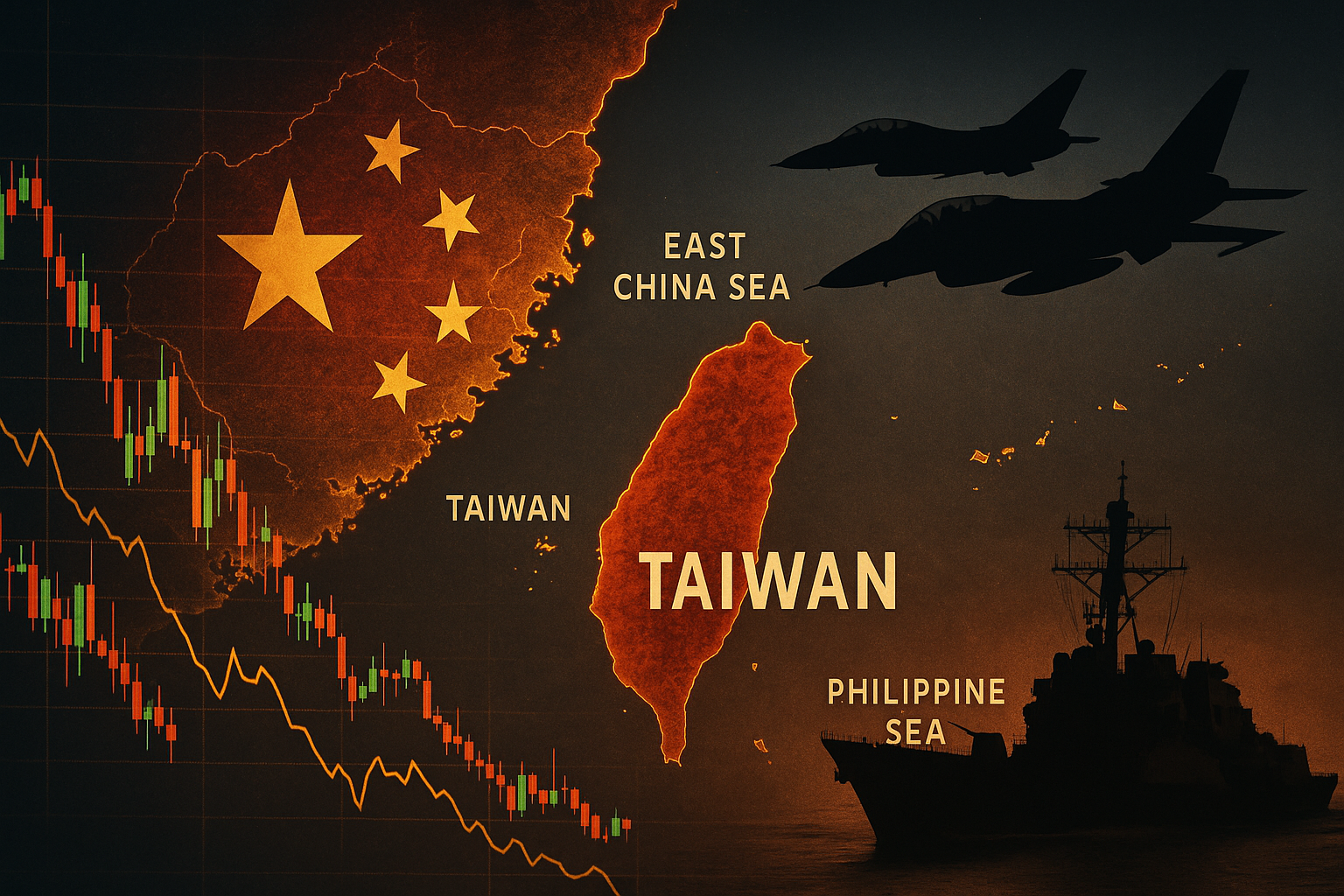
If conflict erupts over Taiwan, some of the first tremors will be felt at a few narrow channels half a world away – the great maritime chokepoints through which the lifeblood of the global economy flows. In particular, the Strait of Malacca, the Strait of Hormuz, and the Luzon Strait might become strategic pressure points. Control of these passages has long equated to power (and vulnerability) – history and geography have made them unavoidable. Let’s explore why these chokepoints matter and how they factor into a Taiwan crisis scenario.
Malacca Strait – China’s “Malacca Dilemma”: This pinch point between Malaysia, Indonesia, and Singapore is one of the world’s busiest shipping lanes, connecting the Indian Ocean with the South China Sea. Approximately one-third of global seaborne trade and major energy shipments pass through Malacca. For China, it is the vital corridor for oil from the Middle East and Africa. Over 70% of China’s oil imports travel by sea navyleague.org, and much of that goes through Malacca. Former President Hu Jintao famously fretted about China’s “Malacca dilemma” – the fear that hostile powers (like the U.S. Navy) could cut China’s energy jugular in a conflict. In a Taiwan war, this dilemma becomes acute. The U.S. and allies could indeed enforce a distant blockade at chokepoints like Malacca, interdicting tankers bound for China. The logic: strangling China’s fuel supply to cripple its war machine. A U.S. think-tank study notes China imports 85% of the soybeans it consumes (for food and animal feed) and a huge share of oil; severing those sea lanes would quickly hit Chinese food and energy security navyleague.org. The flip side is that any fighting or even threatening moves around Malacca would send global oil prices skyrocketing, hurting all economies. But the threat alone could be leverage. It’s a risky strategy (could broaden the war), yet the mere possibility forces China to consider quick action – it can’t sustain a long conflict with its maritime lifelines cut. Notably, China has tried to mitigate this via pipelines (from Myanmar, Central Asia) to bypass Malacca, and building a larger domestic reserve. Still, there’s no easy substitute for Malacca. It is China’s Achilles’ heel in a protracted war. We might see intense great-power naval cat-and-mouse in the Indian Ocean if things escalate – with U.S. submarines shadowing Chinese-bound tankers while Chinese naval groups push out to escort them.
Hormuz – The Global Oil Valve: The Strait of Hormuz, at the mouth of the Persian Gulf, is the world’s most important oil chokepoint. Some 20% of globally traded oil passes through this narrow strait bordered by Iran and Oman. How does a Taiwan conflict relate to Hormuz? Indirectly, but importantly. First, if the U.S. Navy is tied up in the Pacific, regional actors like Iran might test the waters (literally) in Hormuz, perhaps to gain leverage or simply because a distracted U.S. can’t as easily police the Gulf. Any mischief there – mines dropped, harassment of tankers – could jolt oil markets. Second, China would be extremely keen to keep oil flowing from the Gulf to it during a war. Iran and other Gulf states might quietly assist by continuing shipments (some might even reflag ships or use shadowy methods to evade a blockade). Conversely, the U.S. would pressure Gulf allies (like Saudi Arabia, UAE) to deny oil to China or at least increase production to stabilize prices for everyone else. In the worst case, a broader conflict could erupt if, say, Iran decides to side more openly with China (as a fellow U.S. adversary) and uses Hormuz as a pressure point – even a temporary closure of Hormuz would cause an energy price spike likely surpassing the 1973 embargo. During the 1973 Yom Kippur War, the oil weapon was used via embargo; in a Taiwan war, the oil weapon could be a physical blockade or destruction in Hormuz. It’s not the most likely scenario – but conflict has a way of spreading. At a minimum, expect insurance rates on tankers to surge and some companies to halt shipments if missiles start flying anywhere near the Gulf. The world has more oil options now (shale oil, strategic reserves) but a Hormuz disruption would still be a gut punch to the global economy.
Luzon Strait – The Gate to the Pacific: Closer to the action, the Luzon Strait lies between Taiwan and the Philippines’ Luzon island. It is a critical gap connecting the South China Sea to the broader Pacific Ocean. For the U.S. and its Pacific allies, Luzon Strait is essentially the path through which naval forces would enter or exit the East Asian waters undetected (it’s a likely route for submarines, for example). For China, controlling or monitoring Luzon Strait would be key to enforcing a blockade around Taiwan and to keeping U.S. reinforcements at bay. Submarine warfare and anti-submarine warfare could concentrate here. Luzon Strait is also the route for many undersea internet cables. In a conflict, one could imagine covert actions to cut cables to Taiwan or disrupt communications, isolating the island informationally (as part of a “gray zone” or initial strike). Luzon’s geography also means the Philippines becomes an important player – the U.S. now has access to bases in the northern Philippines, which could be used for surveillance or even strikes to keep that strait open for allied use. In peacetime, the Luzon Strait doesn’t carry the volume of commerce that Malacca or Hormuz does. But in war, it becomes a strategic military chokepoint – essentially the gap that U.S. carriers must sail through to reach Taiwan from bases like Guam or Hawaii. If China can deny the Luzon Strait (through mines, anti-ship missiles from nearby features, etc.), it complicates U.S. operations. Conversely, if the U.S. holds it, they can move assets in and evacuate shipping if needed. Luzon Strait might thus witness some of the earliest skirmishes or standoffs in a Taiwan scenario (imagine U.S. and Chinese warships maneuvering there, as Russian and NATO ships did in the Turkish Straits during past crises).
Beyond these, other chokepoints could come into play – the Panama Canal (if global war, maybe even that becomes sensitive?), the Suez Canal (less directly relevant but closure would affect Europe-Asia shipping), or even the Turkish Straits if conflict widens. But Malacca, Hormuz, and Luzon stand out for their mix of economic and military significance in an Indo-Pacific conflict.
For investors and businesses, understanding these chokepoints is vital. They are the pressure valves whose closure or disruption can mean spiking energy prices, rerouted supply chains, and insurance claims. During calm times, they barely register in market prices. During conflict, they become front-page news. For instance, analysts might watch satellite data of tanker traffic or shipping insurers’ rate bulletins as proxy indicators of conflict intensity. In previous episodes (like the 1980s “Tanker War” during the Iran–Iraq conflict), even sporadic attacks on tankers in the Gulf caused jitters and innovation (the U.S. reflagged Kuwaiti tankers to protect them). We could see creative responses again: maybe Chinese tankers would turn off AIS trackers and “go dark” to slip through, or the U.S. might convoy commercial ships with naval escorts in certain zones.
The bottom line: geography shapes strategy. Tiny straits and channels can outsizedly impact a conflict’s outcome and the world economy’s stability. The coming Taiwan flashpoint will, in many ways, be a high-tech 21st-century affair – yet it will still pivot around these age-old maritime choke points that have decided fortunes for centuries. Keeping an eye on them is keeping a finger on the pulse of any unfolding crisis.
💻 Silicon Shield: Taiwan’s Semiconductors and Tech Supremacy
Amid the specter of military clashes and blockades, one crucial reason Taiwan commands global attention can be summed up in a single word: chips. Taiwan is the indispensable hub of the world’s semiconductor industry – the tiny brains that power our iPhones, computers, cars, and advanced weapons. It’s often said Taiwan’s chip dominance is a “silicon shield,” dissuading China from attacking because the economic fallout would be catastrophic. Whether or not it truly shields Taiwan, one thing is certain: a conflict would shatter global tech supply chains overnight. Let’s break down why Taiwan’s semiconductors are so critical and what’s at stake.
Chip Powerhouse: Taiwan is, quite simply, the world’s top producer of semiconductor chips – especially the most advanced ones. The island’s crown jewel, TSMC (Taiwan Semiconductor Manufacturing Company), fabricates chips for tech giants around the globe. Apple’s latest processors, high-end Nvidia GPUs, Qualcomm’s mobile chips – many are made by TSMC. In fact, Taiwan manufactures over 90% of the world’s most advanced (sub-10nm) chips cfr.orgcfr.org. TSMC and South Korea’s Samsung are the only two companies that can produce the tiniest, most powerful chips in volume cfr.orgcfr.org. This near-monopoly means if Taiwan’s chip output is disrupted, industries everywhere would feel an immediate crunch. Think about 2021’s auto industry slowdown from a minor chip shortage – now magnify that across all electronics for an indefinite period.
Why Taiwan? Decades ago, Taiwan invested heavily in semiconductor manufacturing, building a highly skilled workforce and an entire ecosystem of suppliers. Companies like TSMC operate as “foundries” – manufacturing chips designed by others. The U.S. and Europe largely moved out of the cutting-edge fabrication business, relying on Asian foundries. Taiwan gained a reputation for top quality and reliability, forging deep ties with American firms (which design chips) and Japanese suppliers (which provide materials and equipment). This specialization and trust are hard to replicate quickly – which is why even though the U.S. and Europe are now scrambling to build more fabs at home, those efforts will take years and massive capital. As of 2025, over 90% of the most advanced chip production capacity sits in Taiwan cfr.org. It’s not just about factories; it’s also about know-how, thousands of experienced engineers, and a complex supply chain tuned to perfection.
The Silicon Shield Theory: Some strategists believe Taiwan’s centrality to tech supply chains deters China, because an invasion that damages chip fabs would be an own goal for Beijing – crippling not just Western customers but China’s economy and military too. Modern China needs those chips (though it’s trying to become self-sufficient, it’s still behind in cutting-edge nodes). Additionally, the global backlash to losing Taiwan’s chips would be enormous – every country reliant on electronics (which is every country) would protest. Indeed, protecting “the world’s chips” might spur a quicker international intervention than abstract ideals about democracy. There’s some evidence this factor looms large: The U.S. Department of Defense has openly called semiconductor supply chain security a national priority cfr.org. Recent U.S. policies like the CHIPS Act (2022) allot billions to boost domestic chipmaking, explicitly because of overreliance on Taiwan cfr.org. By 2025, even the Trump administration (back in office) was pressuring TSMC to invest massively in U.S. fabscfr.org. These moves show that the West is trying to defuse the Taiwan chip time bomb by diversifying production. But until those efforts bear fruit, Taiwan’s silicon dominance remains a fact of life.
From China’s perspective, absorbing Taiwan intact would be an enormous boost – gaining TSMC and other firms’ capabilities. But doing so by force risks pulverizing the very prize it seeks. It’s telling that TSMC’s facilities require ultra-clean environments and constant precision; in a war scenario, even if not directly hit, power outages or loss of key personnel could halt production. Some analysts even speculate that TSMC has a “scorched-earth” contingency – essentially stating that if Taiwan is invaded, these fabs would not fall into Chinese hands operational. It’s all very Cold War in a sense: a mutually assured destruction of the tech economy.
Global Economic Shock: If Taiwan’s chip exports stopped, the immediate effect would be a worldwide manufacturing standstill for anything requiring advanced chips. Smartphone production could pause, auto assembly lines would stop (modern cars have hundreds of chips), data centers couldn’t get new processors, and so on. Companies like Apple, which releases new iPhones annually, would face an existential supply crisis. The stock market impact could be severe for tech sector equities – we might see tech giants’ valuations plunge initially on the uncertainty. Inflation could spike because supply scarcity drives up prices for existing chips and devices. In 2022, a brief COVID lockdown at a single Chinese port or a drought in Taiwan (chips need water) were enough to cause price swings; imagine an outright destruction or blockade.
Defense Tech Impact: Beyond consumer goods, consider military implications – advanced weapons systems rely on Taiwanese chips too. The U.S. F-35 fighter jet, cutting-edge missiles, AI systems – many use commercial high-performance semiconductors. If China seized or destroyed that capacity, it could degrade the West’s ability to replenish precision weapons in a protracted conflict cfr.orgcfr.org. Conversely, China’s own military tech uses chips that, despite China’s huge strides, often trace back to designs or fabs outside China (including Taiwan). In 2023, reports found Chinese missiles and drones using Western-designed or Taiwan-made components (sometimes acquired illicitly). So a Taiwan disruption cuts both ways militarily. It might accelerate any conflict’s end simply because modern war is so hardware-intensive and both sides’ stockpiles would be finite without fresh chips to build more.
The Long-Term Reshuffle: Recognizing this vulnerability, countries have already begun reshoring or “friend-shoring” chip production. The U.S. is subsidizing new fabs by TSMC (in Arizona) and Samsung (in Texas). Europe has its own chip act. These will add capacity, but duplication of TSMC’s expertise is nontrivial – and initial production (mid-decade) will still be less advanced than what’s in Taiwan. In other words, the Taiwan risk remains in the near term. A war would, after the fact, undoubtedly lead to a Manhattan Project-level push to rebuild semiconductor production elsewhere. Perhaps within a few years new mega-fabs would emerge in the U.S., India, or elsewhere to fill the gap. But in the interim? A painful transitional recession fueled by tech scarcity.
One scenario often discussed: If China blockaded but didn’t immediately invade, could Taiwan’s chip companies somehow keep exporting (maybe via airlift)? It’s hard to imagine ships coming in normally. Maybe small quantities by air could still leave. More likely, production would have to halt due to logistics if inputs can’t arrive. Also, TSMC’s machines come from abroad – notably from ASML in the Netherlands (the only maker of EUV lithography tools). Those supply lines would be severed in war.
To put numbers on it, consider that semiconductors are among Taiwan’s top exports, worth over $100 billion annually, and countless downstream industries depend on them. When the conflict in Ukraine hit in 2022, one oft-overlooked risk was noble gases – Ukraine produced neon gas critical for chipmaking lasers. Prices spiked and chipmakers had to scramble for alternate suppliers. That was just a gas. Taiwan is the chips themselves. The economic ripples of its loss make the neon issue look trivial.
In sum, Taiwan’s role as the semiconductor lynchpin means any conflict is not just a local matter; it’s an attack on the nerve center of the modern global economy. The phrase “Silicon Shield” implies the world has a stake in Taiwan’s security because of chips, which might indeed translate into stronger will to intervene or at least mitigate conflict. But should war come, that silicon shield will turn into a silicon crisis. Expect immediate shortages, frenzied efforts by firms and governments to activate emergency stockpiles (some companies keep a strategic reserve of chips), and likely government rationing of critical chips for defense vs. consumer use.
For investors, a Taiwan conflict likely means in the short run tech stocks plummet – not only those directly tied to chip supply (like fab equipment makers, chip designers, etc.) but broadly companies like Apple, Qualcomm, NVIDIA could see production plans shredded. On the other hand, it could be bullish for shares of any company remotely positioned as an alternative (think Intel if its new fabs are coming online, or memory chip makers not in Taiwan). Governments may also treat chip infrastructure like oil – potentially stepping in to bail out or support companies key to rebuilding capacity. It’s not an exaggeration to say that semiconductors today are as strategic as oil was in the 20th century – fueling economies and armies alike.
Taiwan’s “silicon shield” is a double-edged sword: it deters peace-loving stakeholders from risking war, but if war arrives, it ensures everyone takes damage. Understanding this dynamic is crucial – it means the costs of conflict are astronomically high, which is one reason it hasn’t happened yet. But it also means any conflict that does occur will have no real winner, and definitely not in the short term. The world’s digital heartbeat runs through a few facilities in Hsinchu and Tainan (Taiwan’s chip hubs). We must hope they never go offline violently – and plan for the possibility that they could.
📈 When War Rocks the World: How Conflict Reshapes Markets and Supply Chains
Major wars and geopolitical crises leave lasting marks not just on maps, but on markets, industries, and investor psychology. A conflict over Taiwan – involving superpowers and a high-tech economy – would be unprecedented in many ways. Yet, past wars offer clues about how economies and investors react when the cannons roar and when they fall silent. Let’s explore how previous conflicts have reshaped supply chains, changed investor behavior, and even led to structural market shifts, to better understand what a Taiwan war might entail beyond the battlefield.
Globalization on the Line: Historically, big wars often trigger a reversal or re-route of global trade patterns. World War I and II, for example, shattered the previous era of globalization, and post-WWII the world split into blocs. The Cold War saw a U.S.-led capitalist bloc and a Soviet-led communist bloc with minimal trade between. A Taiwan conflict could similarly accelerate a bifurcation of the world economy – a “decoupling” between a China-centric sphere and a U.S.-centric sphere. In fact, even the threat of conflict has already spurred moves in this direction: Western firms are reconsidering supply chains in China (the concept of “China +1” strategy – keeping a presence in China plus another country). If war breaks out, expect a mass corporate exodus from China on par with how Western companies rapidly pulled out of Russia in 2022. Manufacturing that relies on Chinese factories (from electronics to apparel) would face immediate disruption. Companies might permanently shift production to places like Vietnam, India, or Mexico to avoid future risk. This could herald a new era of supply chain regionalization – for example, more manufacturing in the Americas for U.S. markets, in Eastern Europe/Africa for European markets, etc., as companies seek to avoid chokepoints and geopolitical risk.
Market Panic and Recovery Patterns: Markets typically abhor uncertainty leading up to conflict – but once conflict starts, if its parameters become clearer, markets sometimes stabilize or even rebound. This pattern was seen in Gulf War I (stocks fell during the run-up in 1990, then rallied in 1991 when the U.S. swiftly won) and even World War II (Wall Street plunged after Pearl Harbor in 1941, then recovered as the U.S. war effort geared up and victory eventually seemed likely). However, not all wars are equal – a quick, decisive outcome can buoy markets, whereas a quagmire or world war causes prolonged pain. A Taiwan war’s effect would depend on its scope: If it’s a short confrontation (say a brief blockade resolved diplomatically), markets might wobble then recover relatively quickly, especially after central banks and governments throw support (expect emergency rate cuts, liquidity programs, stimulus spending as happened after initial shocks like 9/11 or COVID). If it’s a protracted war or involves direct US–China clashes, we could be looking at something akin to a global recession or depression scenario, with multi-year impact. During WWII, the U.S. stock market was actually fairly resilient – partly because government spending on war boosted production (an example of “military Keynesianism”). But that was with the war not on U.S. soil. A US–China war might involve cyberattacks on financial systems, destruction of assets, etc., which is a whole different ball game.
Investor Psychology – “Flight to Safety” vs “Buy the Dip”: Past crises show a typical initial flight to safety – investors pile into gold, U.S. Treasury bonds, and other safe-haven assets when conflict looms. For example, right after September 11, 2001, gold spiked ~33% (from ~$215 to $287/oz) and the U.S. dollar initially fell while Treasury yields dropped as bond prices rose en.wikipedia.orgen.wikipedia.org. We’d likely see a similar immediate reaction: gold and probably cryptocurrencies (the new digital gold?) could jump, the dollar might strengthen or weaken in complex ways (on one hand, U.S. is a combatant – risky for USD; on the other, everyone still sees USD assets as the safest haven – as happened in early COVID panic). Then, as clarity emerges, some contrarian investors may try to “buy the dip,” especially in sectors likely to benefit (defense stocks, commodities, etc., which we’ll discuss in the next section). In the Russia–Ukraine 2022 conflict, Western markets initially fell but then recovered, whereas Russian markets collapsed (down ~40% and then trading halted) and never fully came back due to sanctions. One lesson: Location matters. If war is centered in Asia, Asian markets would suffer most. We could foresee Chinese stocks plunging (even more so if sanctions hit), Taiwan’s stock market collapsing (physical war zone), and likely Hong Kong and other regional markets nosediving. The U.S. and Europe might see sharp sell-offs too, but perhaps less severe unless the conflict goes nuclear or truly global. They’d also recover faster if the war’s direct damage is contained to Asia and the economic system is patched with policy support.
Supply Chains & Inflation: Wars often cause supply shocks – destroying productive capacity and disrupting trade routes, leading to scarcity of goods and hence inflation. World War II rationing, the oil shock of 1973 (war + embargo), etc., all brought inflation. In 2022, the Russia–Ukraine war sent food (wheat, corn) and fuel prices soaring, contributing to the highest inflation in decades. A Taiwan war could ignite an even more complex inflationary storm: energy (oil, LNG gas) up; key minerals perhaps disrupted (China is a big supplier of rare earth metals – vital for electronics and EVs – it might embargo those, as it has hinted in past spats); and of course electronics and vehicles could spike in price due to chip shortage. However, simultaneously, a war might be demand-destructive – people losing jobs, spending less, a recessionary force. So central banks would face a dilemma: war-driven stagflation (high inflation + stagnant growth). Historical parallels: the 1970s experienced exactly that after the oil crisis, requiring painful high interest rates eventually to tame inflation. One difference: In a war, governments often increase spending hugely (military outlays, emergency stimulus). That can actually boost employment and demand – potentially offsetting some private sector weakness. WWII essentially ended the Great Depression via massive government spending that mobilized idle resources. If a Taiwan conflict spurred the U.S. to say, pass a giant defense and reshoring infrastructure bill, it could ironically stimulate parts of the economy (while of course burdening with debt and causing other distortions). Investors would have to navigate a tricky landscape: some industries booming under government contracts, others busting from trade cutoff.
Reshaped Markets: Each major war or crisis tends to reshape market leadership. After WWII, the U.S. dominated global finance and the dollar became the reserve currency (the war weakened Europe, strengthened U.S.). After the Cold War, defense stocks waned briefly and tech stocks waxed. Post-9/11, we saw defense/homeland security and energy sectors gain new prominence. The Ukraine war of 2022 clearly reshuffled European energy markets (accelerating a move away from Russian gas to alternatives, boosting LNG and renewables investments). A war over Taiwan could have similarly enduring effects: for example, defense and cybersecurity sectors might enjoy long-term higher spending. Countries from Japan to Germany might double down on rearmament (as Germany did in 2022, announcing a ~$100B defense fund after Russia’s invasion). Supply chain diversification would be an investing theme – companies that help build domestic manufacturing, or provide critical inputs outside conflict zones, could see sustained support. Another outcome might be the further rise of India, Vietnam, and other “China-alternative” economies – as both Western and some Chinese manufacturing shifts there. We might look back and say the Taiwan War (if it happened) marked the definitive end of the hyper-globalization era that began in the 1990s and ushered in a new era of economic blocs and strategic trade. That implies different winners (perhaps North America’s manufacturing renaissance) and losers (China’s export machine).
Investor Sentiment – Trauma and Caution: Big wars can scar a generation of investors. Those who lived through the stagflation 70s or the dot-com bust or 2008 financial crisis carried those memories into future decisions (often missing opportunities or seeing bubbles late due to anchoring on past trauma). A U.S.–China conflict would be such a shock that it might make investors permamently more cautious about geopolitical risk. Geopolitics, which in the 2010s was almost an afterthought to many market participants, could become a permanent risk premium priced into assets. Companies might be expected to show “geopolitical resilience” plans to earn investor trust. We might also see more government–business collaboration as in wartime economies, blurring lines that free-market purists used to hold dear.
In conclusion, past wars have consistently shown that markets eventually adapt and often come out with new structures. Supply lines are rebuilt, technology finds ways around scarcities, and economies can be astonishingly resilient given time and policy support. But the transition can be harrowing. For those of us anticipating (or fearing) a conflict scenario, the lesson is to expect short-term turmoil but also to look for the long-term pivots – which sectors will emerge stronger, which strategies will governments back, how will consumer behavior shift? In the next sections, we’ll dig deeper into specific market reactions (like in 9/11 or 2020) and which investments tend to fare better or worse during instability. But the broad historical canvas suggests: wars reshape the world – and thus the market map. As an investor or decision-maker, you want to be on the right side of that reshaping.
🌎 Shaping the Battlefield: Great Powers and the Venezuela Factor
Great-power showdowns are rarely confined to the immediate flashpoint; rivals often maneuver in far-flung theaters to gain advantage – shaping the battlefield before the first shot is fired. During the Cold War, for example, the Soviet Union placed missiles in Cuba, sparking the Cuban Missile Crisis, to alter the strategic balance. In a potential U.S.–China clash over Taiwan, we should watch a seemingly unrelated player on another continent: Venezuela. Why Venezuela? Because it illustrates how powers like China (and Russia) attempt to open new fronts, secure resources, and distract opponents – much like pieces on a global chessboard.
Cuba 1962 vs. Venezuela Today: In 1962, the USSR leveraged Cuba (90 miles off Florida) to pressure the U.S., nearly triggering nuclear war. Today, some analysts see echoes in China’s growing ties to Venezuela, in America’s Latin American “backyard.” Venezuela, under socialist governments hostile to Washington, has welcomed Chinese (and Russian) economic and political support. Beijing has extended tens of billions in loans to Caracas (often in oil-for-loan deals), becoming Venezuela’s largest creditor and a key oil customer reuters.comreuters.com. In 2023, China and Venezuela elevated their relationship to an “all-weather strategic partnership”, the first such with a Latin American country venezuelanalysis.comvenezuelanalysis.com. This suggests Beijing sees Venezuela as a long-term strategic ally.
What could that mean in a Taiwan scenario? Possibly, diversion and supply. If the U.S. is preoccupied in the Western Pacific, China might encourage Venezuela (and Cuba, and others) to make life difficult for America closer to home – whether through political provocation, allowing Chinese surveillance posts, or other moves that tie up U.S. attention. Already, there’s speculation of China establishing a signals intelligence station in Cuba (reported in 2023) – an echo of Soviet eavesdropping sites there during the Cold War. Venezuela could offer port access or even basing to Chinese naval ships. Imagine a Chinese “research” ship docking in Venezuela or jointly exercises – it stretches U.S. defense thin, forcing consideration of two hemispheres.
Oil and Sanctions: Venezuela also sits on the world’s largest proven oil reserves. While its output has plummeted due to mismanagement and sanctions (from ~3 million barrels/day decades ago to ~700k bpd in recent years reuters.comreuters.com), it’s still a significant potential source. In a conflict where the U.S. and allies try to cut off oil to China, Venezuela could be a crucial loophole for Beijing. In fact, China has been quietly buying a lot of Venezuelan oil despite U.S. sanctions, via creative transshipment labeled as “Malaysian” crude reuters.comreuters.com. In 2022, China imported roughly 300–430k barrels per day of Venezuelan crude through these workarounds reuters.comreuters.com. During a war, that covert flow could become an open spigot if China decides to defy sanctions openly. Venezuela, facing its own antagonism with the U.S., might eagerly sell as much as it can to China (getting cash and support) while thumbing its nose at Washington. It’s risky (could invite U.S. intervention or blockade), but as part of an “all-weather” partnership, it’s plausible.
Russian Angle – Second Front Considerations: Russia, China’s de facto strategic partner, would have its own role. In 2027, Russia might still be recovering from Ukraine conflicts and under Western sanctions, limiting its direct help in East Asia. But Russia can tie down Western resources in Europe – by keeping a tense front (say along NATO borders or in cyberspace). It could also supply China with more oil and gas if other sources are cut (through pipelines in Siberia and diverting its sanctioned exports to China at discount). Russia has a history of involvement in Venezuela too – including military advisors and occasional naval visits. It’s conceivable that Russia would coordinate with China to create a “multi-theater” challenge for the U.S.: e.g., a sudden flare-up of fighting in Ukraine or a new provocation in the Baltics right as the Taiwan crisis unfolds. This would stretch NATO and potentially deter full European participation in an Asia fight. (Europe in general might struggle to respond militarily in the Pacific, but politically and economically they’d back the U.S.; Russia would love to weaken that by causing trouble nearer home).
“Shaping the Battlefield”: This military term means taking actions before or beyond the main battle to improve one’s odds. For China, shaping actions might include: securing alternative fuel (like stockpiling oil, signing secret deals with Iran/Venezuela for wartime supply), positioning assets abroad (maybe pre-deploying some space or cyber assets where they can’t be easily hit), undermining U.S. alliances (trying to keep certain countries neutral), and maybe encouraging proxies. For the U.S. & allies, shaping could mean: tightening the ring of alliances around China (as has been happening with the Quad – U.S., Japan, India, Australia – and AUKUS submarine deal, etc.), pre-positioning stocks of weapons and fuel in the theater (and maybe quietly in places like the Philippines or on ships, so they’re available even if supply lines are contested), and courting countries like India, Vietnam, Indonesia to deny China any sympathy or support.
One historical parallel: Before WWI, great powers scrambled for alliances (the web that ultimately pulled everyone in). Before WWII, there were resource jockeying (like Japan securing Southeast Asian oil – which triggered conflict with the U.S.). Right now, we see 21st-century resource jockeying: China locking in rare earth supplies (it dominates mining of these critical minerals), China courting oil states under U.S. sanctions (Iran, Venezuela, Russia) to ensure it isn’t strangled, and conversely the U.S. pressing its allies to secure supply chains (trying to get friendly nations to produce chips, critical materials, etc. so as not to rely on China).
Why Venezuela Matters Strategically: In summary, Venezuela is a case study of how a seemingly local actor can have outsized importance in a global conflict. It’s a potential refuge and resource for China close to U.S. shores, somewhat analogous to how the U.S. used Britain (an unsinkable aircraft carrier off Europe) in WWII, or how the Soviets used Cuba. If hostilities seem likely, watch for an uptick in Chinese and Russian “interest” in Latin America. Already the signs are there – high-level visits (President Maduro visited Beijing in 2023 to deepen ties venezuelanalysis.com), talk of using yuan in trade (to bypass U.S. banking), and joint statements aligning politically against Western “hegemonism.”
From the U.S. perspective, there’s an emerging policy nuance: In late 2022 and 2023, facing high gas prices and war in Ukraine, the U.S. began quietly engaging Venezuela (previously isolated) to see if more oil could be brought to market and to loosen Venezuela’s ties to Iran/Russia/China. This suggests Washington realizes that in a bigger confrontation, peeling away potential adversary partners like Venezuela is beneficial. It’s a classic great-power diplomacy move: deny your rival allies. We might see more surprising détente offers – maybe the U.S. offering some sanction relief to Venezuela in exchange for, say, not allowing Chinese military presence. Whether that succeeds is hard to say; trust is low after years of bad blood.
For investors, how does this esoteric geopolitical chess translate? It means paying attention to secondary effects: energy companies with assets in Latin America could swing based on how sanctions vs. production play out. Shipping insurers might re-rate risk in the Caribbean if Chinese vessels or U.S. blockades enter those waters. Even emerging market bond investors might need to factor which countries become pressure points (e.g., Venezuela’s debt or currency could react to hints of U.S.–China deals or spats).
Lastly, shaping the battlefield isn’t only physical – it’s also about narrative and morale globally. Expect each side to mount vigorous info campaigns: China will blame the U.S. for “meddling in a domestic issue,” try to keep other countries neutral by offering sweet deals or invoking non-interference. The U.S. will frame it as a fight for the international order and freedom, rallying democracies. Countries in Africa or Latin America might be split in support, which has economic implications (like who continues trading with whom).
In essence, a Taiwan conflict is not a two-player game; it’s multi-dimensional chess. Venezuela is one important piece on that board – a symbol of how geography and alliances in unexpected places can influence the main event. When evaluating risk, one must take this holistic view: the conflict could be global in impact even if local in origin. As the old saying goes, “the enemy of my enemy is my friend” – and in 2027, we might see some odd friendships indeed.
📊 Markets in Turmoil: 9/11, Ukraine 2022, and COVID-19 Lessons
To gauge how markets might react to a Taiwan crisis, it’s instructive to look at how they behaved during other major shocks of the 21st century – specifically, the September 11, 2001 terror attacks, the Russia–Ukraine war in 2022, and the onset of the COVID-19 pandemic in early 2020. Each of these events sent fear through financial systems and saw drastic but somewhat short-lived market moves. While none is a perfect analogue to a U.S.–China conflict, together they highlight patterns of panic, policy response, and recovery that give us a playbook for crisis investing.
September 11, 2001 – Terror and a Quick Rebound: The 9/11 attacks were an unexpected blow at the heart of American finance and society. Markets were immediately thrown into chaos: the New York Stock Exchange didn’t even open on 9/11 and remained closed for a week – the longest shutdown since WWII. When trading resumed on Sept 17, 2001, the Dow Jones fell 7% in a single day and ended that week down about 14%, wiping out roughly $1.4 trillion in market value en.wikipedia.orgen.wikipedia.org. Travel and leisure stocks got hammered (airlines like AMR lost 40%+; insurers were hit with $40B in claims en.wikipedia.orgen.wikipedia.org), while defense and security shares climbed in anticipation of increased military spending en.wikipedia.org. Gold spiked ~33% immediately en.wikipedia.org, oil jumped (briefly), and the U.S. dollar initially fell against the Euro and Yen en.wikipedia.org. Yet, remarkably, by November 2001 the market had recovered its pre-9/11 levels. Government and Fed intervention played a big role: the Federal Reserve slashed interest rates and injected liquidity (“$100 billion per day” of liquidity for a few days after the attack to keep markets functioning en.wikipedia.org). The U.S. government boosted spending and confidence by gearing up for the War on Terror. Investor psyche also shifted – there was a patriotic “we’ll rebuild” sentiment and faith that the fundamental economy was intact.
Lesson: Even a severe shock can see markets rebound quickly if the financial system is kept liquid and the real economy’s capacity isn’t fundamentally damaged. A Taiwan war would be a bigger beast than 9/11, but the 9/11 pattern suggests monitoring policy responses is key – central banks flooding the zone with support can put a floor under panic-selling. Also, sector rotation was stark on 9/11: airlines and travel down, defense and pharma up en.wikipedia.org(pharma rose on hopes of spending to counter bioterror etc.). In Taiwan’s case, we’d likely see similar rotation amplifying – e.g., anything related to Asian trade down, anything related to defense/cybersecurity up.
Russia Invades Ukraine 2022 – Commodity Chaos and Adaptation: When Russia launched its full-scale invasion of Ukraine in February 2022, global markets convulsed. Europe, deeply reliant on Russian energy, saw its stock indexes dive into correction territory; the German DAX fell ~10% in the immediate weeks as war fears materialized. The Moscow stock market collapsed ~30-40% and was then frozen for a month. The Russian ruble’s value plummeted ~30% before capital controls and exigent measures stabilized it. Commodities went haywire: oil prices shot up over 30% in the first two weeks, briefly touching ~$130/barrel (Brent) – levels not seen in a decade kansascityfed.orgkansascityfed.org. European natural gas prices spiked hundreds of percent (an unprecedented squeeze). Wheat and corn (Ukraine and Russia are huge exporters) jumped 25–35% kansascityfed.orgkansascityfed.org. These spikes translated to a surge in inflation, especially in Europe. However, markets outside Russia proved resilient: the S&P 500 in the U.S. fell about 10% in Feb-March 2022 but bottomed and recovered by late March as it became clear the war, though terrible, wouldn’t directly spread beyond Ukraine. Also, Western sanctions, while severe on Russia, were calibrated to limit Western economic collateral damage (for example, initially oil and gas still flowed; it took months to phase in energy sanctions). Investors repositioned: European stocks in sectors like utilities and heavy industry underperformed (due to energy costs), while U.S. and global energy companies and defense stocks outperformed strongly in 2022. Indeed, major defense contractors rose as Europe announced rearmament, and oil companies hit record profits as prices soared.
Lesson: In a Taiwan conflict, expect an even more violent commodity reaction initially. But as with Ukraine, markets adapt quickly to new realities. By summer 2022, oil had retreated from its highs as other producers ramped up and consumers adjusted (Europe managed to fill gas storage and find alternate suppliers). The world economy didn’t implode; it reconfigured. Similarly, if China is sanctioned or if East Asian trade is disrupted, alternative sourcing will kick in faster than many expect. Also, expect governments to intervene to stabilize critical commodity markets – e.g., U.S. releasing strategic petroleum reserves (as they did in 2022), or coordinated measures to keep supply chains moving for essentials. An important note: in 2022, safe havens worked – the U.S. dollar index surged (the dollar hit multi-decade highs against Euro and Yen later in 2022, partly war-driven), and gold initially spiked to near record highs around $2000/oz. In a Taiwan scenario, the dollar might strengthen significantly as global investors seek the relative safety of U.S. assets (provided the U.S.–China war doesn’t threaten the U.S. homeland directly), and gold would likely shoot up again as a hedge.
COVID-19 Panic (Feb–Mar 2020) – The Fastest Bear Market: Though a pandemic, not a war, the COVID shock provides a recent extreme case of market reaction to a sudden, global crisis. In February–March 2020, as the virus spread globally, markets went into freefall. The S&P 500 plunged 34% in just 33 days – the quickest drop of that magnitude ever reuters.com. Volatility (the VIX index) hit record highs (~80). What’s notable is the indiscriminate nature of the sell-off initially: nearly every asset except top-quality bonds and cash was sold. It was a dash for cash. Then, extraordinary policy responses – the Fed slashed rates to zero, launched unlimited QE, and fiscal stimulus in trillions was rolled out globally – put a bottom under markets in late March. The rebound was equally historic: by August 2020, the S&P had not only recovered but made new all-time highs reuters.comreuters.com, powered by tech stocks benefiting from the stay-at-home economy. COVID taught investors that policy can trump disaster in the short run, at least for markets, and that markets can look past horrific economic data if they see a light at the end of the tunnel (in this case, expectations that the pandemic would eventually be controlled and low rates would persist).
Lesson: For a Taiwan war, one could imagine a similar liquidity crunch if the conflict is a shock. For instance, if Chinese markets freeze or if global trade finance seizes up, many companies/investors might scramble for U.S. dollars (the world’s safe currency), causing a liquidity shortage. The U.S. Fed might once again open dollar swap lines to allies (as they did in 2020) to ensure everyone has access to dollars. The severity of market decline will depend on perceptions of duration and extent. COVID initially looked like a complete unknown – could have been a decade-long depression scenario. Once it became clear that massive stimulus and later vaccines would alleviate the worst, markets priced in a recovery far ahead of the real economy (stocks rebounded even as unemployment was still high). In a war, if investors believe it will be short or contained (e.g., limited blockade, not full war), markets might similarly anticipate a recovery and bounce back quickly after an initial drop. Conversely, if it seems open-ended or escalating, markets will struggle to find footing.
One more angle: algorithmic trading and modern market plumbing. In both 2020 and 2022, some of the volatility was exacerbated by leverage and algos (e.g., risk-parity funds deleveraging, commodity margin calls). Today’s markets may react faster and more furiously to war headlines than in past decades due to automated trading – meaning flash crashes or sudden swings could be more common. But also circuit breakers and central bank backstops are stronger, which could short-circuit prolonged panics.
Comparative Summary:
- Initial Shock: 9/11 closed markets for days; 2022 Ukraine war over a weekend saw Monday drop but not meltdown; COVID saw multi-day freefall. A Taiwan war likely leads to at least a short market holiday/halt in the region and maybe volatility halts elsewhere. Expect an immediate sharp drop in equities (perhaps 10-20% in a week globally, more in Asia), spike in volatility, and jump in safe havens (gold, Treasury bonds, dollars, Swiss franc, Yen usually too – though Japan being in proximity might complicate the Yen’s safe status).
- Policy Response: Rates would likely be cut or kept low, central banks would flood liquidity. Governments might announce economic support packages for affected industries (e.g., maybe subsidies for companies losing China market, or public buying of strategic commodities). During Ukraine crisis, Europe intervened in energy markets (price caps, alternative sourcing). During COVID, no measure was off-limits. We’d see war-specific measures: e.g., the U.S. might invoke the Defense Production Act to prioritize certain industrial outputs, which can affect stocks in those sectors.
- Recovery: If conflict ends or de-escalates clearly, markets could recover quickly as the worst-case is removed. If it drags, markets may stabilize at lower levels and then grind slowly upward if stalemate (similar to how markets eventually adjusted to a long Cold War or how after initial shock of WWI, markets reopened and functioned even as war continued).
Understanding these past patterns prepares us to not overreact with panic (selling at the bottom) and to look for opportunities (assets that may rebound or sectors poised to gain). It also underscores a core AlphaBriefing principle: have a plan for volatility. Crises are times when having a cool head and a clear framework (which assets are safe, which benefit, which to avoid) makes a huge difference. And as history shows, crisis and opportunity are two sides of the same coin.
💼 Investing in Chaos: Which Sectors Win During Conflict?
When the world turns upside-down, not every investment falls with it. History and empirical data reveal that certain sectors and asset classes tend to outperform or provide refuge during periods of heightened instability, conflict, or economic turmoil. As an investor preparing for a potential Taiwan conflict scenario, understanding these patterns can help in building a more resilient portfolio – essentially war-proofing one’s investments. Let’s dive into the sectors that have historically shone in crises and why they could be relative winners if instability strikes Asia.
Defense & Aerospace – “Bullets over Ballet”: It’s almost too obvious: when war looms, companies that make the tools of war often see demand surge. Defense stocks (think Lockheed Martin, Northrop Grumman, Raytheon, Boeing’s defense arm, etc.) tend to outperform in geopolitical crises. For example, during the Gulf War (1990-91), U.S. defense stocks handily beat the broader market by about 30% investing.com. More recently, post-2022 Ukraine invasion, the S&P Aerospace & Defense index rose ~12% while the S&P 500 fell ~19% over the year investing.com – a huge relative outperformance, as nations scrambled to re-arm and boost military spending. If China–Taiwan tensions erupt, it’s almost certain that defense budgets in the U.S., Japan, Australia, India – essentially all nations alarmed by China – will explode upwards. Western defense contractors will likely sign massive new contracts (to replenish expended munitions, to arm allies like Taiwan, Japan, etc.). Even companies making drones, AI software, or cybersecurity for militaries should benefit. European defense firms too (like Britain’s BAE Systems, France’s Thales) would gain as NATO countries raise readiness. Defense is classically considered a “counter-cyclical” sector in war: it profits from the conflict itself. Investors should be aware though – defense stocks often jump on the rumor or onset of conflict, but if peace breaks out unexpectedly, they can lag. So timing and risk appetite matter. But as a part of a long-term strategy, defense exposure is a direct hedge against war risk.
Energy & Commodities – The Resource Kings: Wars frequently lead to resource scarcity or price spikes, benefiting those who produce those resources. Oil & gas companies have a clear short-term advantage during conflict-driven supply disruptions – higher prices directly boost their revenue. In the 1973 Yom Kippur War, oil stocks soared as oil spiked 400% investing.com. Similarly, in 2022, energy was the top-performing sector by far (ExxonMobil, Chevron, etc. hit all-time highs) as oil and gas prices jumped. A Taiwan war could push oil to uncharted levels if shipping lanes or Middle East stability are affected, so integrated oil majors and even refiners could benefit. Beyond fossil fuels, commodities like precious metals (gold miners), industrial metals (if supply is disrupted from a country, others’ prices rise), and agricultural producers (if China’s import demand shifts or supply from Asia halts) might see windfalls. One caveat: governments might impose windfall taxes or price controls if domestic inflation gets too high – as some countries did on energy firms in 2022 – partially mitigating investor gains. But historically, “real asset” sectors outpace in high-inflation, high-tension periods. For instance, 1970s stagflation saw commodities and related equities strongly outperform growth stocks. Even in WWII, oil and mining stocks were stalwarts.
Gold and Safe-Haven Assets – Glitters in Crisis: Gold isn’t a sector per se, but it’s worth highlighting. Gold has long been the go-to hedge in times of turmoil and has consistently outperformed during major conflicts. It rose 70% during World War II investing.com (though partly due to coming off the gold standard, but still), spiked during the 1970s Middle East conflicts, and jumped in recent crises (up ~30% in 9/11 aftermath, up in early 2022, etc.). Gold mining stocks often provide leveraged exposure to that (though they can be volatile). Likewise, other traditional safe assets: U.S. Treasurys often rally (yields fall) when war fear peaks, as investors seek safety. That happened in 9/11 and early COVID. However, one must be careful – if a war is expected to be inflationary or if the U.S. is a direct participant with heavy borrowing, bonds could suffer later (as seen in 2022, where despite war, U.S. bonds fell due to inflation and Fed hikes). But initially, quality government bonds serve as a refuge. The U.S. dollar also tends to strengthen as mentioned, meaning investors holding USD or USD-denominated assets may gain in relative terms, especially if emerging market currencies falter.
Consumer Staples & Healthcare – The Defensives: If the economy wobbles or people panic, they still need to eat, drink, and get medicine. Consumer staples – think groceries, household products, tobacco, alcohol – have historically been defensive havens in recessions and turbulent times. During WWII, U.S. consumer staple stocks delivered a steady ~5% annual return investing.com, relatively modest but stable and better than many cyclical industries. Likewise, in more recent bear markets, staples tend to fall less. They might not skyrocket from war (unless they sell essential war-time goods – e.g., a canned food company might see a demand uptick in panic buying). But they provide stability and dividends. Healthcare and pharma also often outperform in downturns, partly because they’re necessity-driven and often benefit from government spending. For example, fears of bioterror in 2001 gave a boost to some pharma. A Taiwan war may not directly boost healthcare unless biowarfare/covid type events (unlikely). But healthcare is a solid long-term defensive play that tends to hold up if the broader market tanks.
Utilities – Power in Stability: Utilities (electricity, water, etc.) are classic defensive stocks with regulated returns and captive markets. They often do okay in crises since demand is stable. They underperformed in 2022’s inflation surge (because rising rates made their dividends less attractive), but in war recessions, central banks might cap rates, aiding utilities. They won’t give spectacular returns, but for preservation and income they are considered a safer harbor.
High-Tech and AI (Long-term) – A Wildcard: Typically, high-growth tech stocks suffer in war because risk aversion rises and interest rates/inflation hurt long-dated cash flows. We saw that in early 2022: tech fell hard as war+inflation hit. However, tech is not monolithic. Some technology areas could actually get tailwinds from war mobilization: cybersecurity firms (cyber warfare threat increases, businesses and governments pour money into cyber defense – this was evident after 2017 WannaCry and in 2022 with Russian cyber threats), and surveillance/AI companies that might aid intelligence efforts. Additionally, if supply chains reorder, some domestic tech manufacturing equipment companies might benefit (like those making tools to build chips outside Taiwan). But overall, in immediate war onset, tech is risk-off. Long term, though, wars often accelerate certain technologies. The Gulf War’s demonstration of precision weapons accelerated the tech revolution in military; the Cold War drove advances in computing and aerospace. A Taiwan war could spur breakthroughs in autonomous drones, AI targeting, space technology – companies in those niches could emerge as the next growth leaders once dust settles. But that’s more speculative and for patient visionary capital.
Historical Outperformance Figures: To put some data: A study of conflicts found defensive sectors outperform broader market by ~8.5% on average during wars investing.com. Gold has outperformed stocks and bonds during major crises in the 21st century vaneck.com. And energy stocks typically top the charts in wartime inflationary environments investing.com (e.g., oil stocks +25% relative in Gulf War first 6 months investing.com). Meanwhile, cyclical and consumer discretionary sectors (think retail, luxury goods, travel, automotive) usually are laggards – people delay vacations, hold off on buying cars or expensive gadgets when uncertainty and fuel prices are high. So one might underweight those in a war portfolio.
Government Bonds & Cash: Not sectors, but important asset classes. Short-term U.S. Treasurys or simply holding more cash is a valid strategy in chaos – gives dry powder to buy assets later and low volatility. In 2020 crash, those who had cash could scoop up bargains. Similarly, in war, liquidity is king initially.
Real Estate: Real estate is tricky – in conflict zones obviously it plummets (property in Taiwan or coastal China would drop). But elsewhere, real estate might hold if interest rates fall and if it’s seen as a hard asset. Historically in WWII, real estate in safe countries did fine, but in risky zones it got destroyed. REITs in the U.S. may not be a particular hedge though – they’ll move with credit conditions.
To conclude, one could imagine a hypothetical “Wartime Portfolio” allocation gleaned from history: perhaps 30% government bonds (for safety), 25% defensive stocks (staples, health, utilities), 15% gold/precious metals, 10% energy stocks, 10% defense stocks, and 10% cash investing.com. Such a mix was actually proposed by some analysts as a balanced war portfolio investing.com. Naturally, each investor’s needs differ, but the key is diversification and tilting toward the assets that either benefit from conflict or at least won’t be as harmed.
AlphaBriefing actionable insight: in calm times, you might forgo some of these hedges as they can underperform in roaring bull markets. But given today’s cloudy horizon, shifting some allocation to these historically resilient sectors is a prudent form of insurance. It’s like building a fortress portfolio: high walls of defense stocks, a moat of gold, and a keep of safe bonds and cash. You won’t regret having a fortress if the invaders (volatility) come. And if peace miraculously prevails? These positions still often do okay, just perhaps lag high-flying growth a bit – a small price for downside protection.
🤖 Warfare 2.0: AI, Drones, and Cyber on the Frontlines
Any conflict over Taiwan won’t just be a clash of soldiers and ships; it will be a battle of silicon and software – a harbinger of 21st-century warfare dominated by artificial intelligence, autonomous drones, and cyber weapons. We are already seeing these technologies in action in other conflicts (like Ukraine). A Taiwan war could accelerate their use to unprecedented levels, potentially changing the conflict’s course and spawning new military doctrines. It also has implications for which companies and technologies gain prominence (and thus, investment opportunities). Let’s explore how AI, drones, and cyber might shape a major Pacific conflict.
Drones: The New Dogfighters and Submarines: Unmanned systems, especially aerial drones, have arguably been the “game changer” in modern combat. In Ukraine, both cheap commercial drones and advanced military ones have been used for reconnaissance, artillery targeting, and even kamikaze strikes – accounting for an estimated 75% of artillery target acquisitions and a large share of battlefield casualties atlanticcouncil.orgatlanticcouncil.org. Ukraine developed innovative tactics with mass-produced First-Person-View (FPV) drones, deploying tens of thousands of drones per month via a civil-military tech ecosystem cepa.orgcepa.org. If tiny Ukraine can do that, imagine China – which already fields swarms of drones, from small quadcopters to large stealthy unmanned aircraft – and the U.S., which has its own portfolio of sea, air, and undersea drones. A war around Taiwan will likely feature drone swarms saturating defenses. For instance, China could send swarms of explosive drones to overwhelm a Taiwanese warship’s defenses (essentially the “thousand bee stings” strategy). Taiwan might counter with its own drones or anti-drone lasers and jammers (NATO is now prioritizing such counter-drone tech cepa.org). The U.S. could use long-range drones (like the MQ-9 Reaper or upcoming stealth drones) to strike Chinese ships from relative safety, or small expendable drones launched from aircraft like “wolfpacks” to confuse Chinese air defenses.
At sea, unmanned surface and underwater vessels may patrol – indeed, Ukraine used unmanned suicide boats to attack Russian ships in the Black Sea cepa.orgcepa.org, and Taiwan could employ similar concepts to hit blockading vessels. Drones effectively act as force multipliers: cheaper, no pilot risk, and can be produced in large numbers. Quantity has a quality all its own – a swarm of 100 cheap drones might take out a billion-dollar frigate if not defended well. Thus, controlling the drone domain becomes crucial. Expect a cat-and-mouse: one side deploys swarms, the other side tries electromagnetic warfare to disable them (jamming control signals, using AI-driven targeting to pick drones off quickly).
AI and Autonomy – The Algorithmic Edge: AI’s role might be less visible but equally pivotal. Modern warfare produces enormous data – satellite imagery, signals intelligence, radar tracks, etc. AI can sift through this faster than humans, identifying patterns (e.g., “spot the camouflaged missile launcher” or plotting optimal routes to avoid detection). AI is also key to autonomy: drones that can navigate and attack without constant human control (important if comms are jammed). There are reports that in Ukraine, some FPV drones have used AI to improve strike accuracy (one war college study noted Ukraine’s FPV hit rate improved from ~30-50% to ~80% with AI assistance warroom.armywarcollege.eduwarroom.armywarcollege.edu). China has invested heavily in what it calls “Intelligentized Warfare” – integrating AI for decision support and even autonomous decision-making in combat. For example, AI might help PLA rocket forces choose which targets to strike (radar vs. runway vs. ships) to maximize impact, simulating millions of scenarios. The U.S., similarly, is experimenting with “loyal wingman” drones that use AI to fly alongside piloted jets and engage enemies.
In cyber warfare, AI can both defend and attack – automating the process of scanning networks for vulnerabilities or crafting convincingly phishing messages at scale. And once war begins, AI can help manage logistics (ensuring supplies get where needed under threat) – something the U.S. might rely on if traditional centralized command is disrupted by Chinese strikes.
Cyber War – Invisible but Devastating: A Taiwan conflict will undoubtedly have a heavy cyber component, possibly even preceding kinetic strikes. China might launch massive cyberattacks on Taiwanese infrastructure – power grids, communications, financial systems – aiming to paralyze the island and sow chaos (imagine the power going out and data networks down just as an invasion begins; it’s a force multiplier). In fact, in 2015, a PLA linked unit was found to have inserted malware in Taiwan’s power grid as a contingency. They will also likely strike at U.S. targets: perhaps hacking satellites (to blind U.S. recon and coordination), or attacking U.S. bases’ networks in Japan, or even hitting civilian targets like the financial system or pipelines to deter U.S. involvement. The U.S. and Taiwan, meanwhile, could retaliate with their own cyber tools – maybe knocking out Chinese military communications, causing rocket launch failures, or turning the lights off in parts of Shanghai or Beijing to pressure leadership.
A famous early move could be an attack on satellites and communications. The Luzon Strait area has vital undersea internet cables connecting Taiwan – those could be cut physically or jammed. If satellites providing GPS and surveillance to U.S. forces are hacked or shot down (China has anti-sat missiles and presumably cyber units for space assets), U.S. precision and coordination are hampered. This has led the U.S. to invest in more resilient networks (like SpaceX’s Starlink demonstrated value in Ukraine when Russia jammed other comms). It’s expected the U.S. would attempt to use such private low-earth orbit networks, which then themselves could become targets (cyber or even physical ASAT attacks). So there might be a “shadow war” in cyberspace and space running parallel to the naval and air battles.
Real-world glimpses: In Ukraine, Russia tried to hack the Viasat satellite network on day one of the war to knock out Ukrainian command & control – it succeeded partially, causing some comms outages even in parts of Europecsis.org. That’s a likely model for a Taiwan war start: simultaneous cyber hits on comms, maybe a tailored virus crippling Taiwan’s radar or scrambling its financial sector. Banks could be hit with data-wipers to cause financial panic. (From an investor perspective, such events could shutter markets temporarily or cause confusion about asset ownership, though backups are better now).
Technology as Investment: Given all this, companies that specialize in drones, AI, and cyber defense are likely to see a surge in value in a lead-up or during conflict. We already saw how small Turkish drone-maker Baykar became world famous after its TB2 drones’ success in Ukraine. U.S. companies making autonomous systems (like AeroVironment for small drones, or Palantir in AI intelligence software, or major defense primes with drone programs) could benefit. Cybersecurity firms – from big ones like Palo Alto Networks to niche threat-intel firms – might get huge government contracts and a private sector business boom (as every company heightens defenses against possible Chinese cyber retaliation on Western private networks). In 2022, after some high-profile cyber incidents, cybersecurity ETFs outperformed at times. A war will drastically raise priority (and budgets) for cyber resilience across the board.
Robotics & Logistics: Warfare 2.0 also includes robots beyond drones – ground robots delivering supplies, automated turrets, etc. If casualty aversion is key, both sides might try unmanned systems for dangerous tasks (clearing mines, urban combat recon). Taiwanese tech firms could repurpose to build legions of cheap battle robots with some AI. The U.S. military has projects like robotic combat vehicles and unmanned ships (like Sea Hunter drone ship) – a conflict could accelerate these from prototype to battlefield quickly out of necessity.
Ethical and Control Risks: The heavy reliance on AI and autonomy isn’t without risk – systems could malfunction or be tricked (e.g., hacking an enemy’s drone swarm to turn back on them). There’s also a danger of escalation: a fast-paced AI-driven battle might outstrip human decision-making and potentially lead to accidents or misinterpretations (imagine an AI misidentifies a civilian plane as hostile and shoots it – causing diplomatic crises). Countries will have to figure out how to keep a proverbial “human in the loop” for critical kill decisions to maintain some check. But if one side goes full-swarm and the other doesn’t, the laggard may suffer, so there’s an incentive to unleash AI at full throttle.
In summary, AI, drones, and cyber capabilities will be as decisive in a Taiwan war as carriers and fighter jets were in past conflicts. They present both a tactical edge and strategic complexity. For observers and investors, this means a focus on tech-enabled warfare companies and awareness that traditional measures of military power (like number of ships or planes) might not tell the full story. As we advance, war is increasingly a battle of algorithms and silicon as much as steel and gunpowder. The conflict, if it comes, could accelerate a broader adoption of these technologies across society too (as many war-time innovations later find civilian uses – just as the internet and GPS did).
The future of war is now, and any Taiwan conflagration would hammer that fact home. Prepare for headlines not just of missile strikes, but also massive cyber outages and swarms of drones darkening the skies – the stuff of sci-fi, sadly turned reality. And on the other side of the conflict, whichever nation better harnesses these tools may come out on top.
🛡️ The Arsenal of Democracy: U.S. and Allied Response Capacity
If China were to move on Taiwan, how capable are the United States and its allies of responding effectively? This question weighs heavily, as the balance of power in the Western Pacific has shifted over recent decades. The U.S. remains the world’s foremost military power, but China’s local advantages and increasing military might make it a formidable challenge. Additionally, regional allies like Japan, South Korea, and Australia, and partners like India or European NATO states, could play crucial roles. Let’s break down the strengths and limitations of the U.S. and allied response capacity.
U.S. Military Posture in the Pacific: The U.S. has a significant forward-deployed presence in East Asia: notably, the Seventh Fleet based in Japan, including the aircraft carrier USS Ronald Reagan and accompanying cruisers, destroyers, and submarines. The U.S. Air Force has major bases in Japan (Misawa, Yokota, Kadena on Okinawa) and South Korea, and periodically rotates assets to Guam (a crucial U.S. territory with Andersen Air Base and a naval base). However, these bases are within range of China’s massive arsenal of ballistic and cruise missiles (the PLA Rocket Force). In conflict simulations, these bases suffer heavy initial damage cfr.orgcfr.org. The U.S. has been responding by hardening and dispersing forces – e.g., moving some units to more distant but safe locales like northern Australia, and developing the concept of Expeditionary Advanced Base Operations (small, mobile Marine units hopping between islands with anti-ship missiles).
The aircraft carrier groups are a key element: the U.S. could surge perhaps 3-4 carrier strike groups to the region (one already in Japan, others from west coast or Indian Ocean). But carriers have to operate from a distance initially to avoid China’s “carrier-killer” missiles (like the DF-21D). Advanced U.S. fighters (F-35s, F-22s) and bombers (B-2s, B-1s) give quality edge, especially if they can disrupt Chinese sensors. Yet, quantity of Chinese missiles and planes could challenge them. The U.S. pre-positioned stocks of munitions in the Pacific is a concern – war games suggest the U.S. could run low on critical long-range missiles (like anti-ship missiles) within weeks navalnews.comnavalnews.com. The recent CSIS wargame on a 2026 invasion underscored that adequate supply of anti-ship missiles was one of four keys to thwarting China navalnews.com. Right now, the U.S. inventory is insufficient, but ramping up production is underway (budget increases for new missiles, allies co-developing some too).
Allied Militaries – Japan as the Linchpin: Japan is arguably the most important U.S. ally in a Taiwan scenario. It is geographically close (the Ryukyu Islands chain is adjacent to Taiwan), it hosts U.S. forces, and its own Self-Defense Forces are advanced and increasingly assertive. Japan has announced plans to double defense spending by 2027 (to ~2% of GDP) and is acquiring longer-range missiles and F-35 jets, clearly eyeing the China threat. In war games, if Japan allows the U.S. to operate from its territory, allied success odds rise significantly navalnews.comnavalnews.com. Japan’s Navy (Maritime Self-Defense Force) is formidable – about 50 modern destroyers/frigates, top-notch diesel submarines, and even small carriers (carrying F-35Bs soon). Japanese forces could help defend the “first island chain” – the line of islands including Japan, Taiwan, Philippines – bottling up the PLA Navy. However, Japan’s constitution and politics historically were pacifist; but with a direct threat, it’s likely Japan would engage, especially if Taiwan’s fall threatens Japanese islands (like Yonaguni, 100 km from Taiwan). Indeed, a Chinese invasion would almost certainly involve missile strikes near Japan or attempts to block U.S. reinforcements – which Japan would deem a threat to its own security and act.
Australia, South Korea, Others: Australia has a smaller but capable military. It’s part of the AUKUS pact to get nuclear submarines in the 2030s. In a near-term conflict, Australia could provide bases (for U.S. bombers, etc.), naval assets in a blockade enforcement or resupply capacity, and intelligence. It also might help patrol South East Asian straits to cut off China’s fuel (though that’s a big escalation). South Korea is in a tricky spot: its military is strong (especially army and air force), but it’s focused on North Korea. If North Korea sees the U.S. busy in Taiwan, it might try something; hence South Korea might have to stay put. However, if North Korea stays quiet, South Korea could contribute aircraft or naval forces. But politically, joining a war against China is huge for Seoul given proximity and economic ties – far from guaranteed unless they see existential threat.
India is another factor – not an ally but a “aligned” power. India has fought China before and remains locked in a border standoff. In a Taiwan conflict, India might seize the chance to push at the Himalayas or at least provide rear support – maybe quietly supply U.S. ships or share intelligence. The Quad (U.S.-Japan-Australia-India grouping) indicates India’s interest in balancing China, but India would likely avoid direct fighting unless provoked on its front. However, Indian Navy could make life hard for China in the Indian Ocean (targeting Chinese shipping, which is key for China’s oil). This could serve as a leverage/deterrent.
European Allies: The UK and France have expressed support for a “free and open Indo-Pacific” and occasionally send warships through the area. In a full war, they might contribute token forces (maybe a British frigate or French patrols). But Europe’s main impact would be economic sanctions and diplomatic clout, since militarily their presence is limited by distance (the UK could send a carrier group, but it’s not near peer with U.S. carriers and would take time). NATO as an alliance likely wouldn’t formally join combat, but individual nations might. Also, if Russia were agitating in Europe concurrently, NATO might be too occupied.
China’s Vulnerabilities Allies Could Exploit: The U.S. and allies have significant strengths in areas China is weak. For instance, anti-submarine warfare (ASW): the U.S. has decades of experience hunting subs; China’s sub fleet, while large, is mostly noisy diesel boats; allied ASW (from U.S., Japan, Australia) could severely attrit Chinese subs, protecting sea lanes. Also, strategic airlift and sealift: the U.S. can move forces globally; China has less experience projecting power far from home. If the conflict lengthens, the U.S. industrial base – along with allies – could outproduce China in advanced weaponry, given combined GDPs (but that assumes mobilization and time).
Allies could also wage a war of attrition via economic means: a cohesive sanctions regime cutting off China’s access to high-tech, finance, and markets would cripple China’s economy over months (though at heavy cost to world economy). But allied unity is key – and likely strong if China is seen as the clear aggressor. Already, NATO in 2023 declared China a “systemic challenge”. So even if European militaries don’t show up in the Taiwan Strait, their economic weight in isolating China (similar to isolating Russia) would be a major part of “response capacity.”
Home Front and Public Opinion: War with China would be unprecedented in scale, and sustaining U.S./ally response means maintaining public support. The U.S. population has no desire for a long war, but if China is clearly the aggressor, initial resolve could be strong. One risk: casualties. U.S. war games predict potentially thousands of U.S. casualties (perhaps ~3,000 killed in action within weeks) and loss of carriers and ships navalnews.comnavalnews.com. This is not like recent wars where the U.S. had air superiority and low casualties; this would be a peer conflict. The shock of lost ships (something not seen since WWII) might test U.S. will. However, similarly China would take enormous losses (tens of thousands of troops if invasion partially succeeds then fails, plus most of its navy sunk) navalnews.com. Allies like Japan would also be hit on their territory by missiles, which could stiffen their resolve (attack tends to unite people against the aggressor historically).
Bottom Line of Capacity: Can the U.S. and allies defeat a Chinese invasion of Taiwan? Many analysts say yes – but at very high cost navalnews.comnavalnews.com. The recent CSIS simulations found that in most scenarios where the U.S. and Japan fully intervened, Taiwan could be kept unconquered, but losses were heavy navalnews.comnavalnews.com. Key conditions for success: Taiwan must hold out initially, U.S. must intervene with full force immediately, Japan must allow operations from its soil, and the U.S. needs sufficient anti-ship munitions navalnews.com. If those are met, China faces a nightmare amphibious operation and likely fails to occupy the whole island permanently navalnews.comnavalnews.com. However, China might still inflict massive damage (to Taiwan’s cities, to U.S. bases and ships) which might lead to a stalemate/truce scenario rather than a clear “win” for either.
For investors and citizens, the allied capacity question is double-edged: a robust allied response may deter China from ever attempting an invasion – that’s the hope of strong deterrence. However, if miscalculations occur, we would witness a level of conflict not seen since 1945. The takeaways: watch for alliances tightening (like new basing agreements, joint exercises – these are positive signals for deterrence). Also track military procurement trends – those tell where governments see gaps (like the U.S. ordering more long-range anti-ship missiles, Japan buying Tomahawks – all happening now navyleague.orgnavyleague.org). These tidbits translate to both better defense postures and opportunities in the defense industry.
In the end, the combined weight of the U.S. and its allies, if fully brought to bear, is still greater than China’s – economically, militarily, technologically. But the gap has narrowed, and geography favors China near its shores. The credible capacity to respond is what underpins deterrence. As the U.S. calls China its “pacing challenge,” we can expect continued efforts to strengthen this response capacity in the next years – essentially, an arms race to ensure any attempt on Taiwan would fail. Whether that prevents war or inadvertently provokes it is the million-dollar (or rather, multi-trillion-dollar) question.
🏮 Cracks in the Dragon’s Scales: China’s Hidden Vulnerabilities
Despite its impressive military buildup and economic might, China has significant vulnerabilities that could hinder its ability to sustain a conflict and weather the ensuing geopolitical storm. Some of these are structural issues – demographic trends, economic dependencies – and others are wartime Achilles’ heels – like critical resource imports. Understanding these weak spots provides insight into how a conflict might play out and how global pressure could be applied effectively.
Economic Fragility – Debt and Dependency: China’s economy, while huge (second only to the U.S.), carries large imbalances. Growth has slowed markedly from the double-digits of yesteryear to perhaps low single digits now. The country is saddled with massive debt, particularly in the property sector and among local governments. Years of infrastructure stimulus led to ghost cities and high leverage. A conflict scenario (and the sanctions likely to come with it) could trigger a financial crisis in China. Capital flight would intensify (if any channels remain open), and the government might have to freeze bank accounts or the stock market to stem panic. We saw a mini-sample of this when Russia was hit with sanctions – its central bank froze capital flows to stabilize the ruble. China’s financial system is larger and more complex, but also somewhat insulated (capital controls already exist). Still, a loss of export revenue and frozen assets abroad (China holds over $3 trillion in foreign reserves, much in USD assets) would shock its banking system. Notably, China relies on high-tech imports for key industries – especially semiconductors. Despite “Made in China 2025” plans, it still imports more than $300 billion in chips annually and can’t produce the cutting-edge ones domestically. If war severed those imports (due to blockades or sanctions), its tech sector (and even maintenance of military hardware) would suffer. Recently, the U.S. has tightened export controls on chipmaking equipment cfr.org, indicating that cutting off tech supply is a lever already being used in peacetime. In war, it would be near-total, hobbling industries from consumer electronics to aerospace.
Resource Thirst – Food and Fuel: China is the world’s largest importer of many commodities, making it something of a “resource island”. Energy is paramount – China imports about 70% of its oil navyleague.org and around 40% of its natural gas (including LNG). It is also a major importer of iron ore, copper, and other industrial materials. A blockade of maritime routes (like Malacca) or sanctions limiting sellers could choke its economy and military. Even though China has strategic petroleum reserves, those might cover a few months at best. It has tried to diversify via pipeline (oil from Russia and Central Asia, gas from Russia and Myanmar), but the bulk still comes by sea. Allies could target these routes (for instance, interdict oil tankers heading to China – as discussed earlier). On food, China feeds 1.4 billion people but has only ~7% of the world’s arable land. It’s largely self-sufficient in staples like rice and wheat, but is heavily reliant on imports for soybeans (85% imported) used for cooking oil and animal feed navyleague.org, and also imports corn, meats, and dairy to satisfy a more affluent diet. Cut off soybean imports (mostly from U.S. and Brazil) and China’s livestock sector (pork, poultry) faces crisis – meaning food inflation and potential shortages of protein. During WWII, food scarcity undermined Japan’s home front morale; in a modern war, urban Chinese who suddenly find grocery shelves empty will put pressure on the government.
China also has a protein problem from the sea: its population relies on fish (and demands rising). Chinese distant-water fishing fleets scour the globe (often controversially) to catch seafood, supplying ~21% of protein consumed in China navyleague.org. If war disrupts those fleets returning or if other nations cut off fishing access, there’s another protein hit. And as noted, by 2030 China’s fish demand will outstrip what its fleets can catch navyleague.org, so it’s running into limits anyway – war would hasten that reckoning.
Demographic Crunch: Perhaps the biggest strategic vulnerability is China’s population trajectory. After decades of one-child policy, China’s society is aging rapidly and its population has now begun to decline. In 2024, China recorded its third straight year of population decline thinkglobalhealth.org. The UN projects China’s population could shrink from 1.4 billion now to around 1.3 billion by 2050 and potentially halved to 633 million by 2100 if trends continue thinkglobalhealth.org. That’s dramatic. In the nearer term, the working-age population is shrinking and the elderly share is rising. This means fewer young people to recruit into the military and to work in factories, and more resources needed for healthcare and pensions. For a war effort, an older society is less resilient and less willing to sacrifice its only sons (culturally, many families have just one child). Xi Jinping is acutely aware of the demographic crisis – recent policies encourage more births, but with little success so far thinkglobalhealth.orgthinkglobalhealth.org. If one looks at this cynically, it gives a possible timeline incentive: some argue China might act on Taiwan sooner (say by 2030) before it becomes too old and economically strained to attempt such a risky endeavor. But conversely, if they wait too long, the balance of human capital tilts away.
For investors, a shrinking, aging China means its long-term growth and market potential are not what they once were – a consideration beyond war. But in conflict, an aging populace might endure economic hardship less stoically (pensioners can protest too, as seen by pension-related demos recently in Wuhan).
Political Cohesion and Food Security: China’s Communist Party prizes social stability above all. Historically, Chinese dynasties fell when famine, economic crisis, or foreign humiliation sparked domestic uprisings. The Party is very aware that a failed war, massive casualties, or severe economic pain could threaten its rule. Thus, internal instability is a vulnerability. If a quick victory wasn’t achieved, the leadership would be in a vice: continue a grinding war and risk popular discontent (not to mention discontent within elites if their interests suffer), or back down and lose face/nationalist legitimacy. Already, Xi has centralized power to avoid elite splits, but that means more pressure on him personally if things go wrong. Western strategies could exploit this by shaping information narratives to Chinese people (though that’s tough given censorship) – e.g. highlighting Chinese losses, emphasizing that the war is Xi’s choice causing needless suffering, etc. It’s psychological warfare, but it can weaken resolve.
Food as Pressure: We touched on soybeans; note that China is the world’s largest soybean importer (for context, ~60% of globally traded soy goes to China). In a sanction scenario, the U.S. and Brazil (the top suppliers) might stop exports to China, or physically the routes might be cut. China could try to ration or substitute, but it would struggle to quickly replace that protein feed (pig herd is huge in China, reliant on soy feed – that’s why pork prices swing with soy). Food inflation can be politically destabilizing – see the 1989 protests in Beijing which had, among many causes, economic grievances including inflation. So a war that sparks a food/fuel crisis at home could undercut Chinese morale and support.
Supply Chain Chokeholds: While China is a manufacturing powerhouse, it still lacks in certain areas – e.g., high-end jet engines, semiconductor lithography equipment, some pharmaceutical ingredients (though it dominates others). The West could embargo those items. Conversely, China might embargo its own advantageous exports like rare earth metals (it controls ~60% of global production), which are critical for electronics and military hardware. In fact, China has done that in small measure before (e.g., briefly banning rare earth exports to Japan in 2010 during a territorial spat). But for many of those, alternate sources exist or can be developed with effort (rare earth mines in U.S., Australia can ramp up, albeit with time). So China using that weapon could be a short-term nuisance but long-term losing its market share.
Human Capital and Innovation: Prolonged isolation or conflict might cause an exodus of talent or reduce foreign R&D collaboration that China has benefited from. Already with tensions, some expats and multinationals are leaving. War would amplify that – depriving China of some knowledge flows.
Summing up, China’s war stamina is suspect in several dimensions: fuel, food, finance, and demographics. A swift, decisive action might be within its capability (hence probably why it drills for a “shock and awe” blitz on Taiwan). But a protracted conflict could expose these cracks. Strategically, the U.S. and allies would aim to stretch the conflict and cut off China’s lifelines, betting that time is on their side as China’s vulnerabilities bite harder each day Taiwan holds out.
For us analyzing this, it means if a crisis drags on, we’d likely see China’s economy spiral in ways that could even put the Party’s rule at risk – a scenario with unpredictable outcomes (could Xi’s leadership be challenged internally? Could social unrest force concessions? Or conversely, could nationalism rally people to endure even hardships?). In investing terms, any company or sector reliant on the Chinese consumer or Chinese supply chain should be aware that these vulnerabilities might lead to sudden policy lurches (like price controls, requisitions, factory shutdowns to conserve energy, etc.) that could hurt profitability or reliability.
Ultimately, knowing the dragon’s weak points is key for formulating strategy – both military and economic. It also reminds us that while China appears strong, its leaders face immense pressures – some self-inflicted (one-child policy fallout), others structural. Those pressures might drive them toward risk-taking (external adventure to distract from internal issues) or make them cautious (fearful that a misstep could implode their own regime). It’s a double-edged sword in forecasting their behavior.
🐻 The Bear’s Limits and a Venezuelan Wildcard: Russia and Strategic Checkmates
While our focus is the Pacific, any major confrontation with China would also involve careful watching of Russia – the “other” great power adversary of the West – and seemingly unlikely players like Venezuela, which we discussed earlier but warrant a closer strategic look in the context of Russia’s role.
Russia’s Constraints – War on a Shoestring: In 2025, Russia is entrenched in a drawn-out war in Ukraine and dealing with heavy sanctions. By 2027, even if the Ukraine conflict has ended or frozen, Russia’s military will likely be weakened and in rebuilding mode. Its economy, hit by sanctions and loss of European energy markets, is stagnant at best. This limits how much Russia can directly aid China in a Taiwan conflict. It’s unlikely Russian forces would physically join combat in the Pacific (their navy’s Pacific fleet is modest and far away; their ability to project power in East Asia is minimal aside from nuclear forces). However, Russia can indirectly help or hinder the U.S.:
- European Theater Threat: The biggest card Russia holds is the ability to threaten NATO in Europe. If the U.S. is tied down in the Pacific, Russia might use that moment to pressure the Baltics, Poland, or expand in Ukraine, calculating that U.S. and NATO response would be slower or smaller. This could force NATO allies to retain forces in Europe and not divert assets to Asia. Essentially, Russia could “fix” a portion of Western capability in the West. However, Russia’s appetite for a direct NATO clash is likely low given its Ukraine struggles. Still, it could engage in destabilizing activities: cyber attacks on European infrastructure, nuclear posturing (raising nuclear alert to pin NATO’s focus), or support to anti-Western proxies in the Middle East that draw U.S. attention.
- Arming China: Russia could also supply China with what it has in surplus. Possibly energy – redirecting more oil and gas to China to help cover if Middle East supplies are cut. In fact, Russia would be very eager to sell more oil to China (likely at a discount) since war will spike prices – a boon for Russian revenue if it can export. Russia’s own need to import high-tech might limit it, but it could share some military tech or provide spare parts (though China’s systems are mostly indigenous or Western-derived for electronics, not so reliant on Russian parts except for some aircraft engines historically). Russia could provide advanced weapons like its hypersonic missiles or strategic bombers if it really sided with China, but that’s a big step – almost co-belligerency. More plausibly, Russia might provide intelligence support – e.g., satellite imagery (Russia has recon satellites) or early warning of U.S. moves, as part of a quiet coordination.
- Nuclear Distraction: Russia’s large nuclear arsenal means the U.S. can’t ignore it. If Russia heightens nuclear readiness or even tests a weapon (say, to scare), the U.S. must devote attention. However, the U.S. has separate nuclear forces for deterrence – so it might not subtract from a Taiwan fight directly, but it adds risk and complexity for U.S. leadership (managing two nuclear standoffs simultaneously).
Venezuela – The Bear and Dragon’s Pawn: Venezuela, as earlier noted, is strengthening ties with both Russia and China. Russia’s Rosneft was deeply involved in Venezuelan oil until sanctions, and Moscow has provided political backing to Caracas. There were even reports of a small number of Russian troops or mercenaries in Venezuela for security advisory roles. If the world bifurcates into war camps, Venezuela stands in the Russia-China camp. How could Russia leverage Venezuela? Possibly by using it as a staging area for intelligence or assets closer to the U.S. – for instance, a Russian electronic surveillance ship or aircraft operating out of Venezuela or using Venezuelan ground stations to monitor U.S. communications. In the Cold War, the Soviets would sometimes send naval assets to the Caribbean to worry the U.S. It’s not a direct threat but could force the U.S. to allocate some defense to homeland/region (like anti-submarine patrols for Russian subs in the Atlantic). Already, Russia occasionally flies long-range bombers to Venezuela on exercises, and in 2019 there was talk of a temporary Tu-160 bomber deployment (which caused U.S. concern). So in a Taiwan war, maybe Russia parks a couple of strategic bombers in Venezuela or floats the idea of basing (even if just a feint), causing a media stir and some political distraction in Washington.
Global Anti-U.S. Coalition? One worst-case scenario is a quasi-coalition of authoritarian states – China, Russia, Iran, North Korea – each taking advantage of U.S. distraction to pursue their regional aims. For example: North Korea might launch an attack on South Korea or at least barrage missiles to pin U.S./Japan attention; Iran could threaten Hormuz or encourage proxies to attack U.S. interests in the Middle East (or as we saw in Oct 2023, coordinate multi-front conflict on Israel to bog down U.S. diplomacy and resources). Russia might escalate in Europe. This would be a nightmare for the U.S., essentially fighting brushfires on multiple fronts. It’s a plausible scenario, because these countries know they’re stronger together in overwhelming U.S. bandwidth. However, coordination is tricky – interests aren’t perfectly aligned, and each also fears backlash (e.g., Iran going too far might invite Israeli/U.S. strikes; North Korea risks regime survival if it full-on attacks). More likely is some calibrated support but not full war engagement by these side players.
Russia’s Limits – Economy and Tech: After years of sanctions and brain drain, Russia’s ability to build advanced systems has degraded. It’s unlikely to supply China anything China can’t make itself. In fact, China has overtaken Russia in many tech spheres (drones, AI, even some missile tech). So China might not need Russian arms – if anything, Russia needs Chinese microchips and electronics for its own weapons under sanctions cfr.org. Possibly, China would reward Russia for moral support by covertly giving or selling it some Western-banned tech (as it has reportedly done for things like dual-use chips). So ironically, the support may flow opposite: China aiding Russia’s Ukraine war effort behind the scenes with material (as has been alleged for components and drones). In a hot war, one might see China supplying Russia with more overt military aid (since at that point, why not – global polarization is complete). That could worsen NATO’s Russia problem.
Latin America and Others: Venezuela aside, China has built influence in other Latin American countries (e.g., critical infrastructure investments, Belt & Road projects). In war, the U.S. might pressure those countries to expel Chinese presence (like ports concession or 5G networks), while China could use them to circumvent sanctions (like transferring goods via third countries). It’s a minor theater economically but relevant diplomatically (China may get some to not condemn it, fracturing global unity).
So, How Does the Bear Play? It likely tries to maximize U.S. discomfort with minimal direct confrontation with U.S. forces. That means:
- Up the nuclear rhetoric to inhibit U.S. freedom of action.
- Keep NATO on edge – maybe run massive exercises on its borders or simulate missile launches.
- Deepen conflict in Ukraine (if ongoing) or elsewhere to suck Western resources.
- Sell as much energy and raw materials to China as possible to help it bypass sanctions.
- Politically, veto UN resolutions against China, and rally anti-West sentiment globally (Russia still has some clout in parts of Africa, etc., which could help China avoid total isolation).
- Cyber: Russia’s cyber corps could join forces with China to hit Western networks. Russian hackers are seasoned, so a joint campaign could be potent.
However, Russia must also worry about over-extension. If it provokes NATO too much, it might get a second front it can’t handle. So it’s a balance. Possibly a tacit division: Russia handles Europe distraction, China handles Asia warfighting, Iran stirs Middle East, North Korea threatens in East Asia. Essentially, an informal “axis” of trouble that divides U.S. attention.
For markets and strategy, the involvement of Russia and others means a Taiwan war’s economic impact could spread. For example, if Russia uses the chance to cut remaining gas to Europe or if Iran causes an oil price shock, then global markets face multiple simultaneous crises (stock downturn from war + commodity super spike from broader chaos). It’s a cascade risk scenario.
From an investment point: defense contractors, obviously, profit as Western countries might rearm on all fronts; energy commodities likely spike with multiple instabilities (oil, gas up, maybe uranium if nuclear saber-rattling hits fuel markets); cybersecurity firms see huge demand globally as cyber war goes wild. Conversely, global trade reliant companies (shipping, aviation, emerging markets dependent on stability) get hammered by broad conflict.
One interesting angle: If Venezuela becomes a critical alternative oil supplier (to the U.S. or China), those with foresight might have positioned assets there. E.g., Chevron got a U.S. license to pump more in Venezuela in 2023 as relations warmed slightly; if Venezuela cooperates with the West instead of siding with China, that could mitigate an oil shock. That’s likely why the U.S. opened to Caracas recently – to prevent an anti-U.S. bloc from monopolizing those barrels. Geopolitics and energy markets are deeply intertwined here.
In summary, Russia’s constraints (economy, ongoing war, inferior conventional forces vs NATO) mean it won’t want direct war with the U.S., but it will opportunistically pressure wherever it safely can. Venezuela’s strategic value is as a card in the Western Hemisphere that China/Russia can use to distract or supply. For the outcome in Taiwan, these factors won’t likely determine the battlefield result (that’s U.S. vs China & Taiwan mainly), but they shape the strategic depth of each side. The U.S. will try to keep other conflicts frozen while handling Taiwan; China will hope its quasi-allies make life hard for the U.S. globally.
The interplay of the dragon and the bear, with a Caribbean wild card thrown in, underscores that a Taiwan conflict isn’t isolated – it’s potentially a global systemic crisis, the likes of which we haven’t seen since World War II.
📝 War Game Scenarios: Blockade, Invasion, and Other Flashpoints
How exactly might a China–Taiwan conflict unfold? There are multiple pathways ranging from coercive pressure to full-scale invasion. Each scenario carries different risks, timelines, and market impacts. In this section, we’ll run through five plausible conflict scenarios – from a slow-burn blockade to a sudden invasion – and consider their likely sequence of events and global repercussions.
Scenario 1: Blockade – The Slow Squeeze
China could choose to blockade Taiwan with its navy, air force, and missile batteries, cutting off sea and air access in an attempt to force capitulation without an amphibious invasion. This might start with a “customs quarantine” pretext – e.g., imposing inspections on ships, declaring exercise zones around ports, or enforcing an air defense identification zone that effectively shuts down flights. Over days and weeks, Taiwan’s economy would strain as shipping insurance skyrockets and vessels avoid its ports. Short term, Taiwan has reserves of fuel and food, but a prolonged blockade (say 4-8 weeks) would start biting – factories (especially the chip fabs) might slow due to lack of materials or shipments out, and public worry could rise (leading to runs on supermarkets, etc.). The U.S. and allies would face a dilemma: breaking a blockade could mean direct combat with Chinese forces – an act of war – yet doing nothing undermines credibility and dooms Taiwan slowly. A modern “Berlin Airlift” is a possible response navyleague.orgnavyleague.org: the U.S. and Japan (and others) might organize an armada of cargo aircraft and maybe convoys by sea with escorts to supply Taiwan navyleague.orgnavyleague.org. China would then face the choice to attack those relief efforts or let them through. If it fires on them, it’s outright war; if it doesn’t, the blockade is busted. Historically, as with Berlin, democracies chose the airlift option navyleague.org. In market terms, a blockade scenario would cause significant anxiety but perhaps not full panic immediately – initial hopes might be that negotiation can solve it. However, risk insurance on shipping in the whole region would soar; global trade flows would reroute (with cost), oil prices might creep up due to war risk premiums on shipping lanes. It’s a war of nerves. Taiwan’s stock market would plunge given the uncertainty and economic paralysis, and emerging markets in Asia would feel contagion. But if an airlift begins successfully (like supplies reaching Taipei), markets might stabilize on optimism of avoiding shooting war. This scenario could persist for some time as a test of wills, during which diplomats might broker a face-saving deal (e.g., “talks on reunification” in exchange for lifting blockade – although that just defers issues). If unresolved, a blockade likely escalates to one of the next scenarios as pressure increases.
Scenario 2: Gray-Zone Plus – Shadow War
China might opt for an aggressive “grey-zone” campaign short of official war to unnerve and wear down Taiwan. This could include massive cyber attacks (blacking out power, hacking banks), orchestrated social unrest via disinformation, and deniable attacks like cutting undersea internet cables (already a vulnerability through Luzon Strait) or using civilian fishing fleets/maritime militia to swarm Taiwanese waters. There might be sporadic missile firings into the sea as intimidation, or a seizure of a small Taiwan-held island (like Kinmen or Matsu near China’s coast, or Pratas Island in the South China Sea) – an act of war but potentially limited in scope. This approach tries to undermine Taiwan’s society and confidence, possibly even forcing its leadership to negotiate on Beijing’s terms without a full invasion. The risk is miscalculation: what if Taiwan fires back at a swarming militia boat and kills Chinese personnel? China could then use that as a pretext to start open conflict. Markets in such a scenario would be volatile day-to-day with each cyber incident or flare-up, but might not fully crash unless a crossing of the Rubicon (like open missile exchange) occurs. It could feel akin to the 1995-96 Taiwan Strait Crisis, when China lobbed missiles near Taiwan – markets dipped but recovered after the U.S. showed force and China stepped back. However, today’s China is stronger and might not back down easily. Investors would be walking on eggshells – seeing e.g. cyberattacks on global companies (FedEx, Maersk were hit indirectly by NotPetya in 2017 from a Russia-Ukraine cyber spillover; similar could happen). So even if “shadow,” the effects can spill globally (imagine a major Taiwanese chip company’s data centers hit – disrupting production for global clients).
Scenario 3: Full Invasion – Fire and Fury
This is the nightmare: a D-Day style amphibious assault on Taiwan, preceded by heavy missile strikes and air attacks. Likely timeline: heightened Chinese military mobilization gets detected (satellites see landing craft staging, etc.) – perhaps weeks or days before. Markets would tank in anticipation the moment such buildup is verified. Then hostilities commence likely with a massive missile barrage (hundreds of ballistic and cruise missiles raining on Taiwanese airfields, radars, naval bases, communication nodes in the first hours cfr.orgcfr.org). Cyber attacks and anti-satellite attacks coincide to blind Taiwan and disrupt U.S. C4ISR (Command, Control, Communications, Computers, Intelligence, Surveillance, Reconnaissance). Chinese air force sweeps attempt air superiority, while its navy and civilian merchant marine mobilized as transports start crossing the Strait carrying tens of thousands of troops. Taiwan fights back fiercely – using shore-based anti-ship missiles, mobile air defenses, and its small navy/subs to attrit the invasion fleet. They may also get help if, as assumed, the U.S. and Japan intervene quickly – U.S. subs torpedoing ships, U.S. and Japanese fighters contesting air, etc. Intense battles ensue around Taiwan’s perimeter. A percentage of Chinese forces likely manage to land on beaches in the southwest or north despite heavy losses. Urban warfare could begin if they reach cities. However, most analyses say a successful invasion would be enormously difficult for China, requiring sustained reinforcement and resupply that U.S./Taiwan would be actively destroying cfr.orgcfr.org. The war might escalate to U.S. strikes on mainland Chinese missile launchers or ports (to stop the next wave of troops) navalnews.com, which opens Pandora’s box – China might then hit U.S. bases in Guam, Japan, and perhaps even threaten Hawaii or the U.S. West Coast with long-range missiles if desperate. This scenario is full-scale war between great powers. The global economy would reel: stock markets globally could easily drop 20-30% or more in short order (with trading halts likely), oil could spike past $150 or $200 as insurance in region evaporates, global trade essentially freezes up as shippers avoid war zones and cyber disruptions hamper transactions. Depending on how long it lasts (weeks? months?), we’d be looking at a severe global recession at minimum. If it escalates toward nuclear (not unthinkable if e.g. China, facing defeat, fires a tactical nuclear weapon in the ocean as warning), all bets are off – that becomes a multi-decade global realignment moment akin to WWII’s end.
Scenario 4: Punitive Strike & Sanctions – The Iron Curtain Falls
Another possibility is that after a period of standoff (blockade or grey-zone), the response is an economic war rather than all-out fighting. Say China blockades or seizes a small island and the U.S. decides to respond mostly with sanctions and diplomatic isolation rather than immediate military strikes (especially if allies like Europe push for non-military solutions). In that case, we’d see a rapid decoupling: the U.S., EU, Japan, etc. impose Russia-style sanctions on China – cutting it from SWIFT banking, freezing Chinese state assets, export controls on technology, etc. China likely retaliates by cutting exports of critical goods (rare earths, maybe iPhones – Foxconn halts shipments, etc.), maybe defaulting on U.S. debt holdings by freezing payments to Western holders. This scenario is an economic conflict that could accompany limited military exchange but not full war. It basically divides the world economy into two blocs overnight (“new Iron Curtain”). Markets would be extremely volatile as supply chains rupture. Some companies would be casualties (e.g., Western luxury brands suddenly banned in China might see earnings evaporate; Chinese banks cut off from dollar funding might cause a financial crisis in Asia). Conversely, some sectors would boom (U.S. domestic manufacturing of things previously imported, defense sector as rearmament goes into overdrive, etc.). This scenario is probably the most likely if a quick military result isn’t achievable – both sides might pause short of total war and instead slug it out with economic weapons. It would still be catastrophic to growth: imagine China’s $500 billion of exports to the U.S. per year vanishing and vice versa. Many emerging markets that depend on selling to or buying from China get caught in the crossfire (commodity exporters, Asian manufacturing hubs, etc.). Over time, two separate trade systems would develop – but the transition shock could rival the Great Depression’s trade collapse. Investors would need to reposition portfolios to essentially pick a side or invest in the autarky-enabling industries (local supply chain champions).
Scenario 5: Regional Wildfire – Multi-Front Crisis
This is the broader conflagration scenario we touched on: simultaneously, North Korea attacks South Korea or fires missiles toward Japan; Iran and maybe Hezbollah cause a new Mideast war; Russia pushes in Eastern Europe – all coordinated to stretch the U.S. and allies thin. It’s basically a World War III situation albeit possibly without direct Western vs Russian troops engagement (unless Russia actually invades a NATO country). The effect would be pandemonium internationally – the global security architecture upended on multiple continents at once. If such coordination happened, it likely means alliances have basically split into two global camps. The war could last longer and be more unpredictable in this case. Safe havens might shift – ironically, if U.S. homeland remains secure, U.S. assets might still be relatively safe; or maybe the Swiss franc and neutral countries become refuge as in past world wars. It’s a dark scenario with incalculable outcomes (e.g., does India stay neutral or side quietly with US? Do smaller flashpoints erupt like Pakistan-India or China-India? Could even Latin America have conflicts if the world splits ideologically?). For planning, one could expect extreme commodity scarcity (like 1970s style fuel rationing in some places), government market interventions (stock exchanges shuttering temporarily, nationalization of key industries for war effort). It’s essentially a transformation to wartime economy. For investors, traditional strategies pivot to survival and preservation rather than growth.
Which Scenario is Most Likely? That’s hard to say – many analysts think outright invasion (“Fire and Fury”) is unlikely in near-term because it’s so high-risk. Blockade or grey-zone escalation (Scenarios 1 or 2) could be initial steps, possibly leading to either de-escalation or further escalation. Some optimists think a permanent grey-zone (continued pressure without full war) could persist years – stressful but not apocalyptic for markets (though Taiwan’s economy would suffer constant pressure). However, history shows protracted high tensions often snap eventually (like WWI after years of arms race, or Pearl Harbor after embargo on Japan). So markets cannot assume it will stay gray; they must price some risk of black (outright war).
In all scenarios, timeframes matter: a short sharp conflict (weeks) with resolution might see markets drop then rebound strongly (as Gulf War 1991 did). A long war (months or more) could lead to structural economic changes (like supply chain relocation, new trade blocs) that permanently change valuations (some companies going bust, others skyrocketing). So investors will be watching closely for signals of war duration and severity to recalibrate.
One thing to emphasize: Humanitarian and social impact will be immense in any scenario beyond the mild grey-zone. Taiwan’s 24 million people would endure hardship or attack, which could spur a refugee crisis (people fleeing to Japan, US, etc.). The world might respond with humanitarian efforts too (like raising capacity to absorb Taiwan’s skilled workforce if they evacuate engineers – ironically speeding chip relocation if TSMC staff moved to U.S. fabs, etc.). It’s a grim silver lining, but we must consider those human elements beyond the capital markets.
Finally, the nuclear overhang: In any high-end clash, nuclear weapons lurk in the background. China has ~400 nukes, mostly to deter U.S. strikes on its homeland. If lines are crossed (e.g., U.S. strikes mainland, or China about to lose Taiwan war), there could be nuclear signaling (test detonations, etc.). This possibility, however remote, would cause spikes in risk aversion (gold might absolutely skyrocket at any whiff of nuclear escalation, far beyond normal war uptrend). A controlled de-escalation would be imperative at that point – historically, even at Cuban Missile Crisis’s height, cooler heads prevailed to avoid Armageddon. We’d hope that precedent holds.
In summary, the scenarios vary from subtle strangulation to all-out slugfest. Each demands different responses from policymakers and investors. But all share one thing: the end of business-as-usual in global affairs. Thus, even scenario analysis itself is valuable – it lets governments, businesses, and individuals plan contingencies (like alternative suppliers, financial hedges, evacuation routes, etc.). As an AlphaBriefing reader, you now have a mental map of what could happen – and that’s the first step in not being caught off-guard if smoke starts rising in the East.
💰 Navigating the Storm: Investment Strategies for Uncertain Times
Confronting the specter of war and global upheaval, investors are understandably anxious. The knee-jerk reaction in a crisis is often to sell everything and flee to cash or gold. While caution is warranted, history shows that with the right strategy, one can both protect wealth and even find opportunity amid turmoil. In this section, we outline a prudent investment playbook for a general audience – focusing on clarity, caution, and sensible risk-taking in the face of conflict.
1. Ensure a Strong Foundation (Diversification & Quality): First and foremost, diversify across asset classes and geographies. Don’t put all your eggs in, say, U.S. tech stocks or Chinese markets or any single currency. A mix might include domestic and international stocks, some bonds, some real assets like real estate or commodities, and cash reserves. Within equities, tilt toward high-quality companies with strong balance sheets, essential products, and stable cash flows (think consumer staples, utilities, healthcare, as discussed) which historically weather crises better. For example, a global consumer goods company or a telecom provider may see less demand destruction than a luxury retailer or cyclical industrial during war. Ensure your portfolio isn’t over-exposed to the direct line of fire – if you have heavy allocations to, say, Taiwanese or Chinese stocks or emerging Asian funds, recognize that risk and consider trimming to a comfortable level.
2. Increase Allocation to Safe Havens Gradually: In unstable times, it’s wise to incrementally raise your holdings in traditionally safer assets. This could mean adding to gold or precious metals (through ETFs or physical bullion). It could mean some U.S. Treasury bonds or high-quality government bonds from stable countries. These tend to gain value when conflict fear spikes (as investors flee stocks for safety). Keep in mind, however, that in a war-induced inflation scenario, longer-term bonds might suffer (if interest rates rise). So prefer relatively shorter-duration bonds which are less sensitive to rate jumps, or inflation-protected bonds (TIPS in the U.S.).
3. Emphasize Defense and Essential Sectors: We identified sectors like defense, energy, cybersecurity, and consumer staples as historical outperformers during instability. Accordingly, an investor might:
- Add a defense sector ETF or specific defense stocks to their portfolio. Not only could these rise if conflict escalates, but they also often pay decent dividends and have government-backed demand.
- Consider energy exposure, including perhaps an oil & gas fund or stocks of major integrated energy companies. They tend to benefit from oil price spikes. If one is concerned about ESG factors, one might instead consider utilities or midstream pipeline companies that will remain in demand. Also, clean energy metals (copper, etc.) might see short-term dips in war but long-term need remains – some allocation to commodity funds could hedge inflation.
- Cybersecurity funds or stocks: Many are available (HACK ETF, etc.). As cyber threats rise, companies and governments pour money into that field. It’s a growth area relatively less correlated with consumer cycles.
- Keep or increase staples and healthcare stocks portion: These won’t shoot the lights out, but they provide income and stability. A broad ETF like an S&P 500 Dividend Aristocrats or a consumer staples ETF could be suitable for broad exposure.
4. Hold Adequate Cash and Liquidity: One lesson from 2020’s COVID crash and other crises is that those with cash on hand were able to take advantage of fire-sale prices. Holding, say, 5-10% (or more, depending on risk appetite) of your portfolio in cash or cash-like instruments (money market funds, short-term Treasury bills) gives optionality. It also reduces portfolio volatility – cash doesn’t swing wildly. Should markets plummet, you can deploy this cash to buy quality assets at discount. Importantly, ensure some of this liquidity is in a safe currency – major ones like USD, CHF, JPY – so if your home currency wobbles (e.g., a war might weaken currencies of directly involved regions), you’re not fully exposed.
5. Be Mindful of Time Horizon: If you’re investing for long-term goals (retirement far off, etc.), remember that markets historically recover from even severe wars given time. The key is not to panic-sell at the bottom. If you have a shorter horizon (needing funds in 1-2 years for a purchase), you shouldn’t be heavily in volatile assets regardless. Align your investments to your time needs. For long-term investors, a market crash can actually boost long-run returns if you continue regular contributions (like into a 401k or index fund) because you’re buying at lower prices – a concept known as dollar-cost averaging. In practice: if war causes a 30% drop, your monthly contributions buy 30% more shares; when recovery comes, you benefit. So, stick to a disciplined regular investing schedule for long-term funds, rather than trying to time every twist.
6. Hedging Strategically: More sophisticated investors might use hedging tools like options or inverse ETFs to protect against downside. For example, buying put options on a broad index can limit losses if the index falls beyond a certain point (essentially like an insurance policy, albeit one that costs a premium). One could also hold a small allocation to an inverse ETF (which goes up when market goes down) as a short-term hedge during especially tense periods. However, hedges have costs and risks (inverse ETFs can decay value over time, options expire), so they must be managed carefully and usually as short-term protection around expected flashpoints. For most general audiences, maintaining some gold, cash, and stable sectors suffices as a simpler hedge.
7. Avoid Knee-Jerk Trading & Stay Informed: Volatility will be extreme. It’s tempting to try to trade news headlines – but that often results in selling low and buying high out of emotion. Instead, prepare mentally and tactically: decide ahead of time what you will do if, say, markets fall 20%. Write down a plan: e.g., “I will rebalance my portfolio by moving 5% from bonds to stocks if market down 20%, and another 5% if down 40%” – a contrarian strategy that forces you to buy low. Or conversely, “If a quick peace rally sends stocks up 15%, I will trim some equities back to bonds to return to target allocation,” locking some gains. Having a plan removes some emotion.
Also, stay informed from credible sources (like AlphaBriefing Premium or other analysis) to understand if fundamental outlooks change. But avoid over-checking the market every minute – that can lead to panic moves.
8. Be Cautious with Leverage: If you invest on margin or with a lot of debt, consider reducing that. War-driven swings can cause margin calls and forced selling at the worst time. The 2022 and 2020 episodes showed how quickly margin can wipe people out. It’s better to go into turbulent times with a conservatively positioned portfolio.
9. Global Diversification – Beneficiaries of Shift: Think about which economies might benefit from a reordering. For instance, if supply chains leave China, countries like India, Vietnam, Mexico, Indonesia could see increased investment. An investor might thus increase exposure to those via emerging market funds or country ETFs (as long as those countries remain out of conflict and stand to pick up business).
If one bloc (China) decouples, others like Brazil (for soy and commodities) or Canada/Australia (commodity exporters) might get boosts as alternative suppliers. Diversifying into some of those markets, ideally through broad EM or commodity funds, could capture that tailwind.
10. Don’t Neglect Personal Finance Basics: All strategy aside, ensure you have your personal finances resilient. This means having an emergency fund (3-6 months of expenses in cash) in case things get rough economically (job disruptions possible in war ripple effects). Pay down high-interest debt – interest rates can become volatile or credit tight in crisis. Keep insurance (health, home, etc.) up to date. In uncertain times, these basics form your safety net so you’re not forced to liquidate investments at a bad time due to personal cash crunch.
11. Be Prepared for Intervention and Policy Changes: Governments may impose capital controls, freeze certain markets or enact windfall taxes in extreme scenarios. As an investor, prefer holdings that are less likely to be targeted by such measures. For example, in war, government might ration gasoline – refiner stocks might be hit by price controls. But perhaps owning the raw commodity (oil futures or broad commodity ETF) might bypass local price caps (though futures can be volatile). Similarly, be aware that in a crisis, trading could be halted – so having some portion in easily accessible assets (like bank deposits or short-term instruments) is wise so you’re not entirely stuck if markets close for a period.
12. Scenario Planning and Flexibility: We outlined multiple scenarios. Consider writing down a brief plan for each: “If blockade scenario: I’ll expect X% drop, maybe move some from sector A to B.” “If full invasion: likely big drop but also likely massive Fed stimulus – I’ll hold tight and maybe add to index fund with any spare cash gradually.”
No plan survives first contact entirely, but planning rehearses your mind. That way, when an event happens, you’re acting on prepared analysis, not raw panic.
Lastly, keep a clear head and long perspective. Major conflicts are transformative but humanity and markets have endured world wars, recessions, and rebounded to new heights. For example, someone who held a diversified portfolio through WWII (despite big interim swings) ended the 1940s no worse off and entered the great post-war boom. The key was staying invested and not making permanent losses by selling at lows. So, while protecting on downside, also maintain some exposure to growth assets – because if worst-case is averted (often it is) or after conflict ends, there can be strong recoveries.
In essence, balance offense and defense in your investments like a well-coached team. You want enough defense (safe assets, hedges) to survive the storm, and enough offense (quality stocks, etc.) to thrive in its aftermath. This balanced, steady approach – devoid of sensational bets – is how most investors can navigate even epochal events.
By following these guidelines, you won’t eliminate risk (that’s impossible), but you’ll manage risk – which is the heart of successful investing, war or peace.
🚀 The Next Step: Seizing Opportunity with AlphaBriefing Premium
If the breadth and depth of this analysis resonated with you, consider that it’s just the tip of the iceberg of what AlphaBriefing Premium offers. In times of grave uncertainty and fast-breaking developments, having a trusted source of clear, insightful, and actionable guidance is invaluable. AlphaBriefing Premium provides exactly that:
- Deeper Dives and Exclusive Forecasts: Premium subscribers receive extended analyses and special reports. This helps you stay ahead of the curve, not reacting after the fact.
- Actionable Ideas: Beyond safety, we scout for opportunities. We do the homework – you get the ideas delivered.
- Clarity and Confidence: Subscribers often tell us the greatest value is peace of mind. It’s like having an expert friend guiding you through the storm.
In short, AlphaBriefing is about taking control of your financial future even when the world seems out of control. It’s about turning knowledge into an asset – one that can pay dividends in preservation of wealth and seizing of future gains.
The landscape will keep shifting; AlphaBriefing Premium will help you shift with it.
If you’re not yet a Premium member, I encourage you to join our community today and unlock full access to all our premium content, including future deep-dive reports and analyses.
We hope you found this analysis illuminating and empowering.
⚠️ Disclaimer and AI Transparency
Disclaimer: The information provided in this article is for educational and informational purposes only. It should not be construed as personalized investment advice or a recommendation to buy or sell any securities or financial instruments. Financial markets and geopolitical situations are complex and inherently unpredictable; past performance is not indicative of future results. All investing carries risk, including the potential loss of principal. Before making any investment or financial decisions, consider your own objectives and risk tolerance, and consult with a licensed financial advisor if needed. The scenarios and strategies discussed are hypothetical and no outcome is guaranteed. While we strive for accuracy, we make no warranty that all information is up-to-date or complete, especially given the evolving nature of geopolitics. AlphaBriefing and its contributors are not liable for any actions taken based on this analysis.
AI Disclosure: This article was created with the assistance of advanced AI technology under close editorial guidance from the AlphaBriefing research team. The AI was used to help organize information, analyze data, and draft content efficiently. All content has been carefully reviewed, and supplemented by our human analysts to ensure quality and accuracy. The blending of AI’s processing power with human expertise allows us to deliver comprehensive analyses like this in a timely manner. We are committed to transparency in our use of AI: it is a tool, not a replacement for human judgment. Ultimately, human analysts curated the insights and recommendations presented here, using AI as one part of the research and writing process. We believe this synergistic approach enhances our ability to provide you with clear, confident, and actionable intelligence – the hallmark of the AlphaBriefing voice.
Thank you for reading this far. Staying informed is the first step in staying prepared. We’ll continue monitoring and guiding you through whatever the future holds – together. Stay safe and stay ahead with AlphaBriefing.