The $1.5 Trillion Race to Own the Sky: What the SpaceX IPO Means for Investors
SpaceX is targeting a $1.75 trillion IPO — potentially the largest in history. As Starlink matures, Amazon Leo ramps, and China's GuoWang expands, the race to own low Earth orbit is the most consequential infrastructure build of the next decade. Here's what investors need to understand.

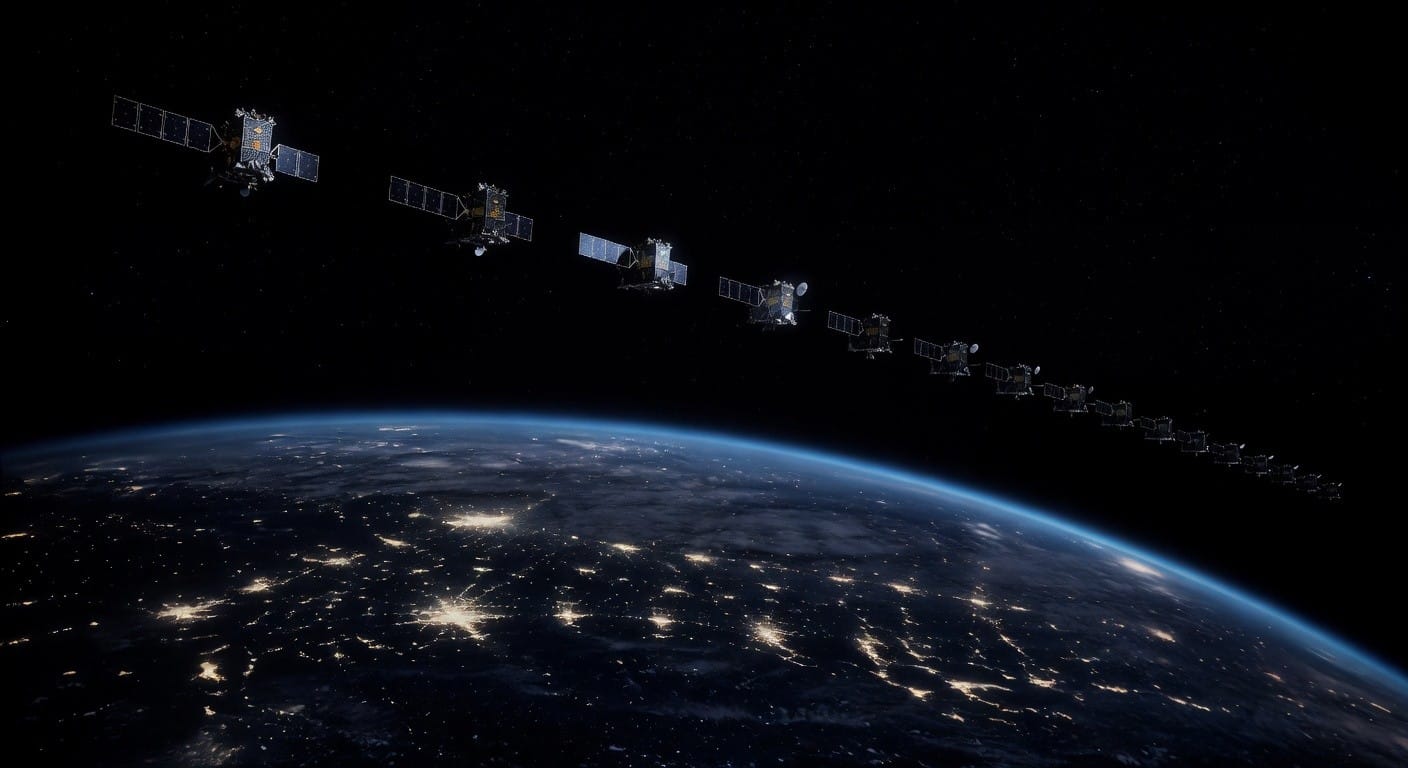
The race to own low Earth orbit is accelerating — and it may be the most consequential infrastructure build-out of the next decade.
In the same week that SpaceX filed confidentially for what could be the largest IPO in US history, Amazon's Project Kuiper deployed its first commercial satellite batch, China's state-backed GuoWang constellation added another 200 satellites, and venture capital poured more than $45 billion into space tech in 2025 alone. The numbers are staggering. But the real story isn't the satellites — it's what they enable, who controls them, and what happens when geopolitical rivals start shooting at each other's infrastructure.
The Economics Are Finally Working
For two decades, the space economy was a government subsidy machine. Satellites were bespoke, expensive, and slow to build. That changed when SpaceX proved reusability could cut launch costs by 90%, when miniaturised electronics made small satellites viable at $500,000 apiece, and when Starlink demonstrated that broadband from orbit could generate real commercial revenue.
The numbers in 2026 are no longer speculative. Starlink is on track for $18.7 billion in revenue this year — a near-80% year-on-year jump. The global space economy hit $626 billion in 2025, with commercial activities accounting for 78% of that total. McKinsey projects a $1.8 trillion market by 2035. For context, that's roughly the current GDP of Canada.
The investment thesis used to rest on moonshots and government contracts. Now it rests on something more compelling: low-latency broadband in markets that cable will never reach, military resilience in a world where adversaries have demonstrated satellite-kill capabilities, and the quiet emergence of orbital compute — using LEO as a platform for AI data processing and relay.
The SpaceX IPO: The Netscape Moment for Space Investing
SpaceX's anticipated mid-2026 IPO at a target valuation of $1.5 trillion or more would do something no previous space listing has managed: give institutional investors direct, liquid exposure to the dominant player in the sector.
It's being called the "Netscape moment" for the space economy — the listing that unlocks a wall of institutional capital that has been unable to participate in the private market. SpaceX is valued at around $800 billion in secondary markets today. Public market appetite, if Starlink's growth trajectory holds, could push that higher.
But the IPO is as much a strategic signal as it is a capital raise. Elon Musk's confirmation that the IPO plans are "accurate" comes at a moment when SpaceX faces intensifying competition from Amazon's Kuiper, Eutelsat OneWeb, and — increasingly — Chinese state-funded constellations that operate outside Western regulatory frameworks.
This is where the analysis gets actionable. AlphaBriefing members get the full investment framework — scenarios, positioning, and the bottom line.
Subscribe to AlphaBriefing — Free, Member, and Paid tiers available.