Everyone Is Fighting Over Electrons. Musk Is Leaving the Planet.
The SPCX deep dive: Starship just reached orbit, the FCC filing asks for a million orbital data centers, and every business under the ticker is a derivative of one number, the price of a kilogram. The money map, the December lockup, the Mars window, and how we would position.

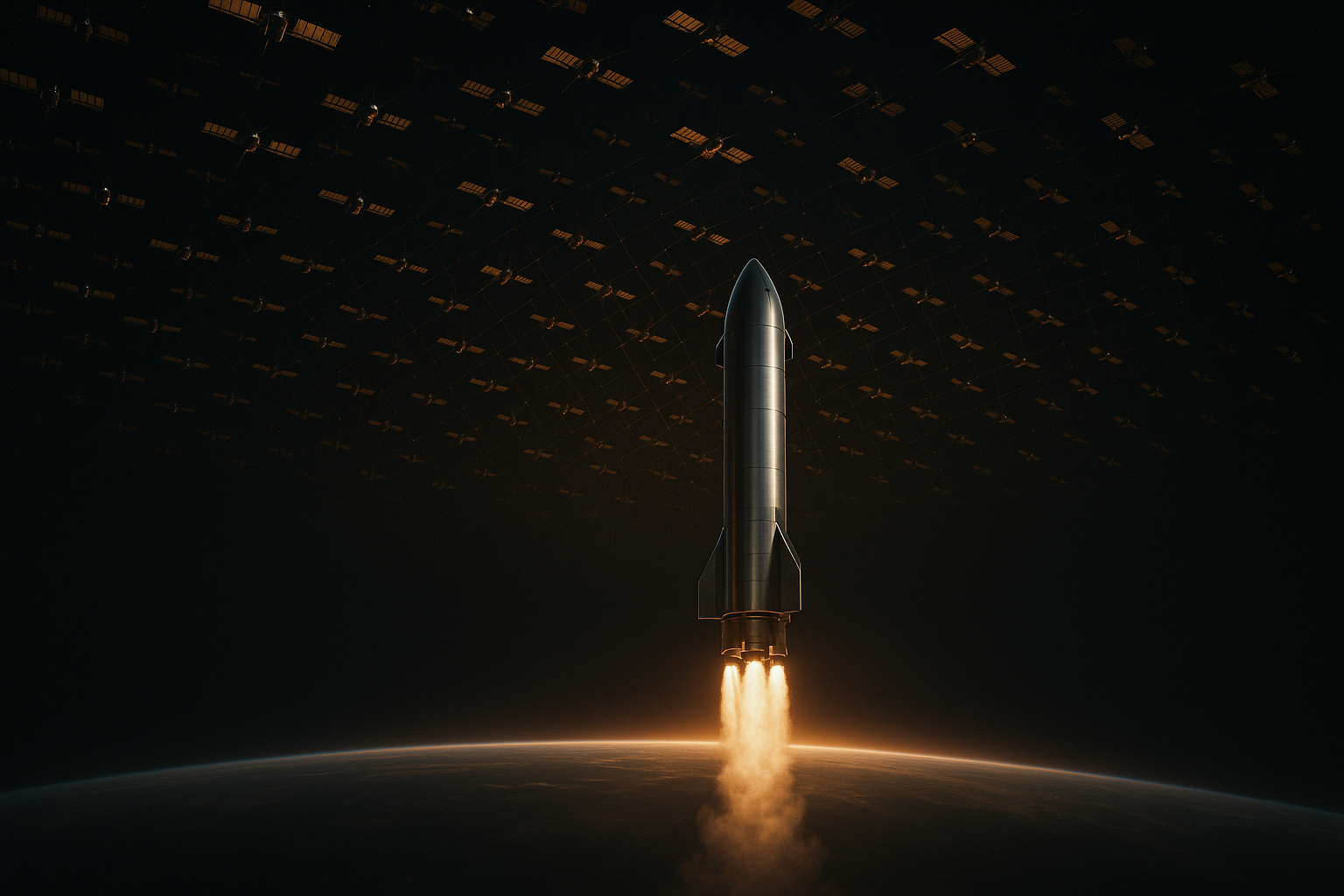
On September 28, on its fourteenth test flight, Starship reached orbit for the first time and released 26 next-generation Starlink V3 satellites, each carrying a terabit per second of capacity. One of the ship's six upper-stage engines failed on the way up. Controllers spent 22 minutes deciding whether to press on, pressed on, deployed the payload, and brought the vehicle home early anyway, splashing it down in the Pacific about three hours after it left South Texas. The clips that circulated were rocket clips. The event was not a rocket event.
Twenty-six terabits of capacity delivered to orbit in one launch is a power and compute story wearing a rocket costume, and it lands weeks after SpaceX filed with the FCC for permission to operate up to one million orbital data center satellites. Read those two sentences together and you have the actual thesis of the most valuable company ever to go public, a thesis almost nobody who owns the stock can articulate.
Last week we published a briefing on the terrestrial AI buildout and argued that electrons are the only honest demand signal in AI, because power consumption cannot be vendor-financed. The entire $725 billion hyperscaler capex wave is, at bottom, a fight over grid interconnections, 20-year power purchase agreements, and land near substations. Every participant in that fight is standing in the same queue.
Elon Musk's answer to the queue is to leave the planet. That is not a metaphor. It is the literal, filed-with-regulators, presented-with-slides capital allocation plan of a company that now trades on Nasdaq under the ticker SPCX, and this briefing is the deep dive into what that company actually is, because it is not what most of its shareholders think they bought.
What SPCX actually is now
Start with the corporate archaeology, because it happened fast and the market has not digested it. In 2025, xAI absorbed X, the platform formerly known as Twitter. In February 2026, SpaceX acquired xAI in an all-stock merger that created a combined entity valued around $1.25 trillion, the largest merger ever recorded. In June, the combined company went public at $135 a share in the largest IPO in history, netting $85.7 billion in proceeds, then added a $25 billion bond two weeks later. As of the end of June it sat on roughly $100 billion of liquidity.
So the ticker SPCX contains three different companies. A launch business that put 78 rockets and 1,041 metric tons into orbit in the first half of this year, the overwhelming majority of all mass humanity sent to space. A satellite utility, Starlink, that ended June with 12 million subscribers, double a year earlier. And a frontier AI lab bolted to a social network, running 1.4 gigawatts of compute, that agreed to buy the coding company Cursor for $60 billion this summer.
The second quarter, the company's first as a public entity, showed what each one is for. Revenue was $7.8 billion, up 92 percent. Connectivity brought in $4.3 billion and earned $1.7 billion in operating income; it is the cash engine, and the only segment that makes money. Space brought in $962 million and lost $542 million; it is the moat under construction. And the AI segment brought in $2.6 billion, up 247 percent, while losing $1.3 billion in operations and consuming $15.8 billion of the quarter's astonishing $18.4 billion in capital expenditure. The AI segment is the furnace, and the whole structure exists to feed it.
The stock closed Friday at $158.96, up about 18 percent from the IPO price and down about 30 percent from its September high of $225.64, with a market value in the neighborhood of two trillion dollars. The pullback has a mechanical explanation we will get to, but it has also created the first genuinely interesting entry debate since the listing.
Here is the single idea that organizes everything else, the one Musk himself keeps repeating while the market keeps hearing something else: every business this company operates is a derivative of one number, the price of putting a kilogram into orbit. Starlink exists because Falcon 9 made satellites cheap to field. Starshield and the Pentagon's Golden Dome money exist because nobody else can launch at rate. The million-satellite compute constellation is economically absurd at today's launch prices and almost boringly obvious at Starship's target prices. Even Mars, which the market treats as a charity line, is just the same number pushed to its limit. SpaceX is not a rocket company that dabbles in other things. It is a machine for driving one variable toward zero, with a portfolio of businesses that each switch on at a different point along the way down.
What follows, for members: the kilogram math behind the orbital data center bet and the honest physics working against it, the three businesses ranked by who funds whom, what exactly has to be true for a two trillion dollar price to make sense, the December lockup that explains the slide from $225, the Mars window that opens next month, the five signposts that will decide the next two quarters, and how we would actually position, with our tracked Watchlist as receipts.
Get the next briefing free in your inbox: Join AlphaBriefing
Behind the paywall: the orbital compute arithmetic and its failure modes, the full three-segment money map, the two trillion dollar valuation test, the December lockup mechanics, Mars as a capex line rather than a dream, five dated signposts, and the positioning, including the one adjacent name the market is mispricing because of SpaceX rather than despite it.
AlphaBriefing Paid gets every intelligence brief, the weekly Top 10, and the live tracked Watchlist.