The $250 Billion Exodus: How Southeast Asia Is Capturing the Manufacturing Future — and Where to Position
A structural reordering of global manufacturing is underway — and the capital flows confirm it. Here's where the real investment opportunity lies, and the risks the bull case ignores.

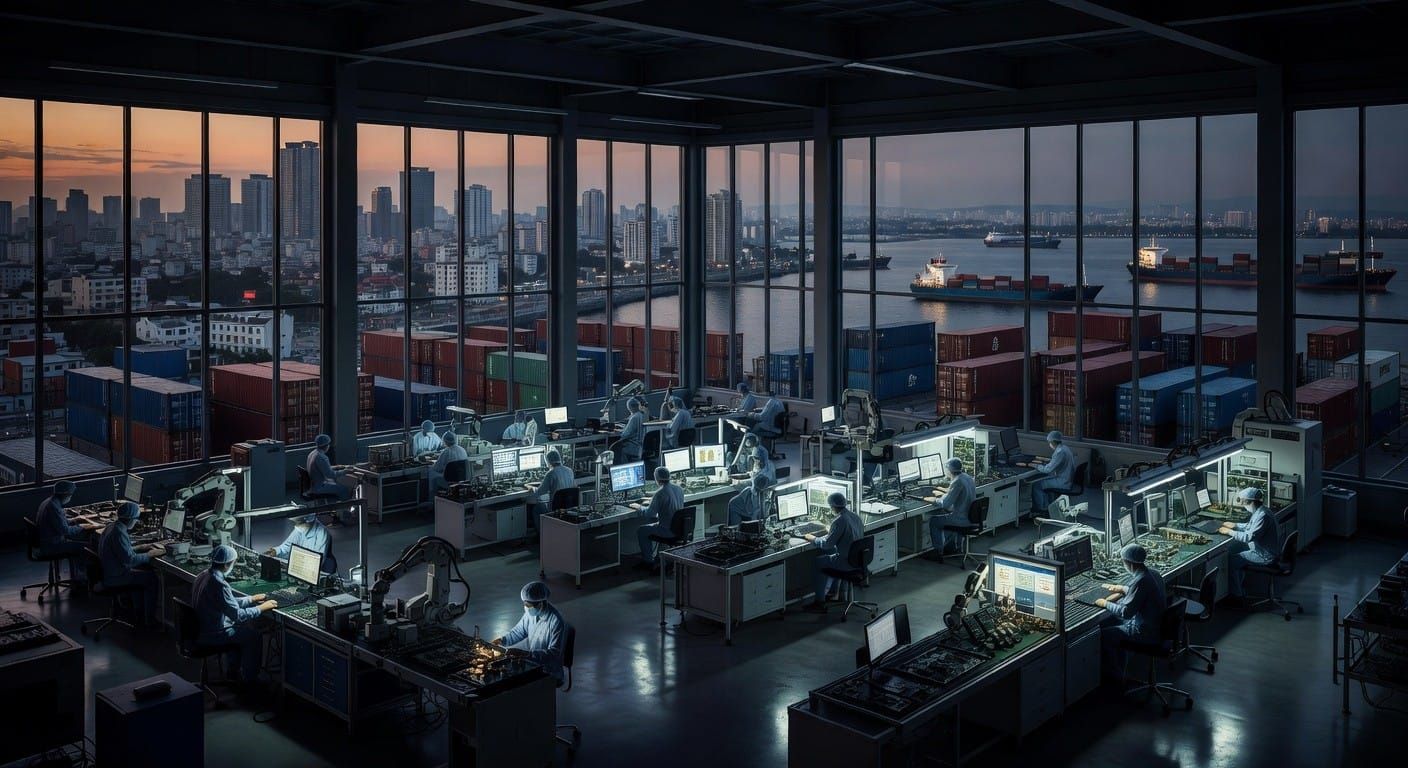
The headlines all say the same thing: the trade war is reshaping global supply chains. But the investment question that actually matters isn't whether manufacturing is leaving China — it's which countries are winning the exodus, and how fast the capital is moving.
The answer, increasingly, points to a cluster of Southeast Asian nations — Vietnam, Thailand, Malaysia, and Indonesia — absorbing the largest redirection of industrial capital in a generation. Between 2019 and 2024, ASEAN economies captured an estimated $220–250 billion in new greenfield manufacturing foreign direct investment linked to the so-called "China Plus One" strategy. Their collective share of global manufacturing FDI has jumped from roughly 11% to 17% in five years. That is not a trend. That is a structural reordering.
And it is accelerating.
The Mechanics of Departure
China Plus One is not a new concept, but the pace and scale of execution have shifted dramatically. What began as a hedge — a second factory in Vietnam to reduce concentration risk — has evolved into a primary strategic directive for multinationals across electronics, automotive, textiles, and increasingly, semiconductors.
The triggers are well-known: U.S. tariffs, COVID-era supply chain shocks, China's rising labor costs, and the dawning recognition among corporate boards that a Taiwan contingency could make existing China exposure existential. What is less understood is the counterintuitive twist: China itself is fueling the shift.
Chinese manufacturers, facing tariff walls on finished goods exported to the U.S., have responded by exporting intermediate components — smartphone parts, battery cells, circuit boards — to Southeast Asian factories for final assembly and re-export. Beijing calls this a sophisticated evolution of its manufacturing ecosystem. Washington calls it tariff circumvention. Both are partly right. The practical effect: ASEAN's export growth is running at roughly twice the global average, with China entrenching itself as "factory to the factories."
Vietnam assembles roughly 20% of the world's smartphones today, up from less than 5% a decade ago. Samsung alone has invested over $20 billion in Vietnamese production capacity. Thailand received a record $42 billion in FDI applications in the first nine months of 2025 — a 94% jump year-over-year — driven in large part by Chinese EV manufacturers and battery suppliers seeking a tariff-insulated export base. Malaysia is expanding semiconductor assembly, testing, and packaging capacity, and now handles more than 20% of global semiconductor backend operations. Indonesia is leveraging its nickel dominance — 22% of global reserves — to build a vertically integrated EV battery supply chain, with Chinese partners providing processing infrastructure in exchange for raw material access.
The Geopolitical Chessboard
None of this is happening in a geopolitical vacuum. Washington is watching the Chinese-capital-in-ASEAN dynamic with deep suspicion, and rightly so. The core concern: are these factories genuinely diversifying supply chains, or merely adding a ASEAN label to Chinese production and routing it around tariffs?
The answer varies by country and sector, and navigating that distinction is where the real investment risk concentrates.
Vietnam has benefited enormously from the trade war but faces a peculiar vulnerability: its trade surplus with the United States — now approaching $120 billion annually — has placed it squarely in the sights of U.S. trade officials. Washington has repeatedly threatened Vietnam with its own tariff regime if it cannot demonstrate sufficient "substantial transformation" of goods before export. Hanoi is acutely aware of this and has been scrambling to attract higher-value manufacturing — semiconductor design, advanced electronics, precision components — that would pass scrutiny. The political balancing act is precarious: Vietnam cannot afford to antagonize Beijing, its largest trading partner, while simultaneously trying to satisfy Washington's origin requirements.
Thailand's position is arguably more durable. Bangkok has positioned itself as a neutral hub, welcoming capital from both Chinese EV manufacturers and Western automotive players. Its Board of Investment has restructured incentives around "smart industries" — AI integration, precision engineering, high-value chemicals — that are harder to dismiss as simple transshipment. The EV pivot is particularly significant: Thailand aims to convert 30% of its automotive production to electric vehicles by 2030, supported by over $20 billion in approved investments, many from BYD, Great Wall Motor, and CATL.
Malaysia is playing a different game. Kuala Lumpur has deliberately positioned itself as the Southeast Asian node for Western semiconductor firms seeking China-free supply chains. TSMC's packaging expansion in Penang, Intel's long-standing Penang facility, and growing interest from European chipmakers reflect a calculated bet on Malaysia's combination of technical infrastructure, English-speaking workforce, and political stability. Crucially, Malaysia has avoided the overt Chinese capital concentration that makes Thailand and Vietnam politically sensitive in Washington.
This is where the analysis gets actionable. AlphaBriefing members get the full investment framework — which markets, which sectors, which names, and the bottom line positioning.
Subscribe to AlphaBriefing — Free, Member, and Paid tiers available.