The Minerals War: How China Turned Rare Earths Into a Geopolitical Weapon
Beijing controls 90%+ of rare earth processing and has deployed targeted export controls on the minerals inside every F-35, EV motor, and 5G chip. This is not an economic dispute. It is a minerals war — and it has already begun.

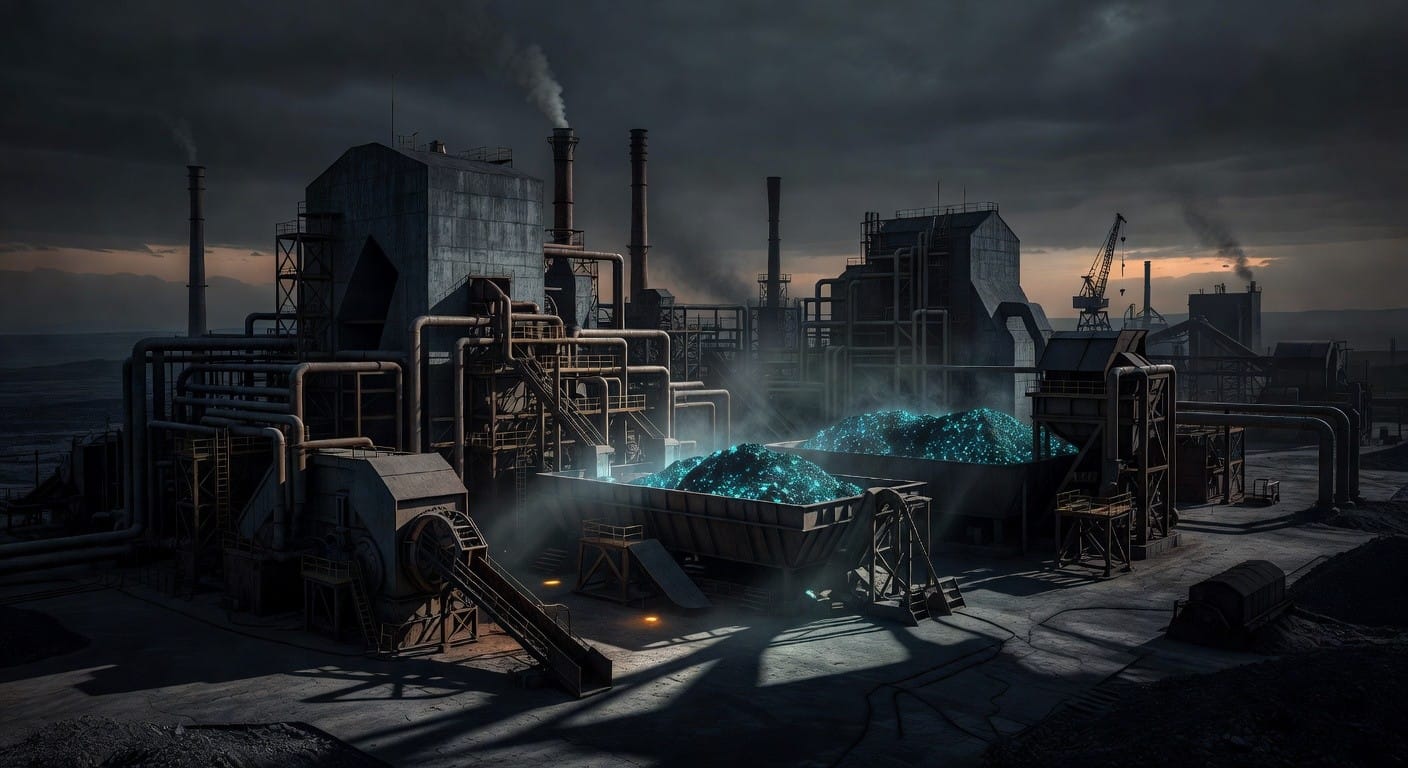
China has found a weapon it doesn't need to fire. Since April 2025, Beijing has deployed a series of increasingly targeted export controls on rare earth elements — the obscure minerals that sit at the heart of nearly every critical technology on earth. The result: a slow-motion embargo on the building blocks of American military power, European green energy, and global semiconductor supply chains.
This isn't about economics. It's about leverage.
The Chokepoint No One Wanted to Talk About
Rare earth elements — a group of 17 metals including dysprosium, terbium, yttrium, and neodymium — aren't particularly rare in the ground. They're rare where it matters: in processed, usable form, outside of China. Beijing controls over 90% of global refining capacity. For certain heavy rare earths critical to defence applications, that figure approaches 100%.
The April 2025 controls targeted seven heavy REEs along with permanent magnets. Then came October's Announcement No. 61 — the most aggressive move yet, applying extraterritorial jurisdiction to foreign-made products that contain even trace amounts of Chinese REE inputs or were produced with Chinese technology. Military end-uses — including the F-35 programme, submarine construction, and precision-guided munitions — have been largely denied export licences.
A nominal truce struck in November 2025 suspended the broadest controls through late 2026. But the targeted restrictions never stopped. Yttrium shipments to the US are down 95%, with prices up 6,900%. Scandium — essential for 5G infrastructure and high-performance aerospace alloys — has no viable Western substitute. In January 2026, China extended the campaign to Japanese firms, disrupting automotive production lines that had nothing to do with defence.
A high-level policy briefing in Beijing tomorrow — March 25 — will address compliance with dual-use export controls, US trade outlook, and minerals including tungsten and antimony. The timing, the day after markets close for the week, is deliberate.
What This Actually Means
The framing from Beijing is "legitimate national security measures." The reality, as analysts at the Asia Financial Review have put it, is economic warfare via chokepoints — waged precisely because it's deniable, gradualist, and devastatingly effective.
The US defence industrial base is the most exposed. The F-35 programme requires dysprosium and terbium for its electric actuators. Virginia-class submarines use REE alloys in sonar systems. Hypersonic missiles require scandium-aluminium alloys. None of these supply chains can be easily rerouted in the short term — the processing infrastructure simply doesn't exist outside China at sufficient scale.
Europe is equally vulnerable, with 98% magnet dependence on Chinese supply. The EU's REE import costs have risen sixfold. Electric vehicle production delays are already filtering into Q1 2026 earnings guidance from several major OEMs.
This is where the analysis gets actionable. AlphaBriefing members get the full investment framework — scenarios, positioning, and the bottom line.
Subscribe to AlphaBriefing — Free, Member, and Paid tiers available.