San Francisco Tried to Buy Its Grid. PG&E Sent Back a $22.5 Billion Invoice.
PG&E says San Francisco would owe $22.5 billion to take over its own grid — more than six times the city's estimate. The gap is really an exit fee, and the ruling on it will decide whether any American city can afford to leave its utility.

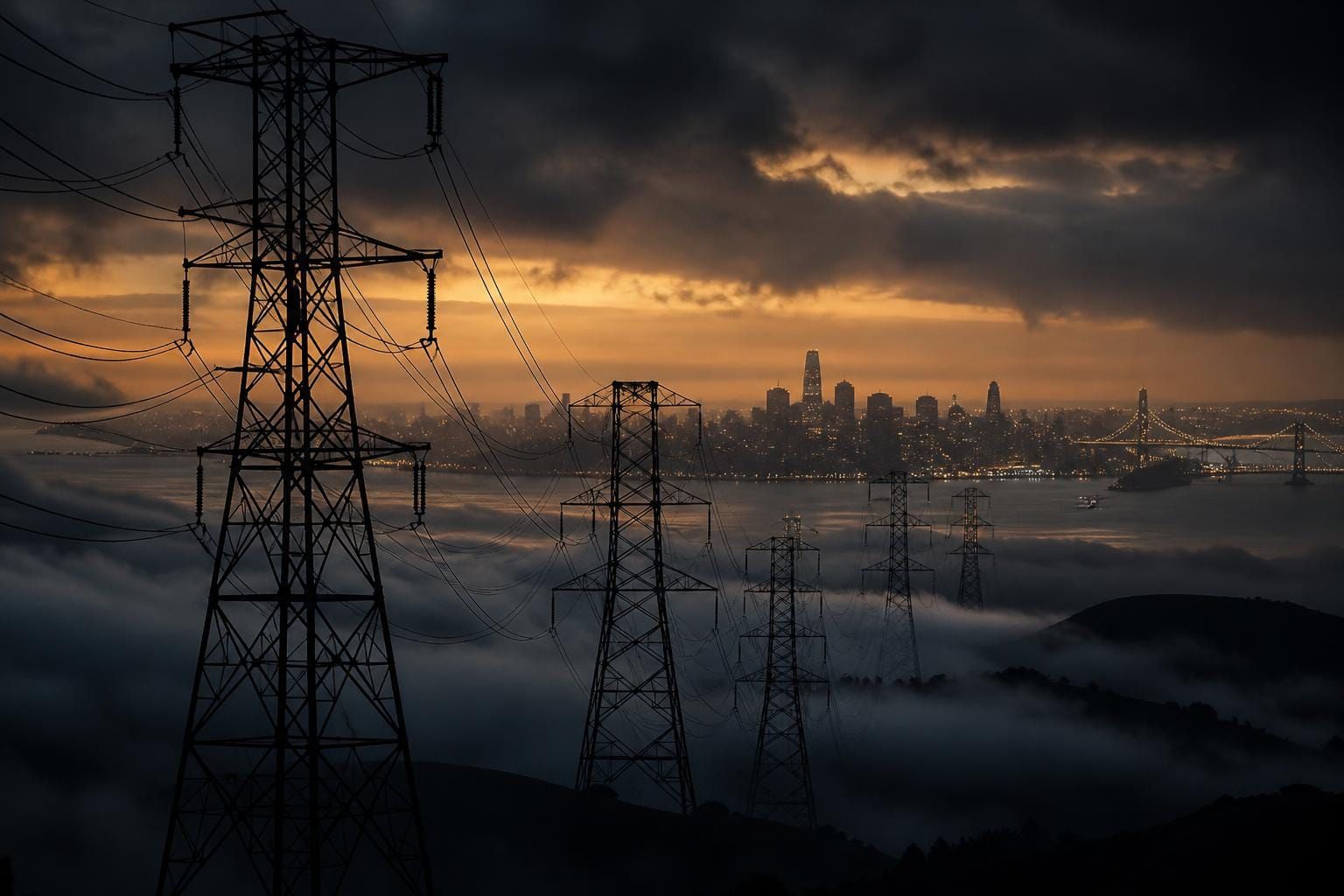
San Francisco has spent a century trying to buy its electric grid. On Tuesday, PG&E finally sent the city an itemized invoice: $22.5 billion.
That number arrived at the California Public Utilities Commission on October 20 inside a 1,164-page filing — ten chapters of testimony from 22 witnesses, a nearly 400-page real estate appraisal, an asset-by-asset depreciation study, and an engineering report on what it would take to physically carve San Francisco out of PG&E's statewide network. The city's own valuation of the same wires, substations, and poles, filed in April: roughly $3.4 billion.
That is not a negotiating gap. It is a 6.6x disagreement about what a city's grid is worth — and buried inside it is a question that matters far beyond San Francisco: can any American city afford to leave its utility?
How a humid substation started a $22.5 billion fight
The current takeover push did not come from ideology. It came from the dark.
On December 20 of last year, a failure at a PG&E substation blacked out roughly a third of San Francisco; some residents waited days for power to return. Investigators later pointed to humidity inside substation equipment as the likely trigger — moisture, in one of the world's wealthiest and most technology-dense cities, took down the grid. Since then the city has logged some 40 smaller outages, enough that officials formally demanded a state investigation into PG&E's local reliability earlier this month.
City Hall's response went beyond complaint letters. San Francisco revived its long-standing ambition to buy PG&E's assets within city limits and run power as a public utility — something it already does for a slice of customers through programs fed by its Hetch Hetchy hydropower system. In Sacramento, State Senator Scott Wiener went further, unveiling a bill in February aimed at breaking up PG&E itself.
PG&E's filing this week is the utility's formal answer, and its message is blunt. "A government takeover of our grid is not the right solution for our San Francisco customers," CEO Patti Poppe said in a statement accompanying the filing. The company's president, Carla Peterman, described the city's plan as "tantamount to carving a hole in the middle of PG&E's integrated grid."
Briefings like this are free to read with a free AlphaBriefing membership. Join free →
Where the $19 billion gap comes from
The two sides are not pricing the same thing. Break the $22.5 billion down and the dispute falls into two buckets.
The hardware: $3.4 billion vs. $13.9 billion. The city values PG&E's in-city distribution assets at about $3.4 billion. PG&E's appraisal says $13.9 billion — roughly four times more. The utility's arguments: San Francisco assigned zero value to more than 2,000 easements, licenses, and land-use rights (worth over $1.7 billion, by PG&E's math), and lowballed replacement costs. The sharpest example is underground conduit — the protective piping that carries power cables beneath the streets. The city priced it at about $247 per foot; PG&E says comparable Bay Area projects have run close to $1,000 per foot. Because valuations lean heavily on replacement cost, that single assumption moves billions.
The exit fee: $8.6 billion. This is the more consequential number, because it has little to do with San Francisco's wires. PG&E argues a takeover would inflict $8.6 billion in damages on the company — about $1 billion to physically separate the city's grid (including replacing the Martin Substation in Daly City, which also serves customers outside the city, with a new facility likely in San Mateo County), and $7.6 billion in what it calls "business severance."
The severance logic is worth understanding, because it is the template every other utility in America will reach for. PG&E is required to keep rates roughly uniform across its service territory, which means its 400,000 dense, urban, relatively cheap-to-serve San Francisco customers help subsidize wildfire mitigation and grid hardening for expensive rural territory. Take the city out of the pool, PG&E argues, and those fixed costs land on everyone left behind — so San Francisco should pay to make the rest of the system whole on its way out the door.
City officials have already rehearsed their answer. When PG&E floated a $20 billion figure earlier in October, they called it "absurd," noting it exceeds San Francisco's entire annual budget. The city's public-power advocates say the purchase would be financed with revenue bonds repaid from electric bills — no tax dollars — which only works if the price stays somewhere near the city's number, not PG&E's.
A century of losing this fight
Skepticism about San Francisco's odds is well earned. The city has tried some version of this at least ten times: eight failed bond measures between 1927 and 1941, two failed ballot measures in 2001, and — most tellingly — a $2.5 billion cash offer for the grid in 2019, made while PG&E was in Chapter 11 bankruptcy under the weight of its wildfire liabilities. PG&E said no even then, when it needed the money.
Other cities have walked this road and turned back. Boulder, Colorado spent roughly a decade pursuing a municipal takeover of its local grid before voters opted for a new franchise agreement with the incumbent utility in 2020. The pattern is consistent: the legal process is slow, the valuation fight is existential, and the utility can outlast almost any city council.
The process ahead for San Francisco runs through the CPUC, which values the assets, and then — absent a negotiated deal — through eminent domain: a two-thirds vote of the Board of Supervisors, followed by a court fight in which the city must prove necessity and pay fair market value, with PG&E contesting every finding. Measured in years, not quarters.
Why this fight matters beyond San Francisco
Three reasons this is more than a local spat.
First, the timing. America's grid is the binding constraint of the decade — data centers, electrification, and reshored industry are all queuing for interconnection, and utility capital spending is exploding. Who owns and controls distribution infrastructure in major cities is becoming a live political question exactly as that infrastructure becomes scarce and expensive. San Francisco is the test case with the most money and the most grievance.
Second, the precedent. The CPUC has to decide not just what PG&E's hardware is worth, but whether "business severance" — the $7.6 billion exit fee — is a legitimate component of a municipalization price. If regulators bless it, every city's public-power ambition in California effectively dies, because no city can afford to buy its grid and indemnify the utility's remaining business. If they reject or slash it, the roadmap is suddenly open — for San Francisco, San Jose, Oakland, and any other city sitting on a frayed PG&E relationship.
Third, the investor read. PG&E's parent, PCG, closed Friday at $12.63 — still trading at a steep discount to the quality utilities, in part because California keeps finding new ways to threaten its business model. A credible forced-sale process at city-friendly valuations would be a new category of risk for every investor-owned utility with an unhappy urban core. A CPUC endorsement of PG&E's framework would do the opposite: it would put a regulatory price floor under the company's most valuable territory. Either way, the valuation methodology that comes out of this case will be read in utility boardrooms far beyond California.
The likeliest near-term outcome is the familiar one: years of proceedings, a number somewhere in the middle that is still too big for the city, and PG&E keeping its grid. But the December blackout changed the politics, the filing changed the stakes, and for the first time in a century, the fight is happening in front of a regulator with the power to set a binding price. San Francisco has always wanted its grid back. Now we find out what "back" actually costs.
If this analysis was useful, this is what AlphaBriefing does every day — geopolitics, markets, and infrastructure, connected to what they mean for your money. A free membership gets you access to every free article at AlphaBriefing.com; paid members get the investment frameworks, scenario pricing, and catalyst calendars behind the paywall. Join AlphaBriefing → — free, member, and paid tiers available.
Sources & Further Reading
- The San Francisco Standard — PG&E outlines its $22.5B price tag for a public power takeover
- The San Francisco Standard — 'Absurd': City officials laugh off PG&E's $20B price tag for San Francisco's grid
- The San Francisco Standard — San Francisco demands state probe of 40 PG&E outages
- The San Francisco Standard — PG&E vs. SF: Why the next few weeks matter for a public power takeover
- KQED — San Francisco Offers to Buy PG&E Electric Grid in the City for $2.5 Billion (2019)
- SPUR — Propositions F and I: Public Power (2001 voter guide)
Disclaimer
AlphaBriefing is an independent intelligence publication. The content in this article is produced for informational and educational purposes only. Nothing published by AlphaBriefing constitutes financial, investment, legal, tax, or regulatory advice, nor should it be construed as a solicitation or recommendation to buy, sell, or hold any security, asset, or financial instrument.
All views expressed are those of the author at the time of writing and are subject to change without notice. Markets are volatile and unpredictable; past performance is not indicative of future results. Any investment involves risk, including the possible loss of principal.
AlphaBriefing and its principals, employees, or contributors may hold positions in securities or assets mentioned in this article. This should be considered a potential conflict of interest. No material relationship with any company referenced exists unless explicitly disclosed. Readers should conduct their own due diligence and consult qualified financial, legal, and tax advisors before making any investment decisions.
Information in this article is drawn from public sources believed to be reliable at the time of publication. AlphaBriefing makes no warranty, express or implied, as to the accuracy, completeness, or timeliness of any information herein. AlphaBriefing accepts no liability for any loss or damage arising from reliance on this content.
© AlphaBriefing. All rights reserved. Unauthorised reproduction or distribution is prohibited.