One Year of Liberation Day: What the Tariff War Actually Did to the World

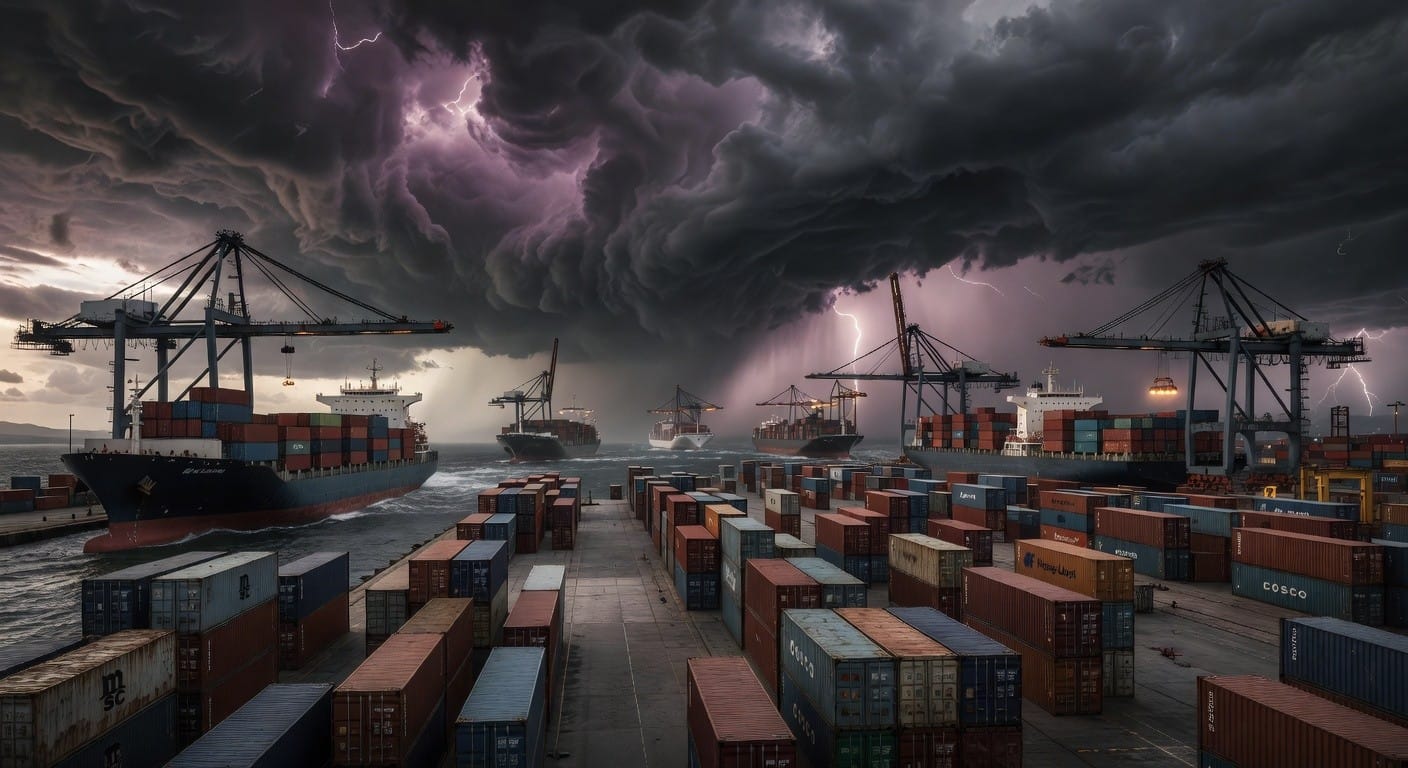
One year ago this week, the world changed.
On April 2, 2025, President Trump stood in the White House Rose Garden and declared "Liberation Day" — announcing the most sweeping tariff regime the United States had imposed since the Smoot-Hawley Act of 1930. It was framed as a declaration of economic independence. Critics called it a declaration of economic war. Twelve months later, the evidence is in — and the picture is more complicated, more consequential, and more instructive than either side wants to admit.
This is the story of what really happened, what it cost, and what comes next.
The Shock That Moved Markets
The numbers from April 2025 are worth revisiting.
Trump announced a universal 10% tariff on nearly all imports, effective within days. On top of that came "reciprocal" tariffs targeting specific trade partners: 54% on China (combined), 20% on the EU, 24% on Japan. Global markets went into freefall. The VIX — Wall Street's fear gauge — spiked to crisis levels. The S&P 500 dropped several percent in the days following the announcement before a partial pause on April 9 allowed a partial rebound.
The move was legally audacious. Trump invoked the International Emergency Economic Powers Act (IEEPA), declaring a national trade emergency to justify unilateral action at a scale Congress had never explicitly authorized. Legal challenges were immediate and numerous.
The Supreme Court ultimately ruled 6-3 in February 2026 that IEEPA doesn't authorize tariffs of this breadth — striking down major portions of the Liberation Day regime. Trump responded by pivoting to Section 122 authority, imposing a fresh 10% tariff on roughly $1.2 trillion in imports under a framework with a 150-day clock.
In other words: one year on, the tariff war is still live.
The Scoreboard: What the Data Actually Shows
The debate over Liberation Day has been dominated by partisan noise. Here's what the data says:
On the US economy:
The short-term damage was measurable. US GDP took a hit of roughly 0.8–1% in 2025. Consumer prices rose. Real wages declined in inflation-adjusted terms. Manufacturing employment, despite the promise of reshoring, actually fell — the sector lost an estimated 89,000 jobs as input cost increases outpaced any production gains.
The trade deficit — the original target of the whole exercise — barely moved. Economists have long argued that deficits are driven by macroeconomic factors (savings rates, investment flows), not by tariff rates. The data bore this out. The Council on Foreign Relations noted the frustrating circularity: tariffs raised the cost of inputs, which raised the cost of American goods, which undermined the competitiveness they were supposed to restore.
On global trade:
Despite dire warnings of a 1930s-style trade collapse, global trade volumes held up better than feared — partly because deals and exemptions proliferated, partly because supply chains are more adaptive than economists model. The weighted average US tariff rate, after the Supreme Court ruling, dropped back toward 6.7%. Trade didn't die. It rerouted.
On inflation:
This is where the pain lingered. PCE inflation ran 1–1.5 percentage points hotter than it would have otherwise. Auto prices jumped roughly 11%. Agricultural input costs — fertilizer, chemicals — spiked. Central banks, already navigating a post-pandemic normalization, were forced to hold rates higher for longer. Rate cuts expected in late 2025 were delayed into 2026 across multiple economies.
The Winners Nobody Talks About
Every trade war creates losers — but it also creates winners. Liberation Day was no different.
Mexico emerged as a significant beneficiary. Caught somewhat outside the highest tariff brackets and positioned as a near-shore alternative to China, Mexico saw a surge in manufacturing investment. US companies — particularly in electronics, auto parts, and consumer goods — accelerated plans to relocate or expand production there. It's one reason AlphaBriefing has been watching the US-Mexico manufacturing corridor so closely.
European and Asian defense industries benefited indirectly. The tariff shock accelerated the erosion of trust in American economic leadership. European allies — already alarmed by signals of US strategic withdrawal from NATO — used the trade friction as further justification for accelerating their own defense industrial buildup. That capital formation is now well underway, with the EU's ReArm Europe / Readiness 2030 plan mobilizing over €800 billion through 2030.
Commodity producers had a mixed but broadly positive year. Oil revenues were supported by elevated prices. LNG exporters captured new market share as global energy supply chains scrambled to diversify away from chokepoints. Gold surged as a safe-haven asset amid the uncertainty.
What Changes the Calculation: The Iran Variable
Here's the overlay that makes 2026's trade picture dramatically different from 2025's: the US-Iran conflict.
The Strait of Hormuz — through which roughly 20% of the world's oil and a significant share of LNG transits — has been severely disrupted. Brent crude has surged toward $120/barrel. Shipping costs are elevated. Supply chain diversification, already underway due to tariff pressures, is now being accelerated by genuine kinetic risk to major trade routes.
This convergence matters: the tariff regime created incentives to restructure global supply chains. The Middle East conflict is adding urgency to that restructuring. Companies that were debating whether to invest in supply chain resilience are no longer debating.
The firms building the infrastructure for that resilience — logistics, near-shoring, energy security — are quietly becoming some of the most interesting investments of the decade.
The One-Year Verdict
Liberation Day was neither the revolution its proponents promised nor the catastrophe its critics predicted.
What it was: a structural shock that permanently altered the incentive landscape for global trade. The tariffs as originally constructed have been largely struck down by the courts — but the signal they sent is irreversible. The era of frictionless globalization is over. Supply chains are being rebuilt with resilience as the primary objective, not efficiency. That process is slow, expensive, and ongoing.
For investors, the lesson is that the disruption itself — the restructuring, the reshoring, the rerouting — is where the money is. Not in predicting whether tariffs go up or down, but in identifying who benefits from a world where global trade operates at higher friction.
That's the trade of the decade. And it's just getting started.
Get this level of intelligence every day. Subscribe to AlphaBriefing — free, member, and paid tiers available.
Sources & Further Reading
- Wikipedia — Liberation Day Tariffs
- CSIS — Liberation Day Tariffs Explained
- Tax Foundation — Supreme Court IEEPA Tariff Ruling
- Washington Post — One Year of Liberation Day Tariffs (March 29, 2026)
- American Progress — One Year After Liberation Day: Workers Feel the Impact
- Council on Foreign Relations — What Trump Trade Policy Has Achieved
- DW — How Liberation Day Tariffs Reshaped Global Trade
- S&P Global — Geopolitical Risk Brief, March 2026
Disclaimer
AlphaBriefing is an independent intelligence publication. The content in this article is produced for informational and educational purposes only. Nothing published by AlphaBriefing constitutes financial, investment, legal, tax, or regulatory advice, nor should it be construed as a solicitation or recommendation to buy, sell, or hold any security, asset, or financial instrument.
All views expressed are those of the author at the time of writing and are subject to change without notice. Markets are volatile and unpredictable; past performance is not indicative of future results. Any investment involves risk, including the possible loss of principal.
AlphaBriefing and its principals, employees, or contributors may hold positions in securities or assets mentioned in this article. This should be considered a potential conflict of interest. No material relationship with any company referenced exists unless explicitly disclosed. Readers should conduct their own due diligence and consult qualified financial, legal, and tax advisors before making any investment decisions.
Information in this article is drawn from public sources believed to be reliable at the time of publication. AlphaBriefing makes no warranty, express or implied, as to the accuracy, completeness, or timeliness of any information herein. AlphaBriefing accepts no liability for any loss or damage arising from reliance on this content.
© AlphaBriefing. All rights reserved. Unauthorized reproduction or distribution is prohibited.