Kim's Nuclear Navy: The Most Dangerous Arms Race Nobody Is Watching

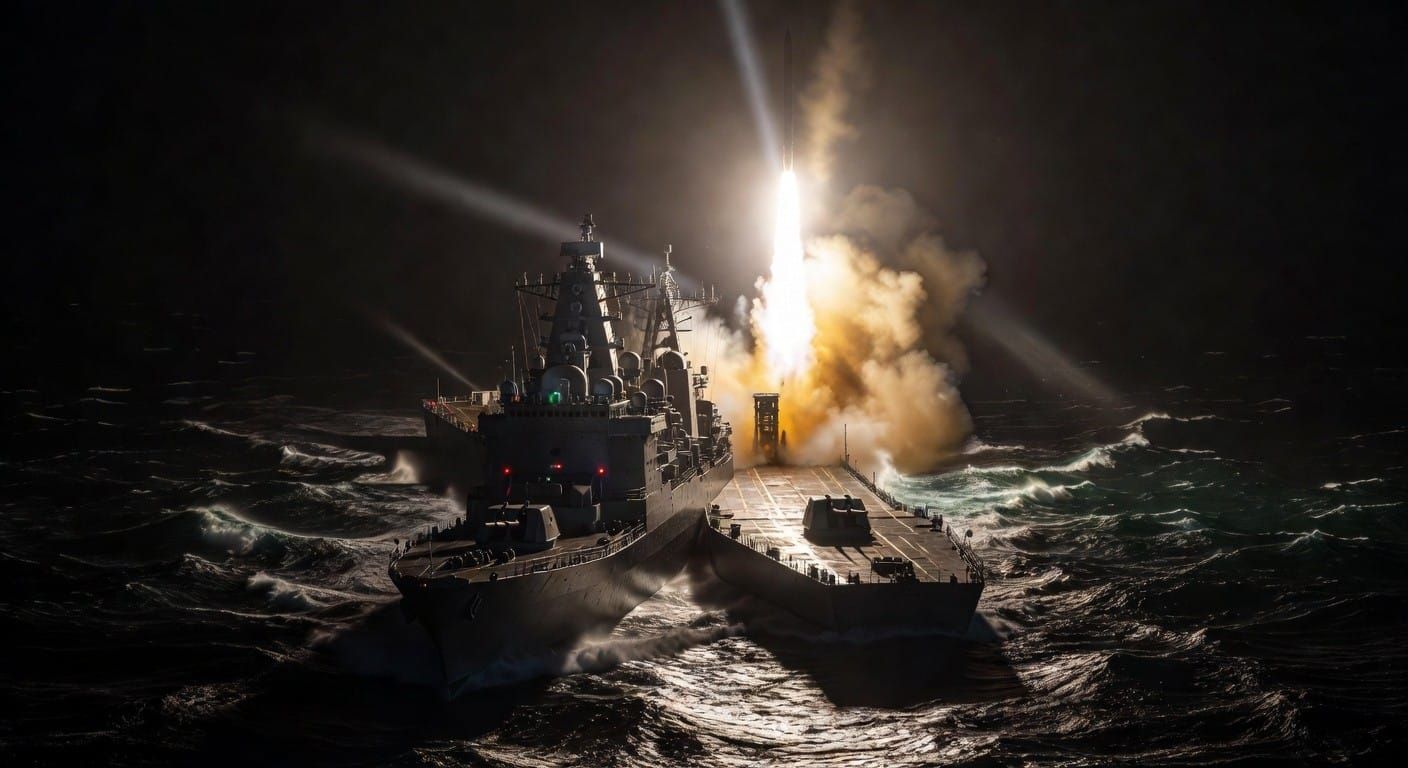
Kim Jong Un stood on the pier at Nampo Shipyard and watched missiles arc from his newest warship into the sea. The date was April 13, 2026. Two strategic cruise missiles flew for over two hours. Three anti-ship missiles hit maritime targets with, in Pyongyang's words, "ultra-precision accuracy."
It was not the first time Kim had watched the Choe Hyon shoot. It will not be the last.
What is unfolding on North Korea's western coast is something analysts have been quietly tracking for over a year: the systematic transformation of the Korean People's Navy from a coastal defense force into a nuclear-capable blue-water strike arm. The world's attention is fixed on Iran and the Hormuz blockade. Almost nobody is talking about what Kim Jong Un is building in the Yellow Sea — and why it matters far beyond the Korean Peninsula.
The Ship That Changes the Equation
The Choe Hyon is not the rusty coastal corvette of Cold War-era Pyongyang. It is a 5,000-ton destroyer — roughly 144 meters long — designed from the keel up for one purpose: to carry and launch nuclear-capable missiles from the sea.
North Korean state media, confirmed by South Korean defense analysts and open-source satellite imagery, indicates the vessel is fitted with vertical launch systems capable of accommodating both cruise and ballistic missiles. CSIS analysts have assessed it as "the centerpiece of a nascent blue-water ambition." 38 North, the leading open-source monitor of North Korean military programs, has flagged its missile density as a doctrinal shift: Pyongyang is no longer content to threaten the peninsula from land. It wants a sea-based leg to its deterrent.
The Choe Hyon was first unveiled in April 2025. A second ship of the same class, the Kang Kon, was damaged during a botched launch in mid-2025 — prompting what state media described as a "furious" response from Kim — before being relaunched following repairs. A third destroyer is under construction at Nampo and is expected to be operationally ready by October 2026.
Kim has ordered his shipbuilders to produce at least two such destroyers — or larger vessels — per year through the end of the current five-year plan in 2030. The math: 10 to 12 nuclear-armed surface combatants within four years.
Russia's Fingerprints
The Choe Hyon did not emerge from a vacuum. South Korean and Western defense analysts have noted Russian design influences on the hull and weapons systems, including what appear to be Russian-origin anti-submarine missiles in imagery released by Pyongyang. North Korea sent over 10,000 troops and hundreds of thousands of artillery shells to support Russia's war in Ukraine; what it received in return is only beginning to come into focus.
The technology transfer thesis is not confirmed by either Moscow or Pyongyang, but the evidence trail is persuasive. North Korea's sudden leap in naval capability — from coastal patrol boats to a capable guided missile destroyer in under three years — is difficult to explain without external technical assistance at scale. The Russia-North Korea military relationship, once a Cold War relic, has become one of the most consequential bilateral defense partnerships on the planet.
Why the World Isn't Paying Attention — and Why It Should
The distraction problem is real. Every intelligence analyst's bandwidth is currently consumed by the Hormuz crisis, the fragile US-Iran ceasefire, and the broader Middle East disruption. North Korea's nuclear naval program is getting a fraction of the scrutiny it warrants.
This is a strategic error.
Here's why the Choe Hyon program matters beyond Pyongyang's usual saber-rattling:
1. It complicates US carrier group strategy. The fundamental US deterrence architecture in the Pacific is built around carrier strike groups. A credible sea-based North Korean nuclear strike capability — even an emerging one — forces American planners to reconsider how carrier groups operate within range of North Korean naval forces. Every destroyer Kim commissions moves the deterrence calculus.
2. It accelerates Japan and South Korea's rearmament. Tokyo and Seoul are already in the middle of the most significant defense buildups in decades. Japan's defense budget is on track to hit 2% of GDP; South Korea is developing its own destroyer program and next-generation submarine fleet. North Korea's naval nuclear ambitions will add fuel to both programs, and generate significant procurement spending in both countries.
3. It changes the Taiwan calculus. A North Korean naval threat in the Yellow Sea ties down US and allied assets that would otherwise be available for a Taiwan contingency. This is not an accident. Kim's deepened partnership with Russia — and Russia's partnership with China — creates a strategic triangle that benefits all three parties in ways that haven't been fully analyzed in Western capitals.
4. It tests the US extended deterrence commitment. Every North Korean nuclear capability advance is also a test of whether the US will actually use its nuclear umbrella to protect Seoul and Tokyo. As Kim's options multiply, the credibility question intensifies.
The Investment Signal Everyone Is Missing
The North Korean naval nuclear program is not, on its own, a direct investment catalyst. But it is a leading indicator for three investment themes that are already playing out and will accelerate.
Asian defense spending is entering a structural upswing. Japan's Mitsubishi Heavy Industries, IHI Corporation, Kawasaki Heavy Industries, and Hanwha Ocean (formerly Daewoo Shipbuilding) in South Korea are all direct beneficiaries of the regional defense buildups that North Korea's provocation is fueling. These are not speculative plays — they are companies already winning government contracts that are only getting larger.
US naval and missile defense stocks have a sustained tailwind. Every North Korean missile test is, at some level, an advertisement for Raytheon's Standard Missile program, Lockheed Martin's THAAD system, and Northrop Grumman's at-sea kill chain capabilities. Japan has committed to deploying Tomahawk cruise missiles — purchased from the US — specifically to deter North Korean and Chinese naval threats. The procurement pipeline is real and long.
Regional risk premiums are underpriced. Markets have largely ignored the North Korean naval escalation cycle because North Korea has been escalating for decades without triggering war. But the strategic environment has materially changed: Pyongyang has nuclear warheads, intercontinental ballistic missiles, and is now building a sea-based delivery system, all while embedded in a military partnership with a Russia that is actively at war and a China that is watching carefully. The risk premium for Korean Peninsula destabilization should be higher than it currently is.
What Happens Next
The third Choe Hyon-class destroyer is expected to be commissioned in October 2026. Kim has reviewed plans for the fourth. He has pledged "limitless expansion" of North Korea's nuclear forces. He is not bluffing about the naval dimension — the ships are in the water.
The short-term question is whether the US, distracted by Hormuz, will have the bandwidth to update its deterrence posture before North Korea's naval nuclear capability becomes operationally meaningful. The medium-term question is how Japan and South Korea calibrate their responses — and whether those responses include capabilities that further destabilize the regional balance.
The long-term question is the one nobody wants to ask: what does it mean for Pacific security when a hermit kingdom with a GDP smaller than Vermont's has a functioning nuclear navy?
Kim Jong Un knows the answer. The rest of the world is still looking at the Strait of Hormuz.
Get this level of intelligence every day. Subscribe to AlphaBriefing — free, member, and paid tiers available.
Sources & Further Reading
- AP News — North Korea's Kim Jong Un oversees missile tests from new warship
- Reuters — North Korea tests cruise and anti-ship missiles from naval destroyer
- Army Recognition — North Korea Plans 12 Nuclear-Armed Destroyers by 2030
- Naval News — North Korea's New Destroyer Sets Sail, Tests Missile Systems
- USNI News — North Korea Guided Missile Destroyer Choe Hyon: Could Be Armed with Nuclear Weapons
- France24 — Kim Jong Un inspects new destroyer and pledges naval nuclear expansion
- 38 North / NK Insider — North Korea extends strategic nuclearization to its navy
Disclaimer
AlphaBriefing is an independent intelligence publication. The content in this article is produced for informational and educational purposes only. Nothing published by AlphaBriefing constitutes financial, investment, legal, tax, or regulatory advice, nor should it be construed as a solicitation or recommendation to buy, sell, or hold any security, asset, or financial instrument.
All views expressed are those of the author at the time of writing and are subject to change without notice. Markets are volatile and unpredictable; past performance is not indicative of future results. Any investment involves risk, including the possible loss of principal.
AlphaBriefing and its principals, employees, or contributors may hold positions in securities or assets mentioned in this article. This should be considered a potential conflict of interest. No material relationship with any company referenced exists unless explicitly disclosed. Readers should conduct their own due diligence and consult qualified financial, legal, and tax advisors before making any investment decisions.
Information in this article is drawn from public sources believed to be reliable at the time of publication. AlphaBriefing makes no warranty, express or implied, as to the accuracy, completeness, or timeliness of any information herein. AlphaBriefing accepts no liability for any loss or damage arising from reliance on this content.
© AlphaBriefing. All rights reserved. Unauthorised reproduction or distribution is prohibited.