America Can't Build Enough Submarines. The Navy Just Hired a Drone Company.
Anduril and the US Navy are putting $6.6 billion into a new submarine yard at the old Bethlehem Steel site — with the Navy paying only for demonstrated output. What that contract structure means for General Dynamics and Huntington Ingalls.

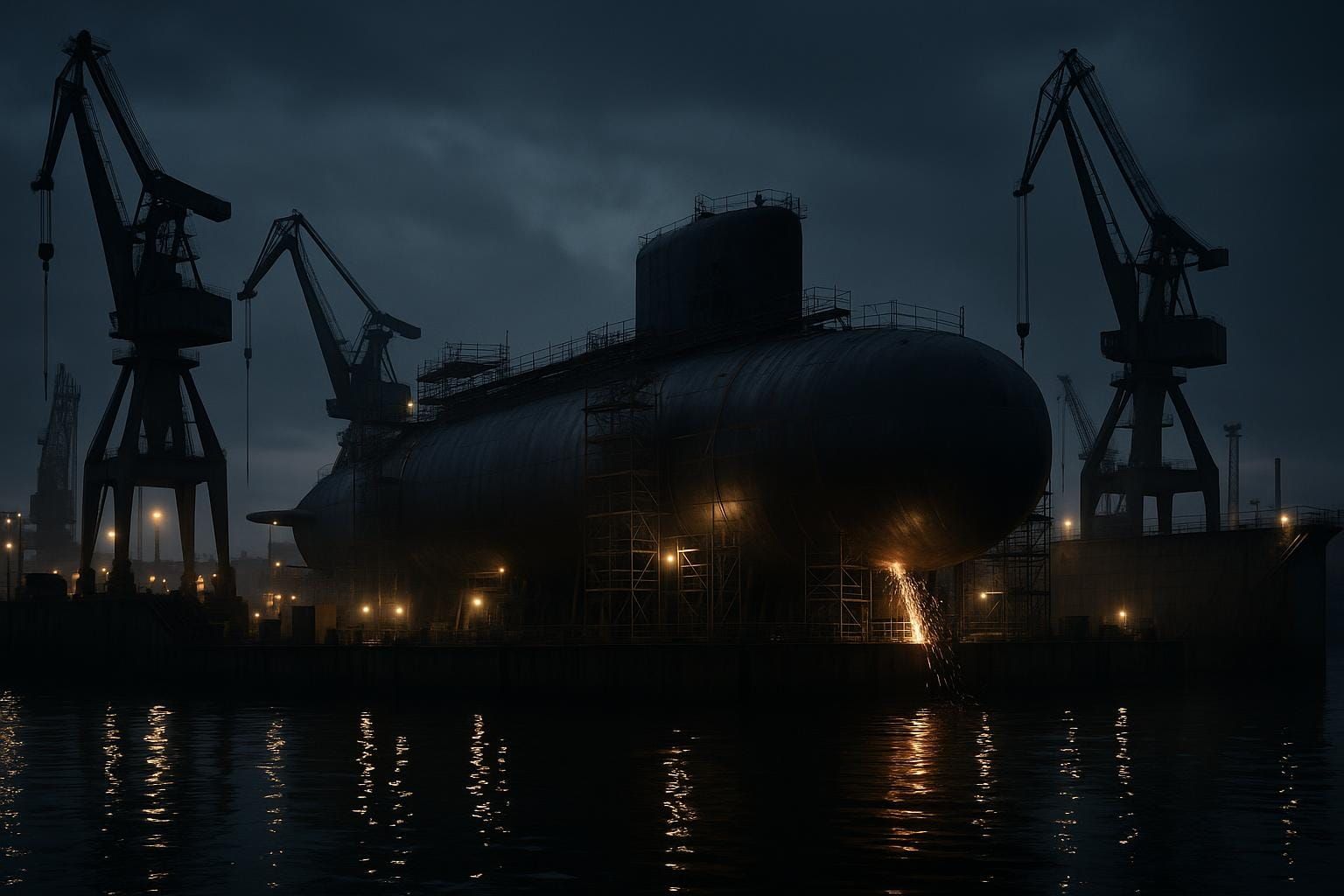
On Tuesday, October 6, President Trump announced a shipyard. Not a Navy shipyard, and not one owned by General Dynamics or Huntington Ingalls — the two companies that have built every Virginia-class attack submarine in existence. The new yard belongs to Anduril Industries, the nine-year-old defense technology company co-founded by Palmer Luckey, the man who sold Oculus to Facebook before he turned 25. Anduril is best known for autonomous drones. It has never delivered a nuclear submarine component in its life.
It is now contracted to. The deal has two halves: Anduril is putting up $3.7 billion of private capital to build "Arsenal-2," a submarine component yard at Sparrows Point outside Baltimore, and the Navy has awarded the company a contract worth up to $2.9 billion — with payments tied directly to demonstrated production output. Combined, it is a $6.6 billion bet that a Silicon Valley-style manufacturer can fix the most stubborn bottleneck in American defense: the United States cannot build submarines fast enough.
The math the Navy can't escape
The numbers are not classified; they are in the Congressional Research Service's standing report to Congress, updated for decades. The Navy procured Virginia-class boats at a rate of two per year from FY2011 through FY2024 — 40 boats through FY2024, at roughly $4.5 billion each when bought at that rate. But procurement is paperwork; production is welding. The industrial base has never actually built 2.0 boats per year, and since 2022 output has been stuck around 1.1 to 1.2 boats per year. The backlog of submarines bought but not built keeps growing — Congress kept buying at a rate the yards kept failing to hit.
Then AUKUS made the arithmetic worse. Under Pillar 1 of the pact, the United States is to sell Australia three to five Virginia-class submarines, which means American yards must replace what Washington sells. The target isn't 2.0 boats a year anymore — it's 2.33. The gap between 1.2 and 2.33 is not a rounding error. It is roughly a full submarine per year that the existing industrial base — General Dynamics Electric Boat in Connecticut and HII's Newport News Shipbuilding in Virginia — cannot currently produce, despite the Navy showering it with money, including a $76.6 billion construction award to Electric Boat in July.
Money, it turns out, was never the constraint. Capacity is: weld shops, graving docks, and the skilled trades that take years to train. That is the hole Arsenal-2 is supposed to fill.
What Anduril is actually building
Arsenal-2 will sit on 187 acres at Tradepoint Atlantic in Baltimore County — the old Bethlehem Steel complex at Sparrows Point, a site that once symbolized American heavy industry and then spent decades as a monument to its decline. The plans Anduril published are specific: more than 2 million square feet of production space (about 40 football fields), a functional 1,200-foot graving dock, high-bay assembly halls, and road, rail, and maritime links connecting the yard to both prime shipbuilders. Anduril says the project will create 3,100 direct jobs and support more than 11,000 indirect ones, with initial operations expected in 2030.
Note what the yard will not do: assemble submarines. Arsenal-2 will build components and large-scale assemblies of the Virginia class and ship them to Electric Boat and Newport News for final assembly. Anduril enters as a supplier, not a prime — the nuclear heart of the boat stays where it is. To get a head start, the company is already standing up a 160,000-square-foot facility in Orange County, California, to manufacture early components — including torpedo tubes — and, critically, to qualify under SUBSAFE, the Navy's unforgiving submarine safety certification regime, two years before the Baltimore yard opens.
The most consequential part of the deal, though, may be the contract structure itself. The Navy is not paying Anduril to try. It is paying — up to $2.9 billion — for demonstrated production outcomes. Anduril carries the execution risk; the taxpayer pays on delivery. For an acquisition system built on cost-plus contracts that pay primes whether or not the boats appear, that is a quiet revolution. If it works, every incumbent contract in the Pentagon's portfolio starts to look renegotiable.
Get the next briefing free in your inbox: Join AlphaBriefing
The rest of this briefing is free — it just requires a free AlphaBriefing account: the Washington entanglement behind the award (and why it was announced days after Luckey joined a Pentagon task force), what the deal actually means for General Dynamics and Huntington Ingalls shares, and the single Anduril quote that should worry both primes.
Create your free account → — 30 seconds, no card.