The Minerals Cold War: How China's Rare Earth Gambit Is Reshaping the Global Economy
China controls 91% of rare earth refining and has weaponised that dominance. The bottlenecks are here — and so is the investment opportunity.

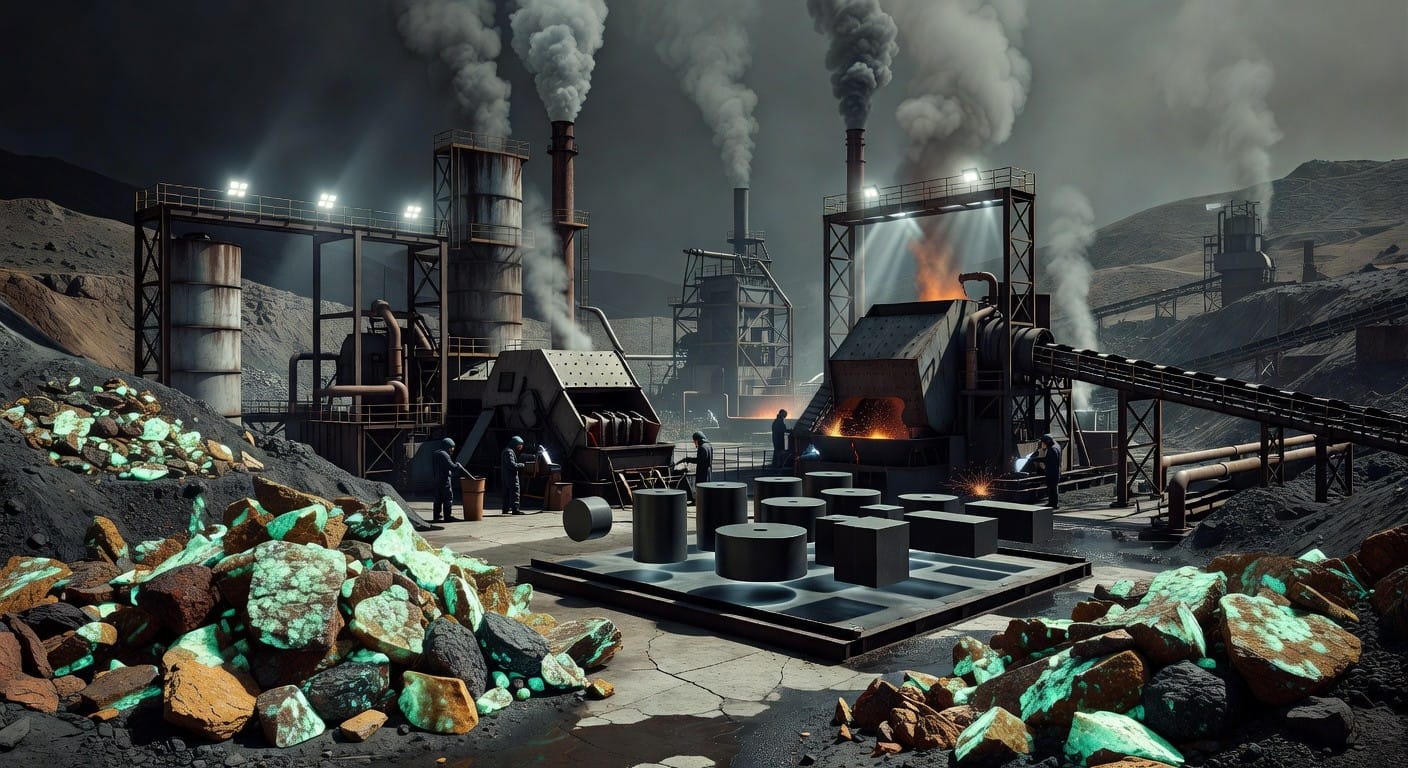
The element you've never heard of is quietly determining the outcome of the next great power competition.
Dysprosium. Terbium. Holmium. These aren't household names — but they sit at the centre of the most consequential geopolitical chess match of 2026. China controls 91% of global rare earth refining and has spent the past 18 months weaponising that dominance in ways that are now cascading through defence supply chains, EV production lines, and wind turbine manufacturing across the West.
This is not a future risk. The bottlenecks are here.
The Squeeze: From Tariff War to Minerals War
When Beijing announced expanded export controls on heavy rare earth elements last October — covering dysprosium, terbium, holmium, erbium, yttrium, and lutetium — it was the sharpest escalation yet in a strategy that has been quietly building since 2023.
The mechanics are deliberate. China's Ministry of Commerce now requires individual export licences for most rare earth shipments, with dual-use designations that can effectively block sales to defence-linked end users. An extraterritorial "50% rule" — triggering controls on any product with more than 50% Chinese-origin rare earth content — extends Beijing's reach into allied supply chains well beyond its borders.
The results are measurable. Chinese rare earth exports fell 15.8% in December 2025. Outside China, prices for heavy rare earth oxides are running 5-6x above Chinese domestic levels. Auto and defence manufacturers in the US, EU, and Japan are rationing inventory, delaying production, and scrambling for alternatives that don't yet exist at scale.
Beijing's strategy is calculated: move slowly enough to avoid triggering a full Western response, but tightly enough to maintain leverage. A second-wave suspension — pausing additional restrictions until November 2026 — was offered as a concession in US-China trade talks. The core licensing regime stayed firmly in place.
Why This Matters More Than Semiconductors
The semiconductor war gets the headlines. The minerals war may matter more.
Every F-35 requires approximately 417kg of rare earth materials. The permanent magnets in every advanced missile guidance system, radar array, and hypersonic propulsion unit depend on dysprosium and terbium to maintain magnetic strength at extreme temperatures. There is no engineering substitute. You cannot design around the periodic table.
The same dependency runs through the civilian economy. EV motors, offshore wind turbines, MRI machines, and the high-performance computing infrastructure underpinning the AI race all require neodymium-praseodymium (NdPr) magnets — a market Beijing has spent two decades engineering itself to dominate.
The US responded with Project Vault: a $10-12 billion EXIM-funded strategic stockpile combined with proposed price floors negotiated with Australia, Japan, the EU, and Mexico. The EU has activated its Critical Raw Materials Act. Australia committed A$1.2 billion to reserves. Japan and Vietnam are funding midstream investments.
It's the right instinct. But these measures take years to mature, and the supply gap is measured in months.
This is where the analysis gets actionable. AlphaBriefing members get the full investment framework — scenarios, positioning, and the bottom line.
Subscribe to AlphaBriefing — Free, Member, and Paid tiers available.