Jamie Dimon Just Warned Us. Is Anyone Listening?

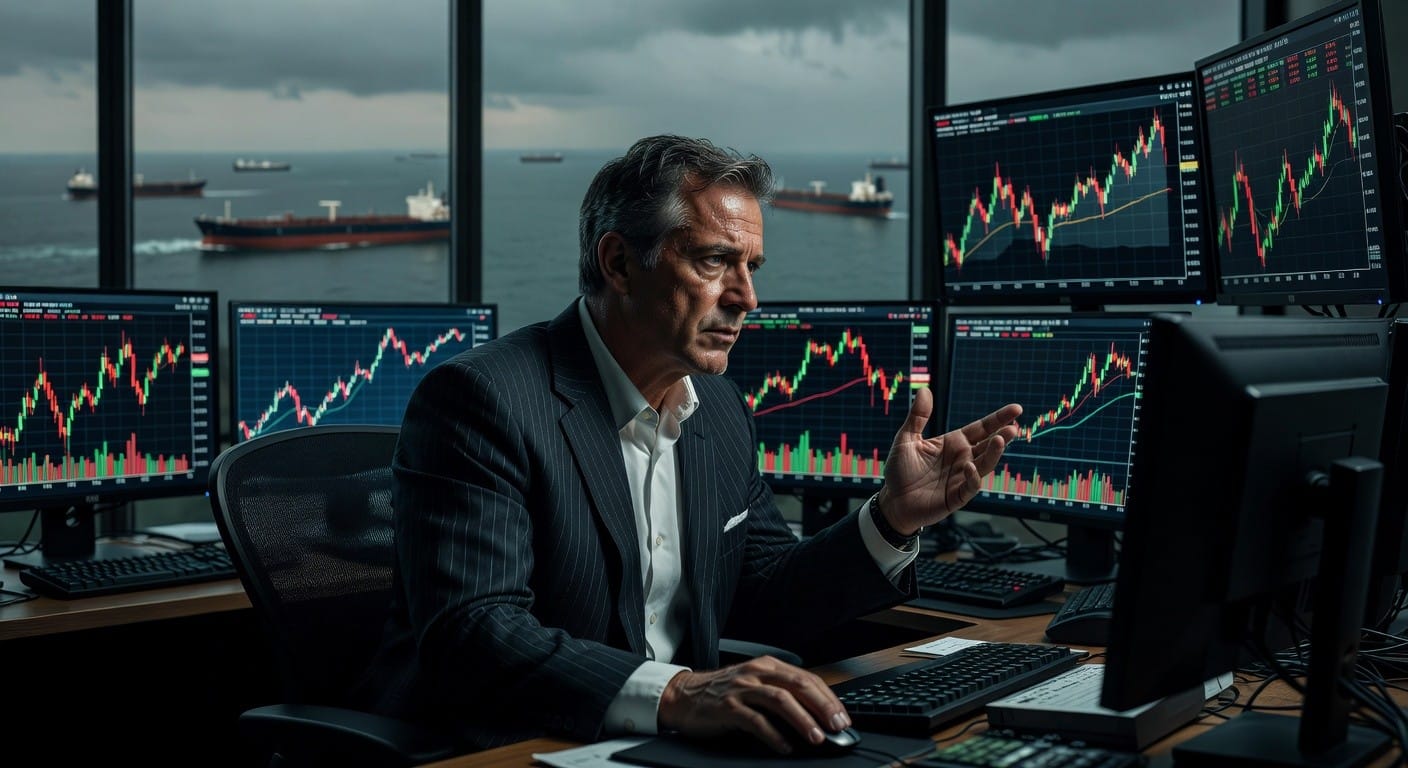
Jamie Dimon's annual shareholder letter landed this morning. Markets are clinging to hopes of an Iran deal. Tuesday's 8 p.m. deadline looms. Here's what the CEO of JPMorgan actually said — and what it means for your portfolio.
Every April, Jamie Dimon publishes his annual shareholder letter. Wall Street reads it like scripture. Unlike most corporate communications, it isn't polished into meaninglessness — Dimon writes what he actually believes, and what he actually believes tends to be more accurate than the consensus.
This morning, the 2026 edition landed. And it arrives at a genuinely precarious moment.
Brent crude is trading above $111 a barrel. Gas prices in the US have hit $4 a gallon for the first time in three years. The Strait of Hormuz — through which 20% of global seaborne oil normally flows — has been effectively shut since early March. And Trump just gave Iran until 8 p.m. ET on Tuesday to reopen it or face strikes on power plants and bridges.
Against that backdrop, here's what the CEO of the world's largest bank by market capitalization wants investors to understand.
The "Skunk at the Party"
Dimon's central warning isn't a recession call. It's something subtler and, in some ways, more dangerous: inflation that refuses to die.
He describes the risk as a "skunk at the party" — the unwelcome possibility that price pressures, instead of continuing their slow retreat, start creeping back up in 2026. Not a 1970s-style hyperinflation spike, but a grinding, persistent elevation that upends the soft-landing thesis most of Wall Street has been pricing in.
The mechanism is obvious if you look at what's happening in the Persian Gulf. The Iran war hasn't just disrupted oil supply — it has interrupted roughly 20% of global oil trade, spiked LNG prices, and created ripple effects through fertilizers, plastics, and food supply chains. Brent hit $126 a barrel in early March; even at current levels of ~$111, the energy tax on the global economy is substantial.
Dimon's letter flags all of this explicitly. The war, he writes, could cause "significant ongoing oil and commodity price shocks" that lead to "stickier inflation and higher interest rates" than markets currently expect. Markets have already priced out Federal Reserve rate cuts for 2026. But Dimon is warning they may not have priced in enough pain.
The Rate Trap
Here's the bind this creates.
If inflation re-accelerates — driven by oil, commodity shortages, and supply chain chaos — the Fed can't cut rates to cushion a slowing economy. It may not even be able to hold rates steady. The result is the worst-case macro scenario: stagflation. Growth slows while prices keep rising. Central banks are paralyzed. Asset valuations built on the assumption of falling rates face a serious repricing.
The S&P 500 is already down roughly 9% from its Q1 highs. The 10-year Treasury yield has climbed 40 basis points since the war began in late February, sitting now at 4.36%. Gold, somewhat counterintuitively, has fallen — down 12% to around $4,672 per ounce — as investors sell safe-haven positions to cover losses elsewhere and as the dollar strengthens on its haven status.
Dimon doesn't predict this outcome. He's too careful for that. But he makes clear JPMorgan is positioning its balance sheet as if it could happen. His "fortress balance sheet" framing — a phrase he's used for years — is meant to signal that the bank can deliver positive returns even in severe downturns. That's cold comfort for investors who don't have a fortress.
The 48-Hour Clock
The Dimon letter is important context. But the 48-hour countdown to Trump's April 8 deadline is the live variable.
Trump posted on Truth Social on Easter Sunday — an expletive-filled ultimatum giving Iran until Tuesday, 8 p.m. ET, to reopen the Strait or face what he called "Power Plant Day" and "Bridge Day." He's threatened this before. He extended his previous deadline. He's also said, in the same breath, that there's a "good chance" of a deal.
Markets have been reading this as noise — hence last week's 3.4% S&P rally on peace hopes. VIX is at roughly 24, elevated but not panicked.
But the binary is real: if Iran doesn't reopen the Strait and Trump acts, Brent could spike back toward $125+, VIX could blow out, and a bond market already absorbing $125 billion in new Treasury auctions this week faces a chaotic environment. If there's a deal, or another delay, markets likely rally again — temporarily.
This is not a situation with clean answers. It's a situation with two tails, and one of them is ugly.
What Dimon Gets Right That Most Miss
Reading the full letter, a few things stand out beyond the headline warnings.
First, he's not a pure bear. Dimon spends considerable time on genuine tailwinds: US consumer resilience, fiscal stimulus equivalent to roughly 1% of GDP, deregulation effects, and AI productivity gains. The $725 billion in AI capex he cites is real investment in real infrastructure that will eventually generate real returns. His view is that America is structurally sound — it's the shocks that could derail it.
Second, he's worried about private credit. Buried in the letter is a warning about potential losses in private credit markets exceeding current expectations. This is a sector that's exploded in the low-rate era and hasn't been properly stress-tested. If rates stay higher for longer, some of those loans get ugly.
Third, the debt math is alarming. Dimon flags US debt-to-GDP hitting 120% by 2036 on current trajectories. This isn't a new concern, but the combination of higher rates and persistent deficits turns what was a long-term worry into a more near-term market risk. Bond vigilantes — investors who sell government debt to force fiscal discipline — have been dormant for years. Dimon is implicitly suggesting they might not stay dormant.
The Bottom Line
Dimon's letter is the clearest signal yet from someone inside the machinery of global finance that the "everything is fine" narrative has real vulnerabilities.
The Iran deadline on Tuesday is the near-term test. Watch oil, watch the 10-year Treasury yield, watch the VIX. If Trump strikes and markets gap down, the question isn't whether to panic — it's whether your portfolio is positioned for a world where oil stays above $100, rates stay elevated, and growth disappoints.
That's the world Dimon is quietly preparing JPMorgan for. Sophisticated investors should ask themselves whether they're doing the same.
Get this level of intelligence every day. Subscribe to AlphaBriefing — free, member, and paid tiers available.
Sources & Further Reading
- JPMorgan Chase — 2025 Annual Report: CEO Letter to Shareholders
- Reuters — JPMorgan's Dimon warns Iran war may drive inflation and interest rates higher
- CNBC — Trump Iran deadline: investors and markets face war and trade deal risks
- Reuters — US pump prices hit $4/gallon as Iran war wreaks havoc on global energy supply
- Wikipedia — 2026 Strait of Hormuz crisis
- The Guardian — Iran war, oil prices, and stagflation risk to the global economy
- Business Insider — Jamie Dimon JPMorgan inflation warning, shareholder letter 2026
Disclaimer
AlphaBriefing is an independent intelligence publication. The content in this article is produced for informational and educational purposes only. Nothing published by AlphaBriefing constitutes financial, investment, legal, tax, or regulatory advice, nor should it be construed as a solicitation or recommendation to buy, sell, or hold any security, asset, or financial instrument.
All views expressed are those of the author at the time of writing and are subject to change without notice. Markets are volatile and unpredictable; past performance is not indicative of future results. Any investment involves risk, including the possible loss of principal.
AlphaBriefing and its principals, employees, or contributors may hold positions in securities or assets mentioned in this article. This should be considered a potential conflict of interest. No material relationship with any company referenced exists unless explicitly disclosed. Readers should conduct their own due diligence and consult qualified financial, legal, and tax advisors before making any investment decisions.
Information in this article is drawn from public sources believed to be reliable at the time of publication. AlphaBriefing makes no warranty, express or implied, as to the accuracy, completeness, or timeliness of any information herein. AlphaBriefing accepts no liability for any loss or damage arising from reliance on this content.
© AlphaBriefing. All rights reserved. Unauthorised reproduction or distribution is prohibited.