The House Voted 417-3 to Send Big Tech the Power Bill. One Senator Said No.
The most lopsided vote of the year met a one-man roadblock — and the fight over who pays for AI's electricity is now the sharpest repricing risk in the power trade.

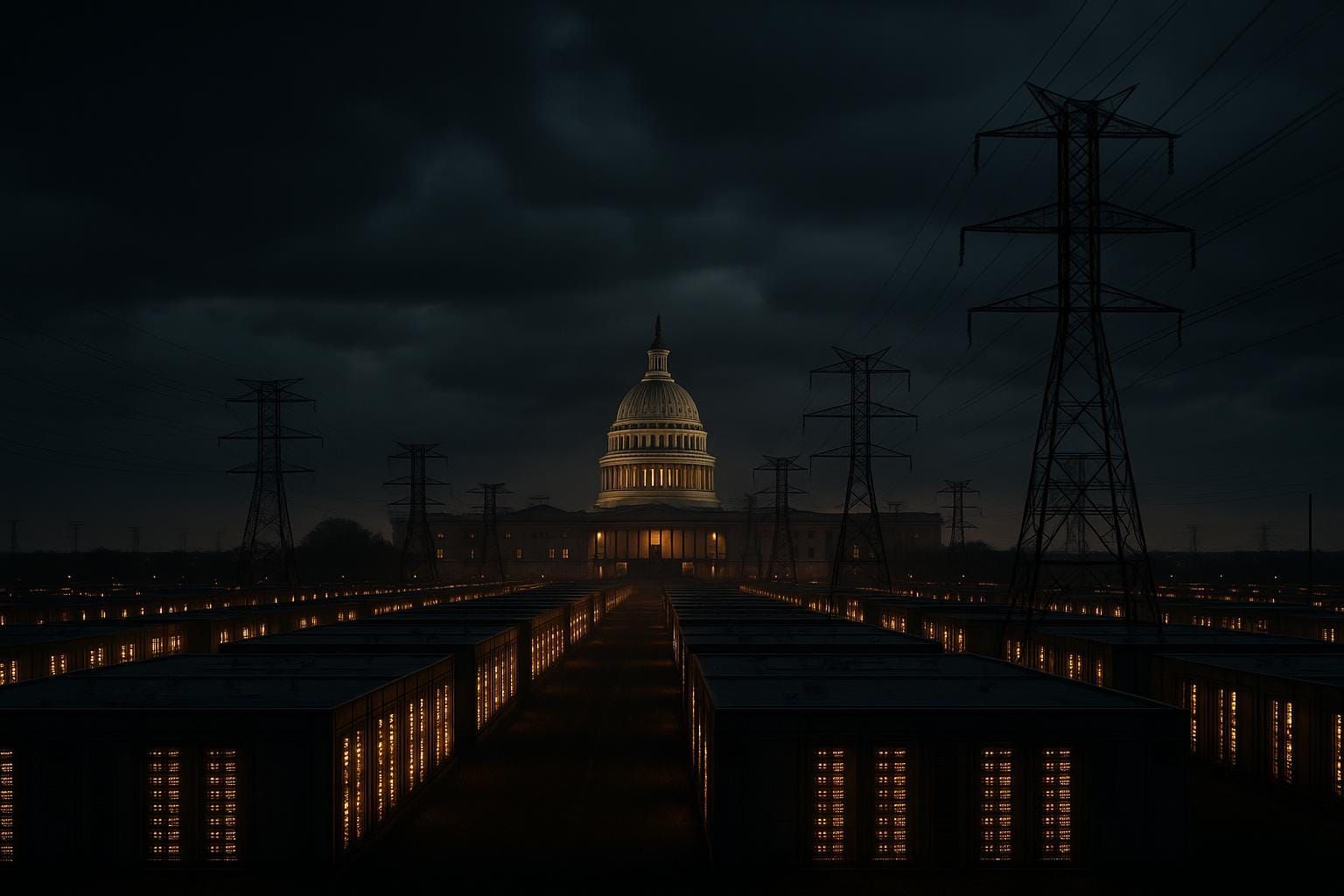
On September 16, the House of Representatives did something it almost never does anymore: it agreed. By a vote of 417 to 3, it passed the Ratepayer Protection Act, a bill built on a principle its Senate sponsor summarized in one line: "If you create the cost, you should pay the cost." The costs in question are the grid upgrades demanded by AI data centers, and the bill says the companies building them — not the households next door — should pay.
Twenty-four hours later, a single senator blocked it.
Both facts are the story. The 417-3 vote tells you that making Big Tech pay for its own electricity is now one of the only positions in American politics with no meaningful opposition. The one-man roadblock tells you the fight has moved on from whether data centers should pay to how much — and that the final version of this policy is still up for grabs. For anyone holding power, utility, or nuclear stocks, that unresolved question is the sharpest regulatory variable in the sector.
What the bill actually does
The Ratepayer Protection Act (H.R. 9340) is narrower than the headlines suggest. It amends the Public Utility Regulatory Policies Act of 1978 — the same statute Washington has used for decades to nudge state utility regulation — by adding a new federal standard that state regulators must consider adopting: large-load customers, defined as data centers with peak demand of at least 100 megawatts at a single facility, should pay the full, incremental costs of the generation, transmission, and distribution upgrades needed to serve them.
Note the verb. States must consider the standard; they are not required to adopt it. The Congressional Budget Office scored the bill as having no effect on the federal budget for precisely this reason. It is soft law — a federal signal to fifty state utility commissions about which way the wind is blowing. That is also why the House vote was 417-3: nobody had to pay for anything yet.
The bill was introduced in the House in June by Rep. Gabe Evans, a Colorado Republican, with Democrat Kathy Castor of Florida as co-lead. Sen. Jon Husted of Ohio introduced the Senate companion in July.
Why the vote was 417-3
Because electricity bills have become midterm politics, and the numbers behind them are not subtle.
In PJM, the largest US grid — serving 67 million people across 13 states and hosting the world's largest data center cluster in northern Virginia — the most recent capacity auction cleared at $333.44 per megawatt-day, the highest price in the market's history and the third consecutive record. Those capacity costs flow directly into retail bills. On the Senate floor, Husted claimed America is expected to build the equivalent of 1,000 major data centers in the next five years, with more than 2,000 projects currently proposed. However precise that projection turns out to be, the direction is not in dispute.
The states stopped waiting for Washington months ago. In July, New York became the first state to impose a statewide moratorium on new hyperscale data centers: Governor Hochul signed an executive order pausing environmental permits for facilities of 50 megawatts or more for up to a year while the state writes new development standards, weeks after the legislature passed its own moratorium bill. New Jersey enacted a law in July creating a separate ratepayer class for large-load customers, according to a McGuireWoods survey of state data center legislation. Similar bills are moving in statehouses across the country.
And the politics are existential for the bill's own sponsor. Husted is defending his Ohio seat against former Sen. Sherrod Brown in one of the cycle's marquee races, and CBS News reported that the Senate GOP campaign arm warned in a memo that the data center issue — Husted's past support for the industry — is "the anchor hanging around Husted's neck." A 417-3 House vote seven weeks before the midterms is what it looks like when both parties decide the same issue is radioactive.
Briefings like this land in members' inboxes before the market prices them in. Join free →
The block
On September 17, Husted asked for unanimous consent to pass the bill — a fast-track procedure any single senator can veto. Sen. Martin Heinrich of New Mexico, the top Democrat on the Senate Energy and Natural Resources Committee, objected. His argument was not that the bill goes too far, but that it does almost nothing: "Congress needs to pass real legislation with real teeth," he said, pushing his own GRID Savings Act, which layers on community engagement, water conservation, and clean energy requirements. Ohio's other senator, Republican Bernie Moreno, then blocked Heinrich's bill in turn. "The term do-nothing Congress exists for a reason," Moreno said. "We absolutely accomplished that right now."
So nothing passed. But the market did not treat it as nothing. The day after the House vote, as the Senate standoff played out, money moved fast into the names that would benefit if data centers are pushed to pay for — or build — their own power. Advanced nuclear developer Oklo jumped 11.3%. NuScale Power rose 8.9%, NANO Nuclear 8.5%. The logic: if hyperscalers must internalize grid costs, dedicated behind-the-meter generation stops being a science project and starts being the cheaper option.
Two weeks later, the tape tells a more discriminating story — some of those pops have fully round-tripped, while a different group of names has quietly kept climbing. Which stocks the market actually believes, and what to own if cost-causation becomes law state by state, is where this gets actionable.
Get the next briefing free in your inbox: Join AlphaBriefing
The rest of this briefing is for paid members: the two-week scoreboard on every major nuclear and power name since the vote (including the one that gave back its entire rally), the framework for who wins and who loses if cost-causation spreads to the states, the specific catalysts to watch between now and the midterms, and the bottom-line positioning.
AlphaBriefing Paid gets you every investment thesis, scenario framework, and catalyst brief we publish — the analysis private intel clients pay four figures for, at a fraction of that.