America Kept the Strait of Hormuz Open for Free. Trump Just Sent the Bill.
Trump says America will keep the Strait of Hormuz — and get paid for guarding it. Forty years of free chokepoint security just became a business. The bill lands on Asia, and the unwind lands on the most crowded trade in shipping.

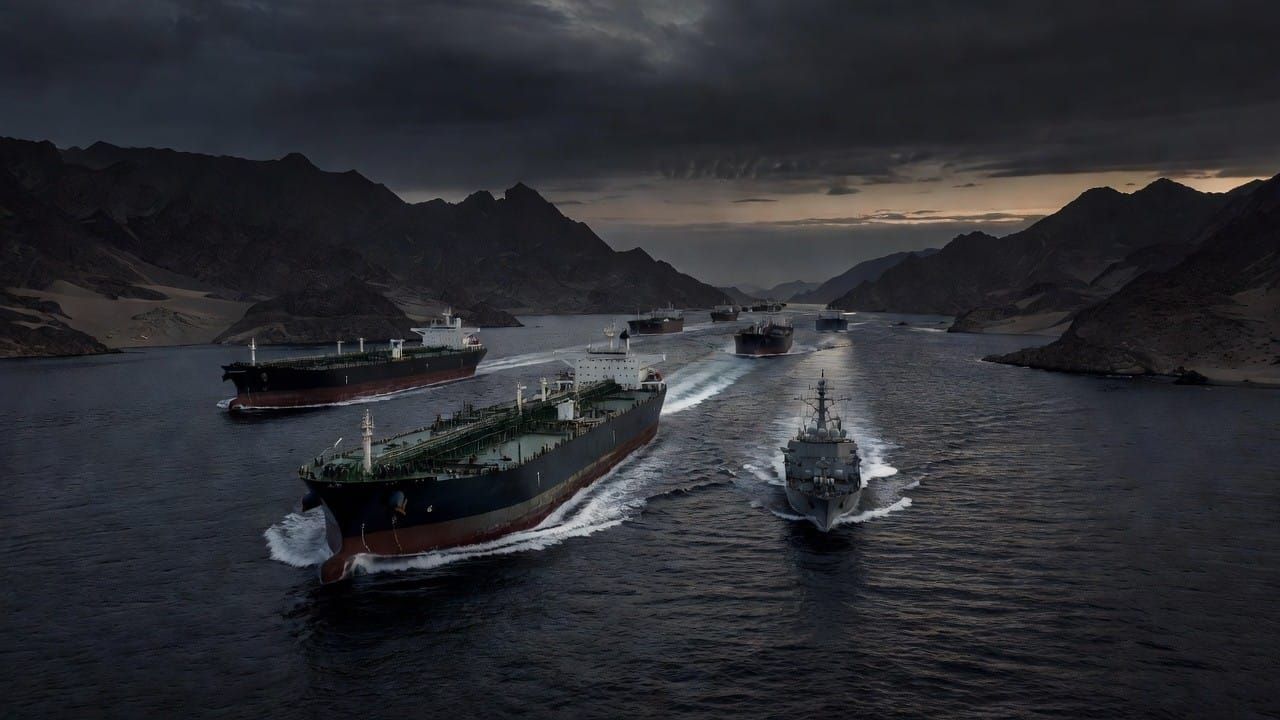
On Sunday, as American aircraft, ships, and — for the first time in combat — one-way attack sea drones struck dozens of Iranian coastal radar, air-defense, and missile sites along the Gulf, President Trump was asked on Meet the Press whether the Strait of Hormuz was open or closed. His answer skipped past the question to something much bigger: the United States is taking over the strait, he said, and keeping it open "by force."
By Monday morning he had finished the thought on Fox & Friends: "We're going to keep the strait, and we'll probably run it." And the part that should have every energy desk, shipowner, and Gulf finance ministry re-running their models: America, he said, is going to get paid for guarding it.
Strip away the delivery and what's on the table is this: after four decades of providing the world's most valuable security service for free, Washington is proposing to convert the defense of the Strait of Hormuz into a revenue business. That is a genuinely new thing in the architecture of the global economy — and the market implications run far beyond the oil price.
The war premium moved. Almost nobody noticed where.
Here is the paradox of July 2026: there is a shooting war at the world's most important oil chokepoint — tankers struck by projectiles on July 7–8, a Qatari LNG carrier and a Saudi-flagged crude carrier damaged, four laden tankers turning back in a single day, ships transiting dark with transponders off — and Brent crude is trading at roughly $78–79 a barrel. That's below where it sat for much of the spring.
The market has learned something over four months of this conflict: the oil keeps flowing. U.S. escorts and strikes have kept the channel physically open, so the barrels arrive — eventually, expensively.
The war premium didn't disappear. It moved. It now lives in two places:
- War-risk insurance. Hull war-risk premiums for a Hormuz transit are running around 5% of vessel value, renewable every seven days — against a pre-conflict baseline of roughly 0.25%, and after peaking above 10% in the worst weeks. For a $120 million VLCC, that is $6 million per transit, before the cargo is insured.
- Freight. The benchmark Middle East Gulf–to–China VLCC route hit a record of roughly $424,000 per day this month. Rates have quadrupled from pre-conflict levels.
In other words: a toll on Hormuz already exists. It is collected privately — by Lloyd's of London syndicates and tanker owners — and it is enormous. What the President proposed this weekend is, functionally, that the United States government should be the one collecting it.
Forty years of free
This is the part the market is treating as bluster, and shouldn't. The U.S. has guarded this waterway without charge since the Carter Doctrine declared the Gulf a vital American interest in 1980. In 1987–88, Operation Earnest Will — the largest naval convoy operation since World War II — reflagged Kuwaiti tankers under the American flag and escorted them through a mined, missile-swept Gulf. Washington billed nobody.
Trump has resented that arrangement, publicly, since at least June 2019, when he noted that China and Japan take the bulk of their crude through Hormuz and asked why America protects the shipping lanes "for zero compensation." At the time it was a tweet. Now it is a doctrine with a carrier strike group behind it — and it rhymes with everything else this administration has done in 2026: the 15% export toll on Nvidia's China revenue, the equity stake in MP Materials, the talks to put Washington on OpenAI's cap table. State power, monetized. This is the first time the doctrine has been pointed at the rest of the world's oil supply.
Which raises the two questions that decide the trade: who actually receives this invoice — and what happens to the most crowded trade in shipping if the toll gets formalized?
The rest of this briefing is for paid members: the actual payers behind the "America gets paid" framing (it isn't who Washington says it is), the three-scenario framework with what each does to freight, insurance, and crude, the specific tickers exposed to the unwind — and the chokepoint precedent that reprices far more than Hormuz.
AlphaBriefing Paid gets you every investment thesis, scenario framework, and catalyst brief we publish — the analysis private intel clients pay four figures for, at a fraction of that.