The World's Oil Spigot Is Being Held Hostage — What the Hormuz Crisis Means for Your Portfolio

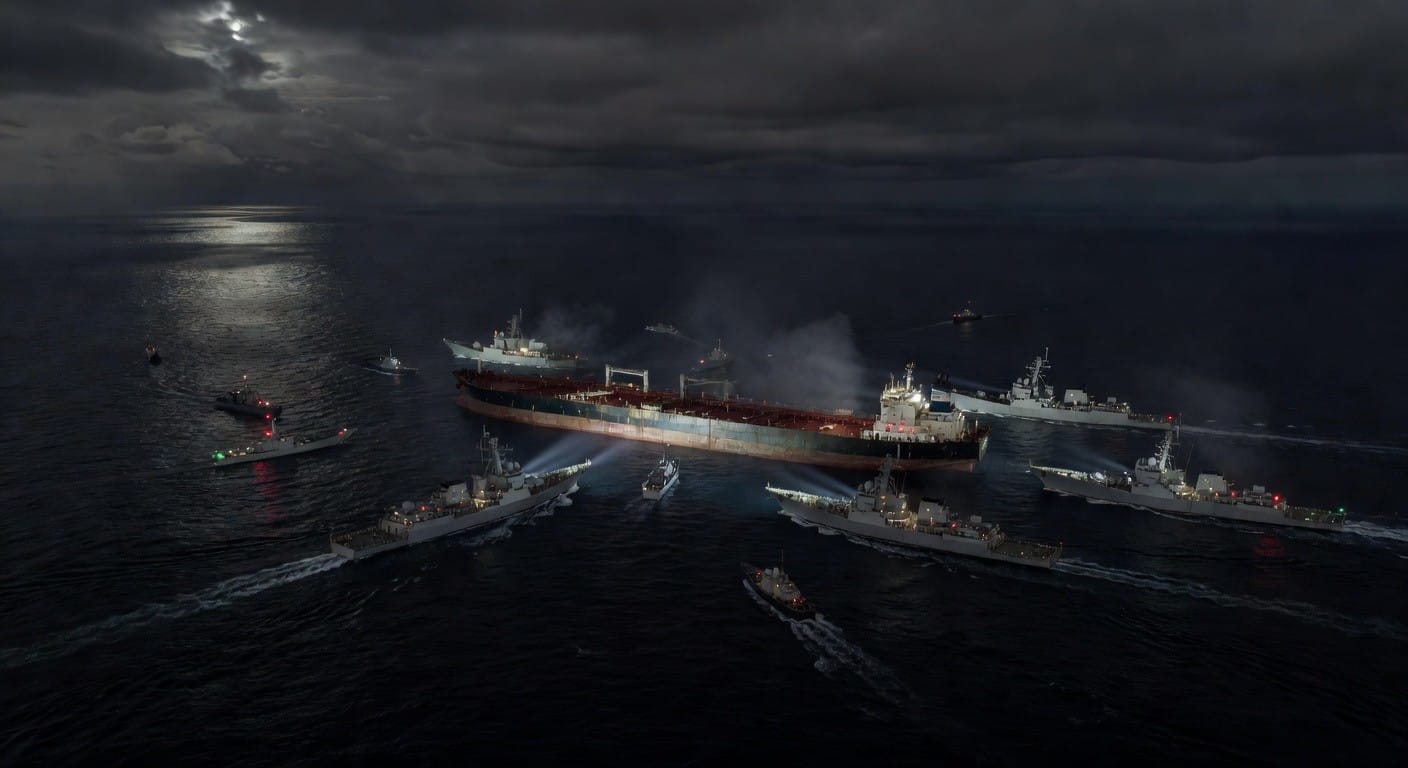
The world's most important waterway is being held hostage — and the clock is ticking.
On March 27, Iran's Revolutionary Guard Corps effectively closed the Strait of Hormuz to vessels linked to the United States, Israel, and their allies. In one move, Tehran weaponized a 21-mile-wide channel that handles roughly 20% of global oil trade and nearly a third of the world's liquefied natural gas. Brent crude has surged past $110 per barrel — up more than 50% in a single month. Markets are in freefall. And President Trump has given Iran until April 6 to stand down — or face strikes on its power grid.
This is not a peripheral conflict. This is a direct hit to the circulatory system of the global economy.
The Chokepoint That Runs the World
The Strait of Hormuz sits between Iran and the Arabian Peninsula — a narrow passage connecting the Persian Gulf to the Gulf of Oman and the open ocean beyond. Every day, approximately 17 to 20 million barrels of oil move through it, along with massive volumes of LNG from Qatar, the world's largest exporter.
There is no easy alternative. The Saudi East-West pipeline (Petroline) can handle roughly 5 million barrels per day — less than a third of normal Hormuz flows. The UAE's Habshan-Fujairah pipeline adds another 1.5 million. Strategic petroleum reserves in the US, Europe, and Asia can buy time — weeks, maybe a couple of months — but they cannot replace sustained supply.
When the Strait closes, the global economy bleeds.
Four Weeks of Escalation
The current crisis traces back to February 28, when the US and Israel launched coordinated strikes on Iranian nuclear and military infrastructure. Iran responded with missile salvos on Israeli cities, attacks on US naval assets in the Gulf, and, most consequentially, the restriction of Hormuz transit.
The timeline since then has been a slow-motion pressure campaign:
- Early March: Iran restricts select tanker transits; Brent crosses $80, then $90
- Mid-March: US releases strategic reserves; prices dip briefly before resuming climb
- March 20–25: Full effective closure announced; Brent surges past $100 and accelerates to $110+
- March 26: Trump postpones threatened strikes on Iran's power grid to April 6, 8 PM ET, citing "progress" in indirect ceasefire talks mediated through Oman
- March 27: Iran denies direct negotiations; Israel warns of escalating and expanding attacks; Gulf states condemn Iranian actions and begin defensive preparations
The April 6 deadline is now the most watched date in global markets.
What $110 Oil Actually Means
The market consequences are already material and spreading fast.
Energy equities are the obvious winner. US producers — particularly Permian Basin operators — are insulated from supply disruption while capturing the price spike. Stocks like Occidental Petroleum (OXY), ExxonMobil (XOM), and Chevron (CVX) have outperformed sharply. The broader energy sector is up roughly 15% in March alone.
Defense contractors have also rallied. Any escalation — whether or not a deal is reached — means elevated US and allied military spending in the Gulf theater.
Airlines, transport, and consumer discretionary are the losers. Jet fuel costs are surging. Supply chains sourcing goods through Gulf shipping lanes are snarled. US gasoline prices have jumped 20–30% in some regions within weeks.
Emerging market debt faces a compound shock: oil import bills are ballooning at the same time dollar-denominated borrowing costs rise, as the Fed's rate-cut calendar gets pushed back by renewed inflation fears.
The S&P 500 has posted its longest weekly losing streak since 2022. The VIX — Wall Street's fear gauge — is at a two-week high and climbing.
The Stagflation Specter
Here's the uncomfortable reality: this is not just an oil price story. It's a stagflation story.
Higher energy costs feed directly into transportation, manufacturing, fertilizer production, and consumer goods pricing. Core inflation — which had been decelerating throughout 2025 — is now re-accelerating. Analysts at BlackRock have warned that if Brent hits $150, the probability of a global recession exceeds 60%. Some models have the number climbing to $250 per barrel if the closure extends beyond three months.
The Fed is caught. Cutting rates into an oil shock would be politically and economically reckless. Holding rates while the economy slows risks a hard landing. Jerome Powell doesn't have a good option here — and markets know it.
The Insider Trading Scandal Nobody Is Talking About Loudly Enough
Buried in the market noise is a story with serious implications for financial markets and national security alike.
In the 15 minutes before Trump announced his March 26 extension of the Iran deadline, over $500 million in Brent crude and WTI oil futures changed hands — and $1.5 billion in S&P 500 futures moved against the market direction that followed. The trades were spectacularly well-timed.
On Polymarket — the crypto-based prediction market — the picture is even more vivid. Record volumes exceeding $529 million in bets were placed on US strikes against Iran. Blockchain analysis identified six wallets that profited roughly $1.2 million by betting on the exact February 28 strike date — just hours before it happened. One trader reportedly used 38 separate accounts to net $2.14 million on US military actions, leaving what investigators described as an "easy to follow digital trail."
No formal US investigation has been announced. But Senate watchdogs have demanded one. Polymarket and Kalshi have implemented new anti-insider trading rules under congressional pressure. And The Atlantic has published a piece warning that predictive markets — by making it financially profitable to leak classified military information — may be getting people killed.
This is a story about war profiteering in the digital age. It won't go away.
The Scenarios: What Happens Next
Scenario 1 — Deal by April 6 (30% probability)
Iran agrees to conditions — likely including verified nuclear program restrictions — and the Strait reopens. Oil falls back toward $80–90 as risk premium deflates. Markets rally hard. Energy names give back some gains; broad indices recover. Trump claims a historic win.
Scenario 2 — Deadline Extension (45% probability)
Talks continue without resolution; Trump extends the deadline again. Oil stays elevated in the $95–115 range. Markets price in prolonged uncertainty. Stagflation risk rises. Defense and energy continue to outperform. Slow grind of economic damage begins to register in corporate earnings.
Scenario 3 — Escalation (25% probability)
No deal, Trump orders strikes on Iran's power grid. Iran retaliates — potentially mining the Strait, attacking Gulf state infrastructure, or targeting US naval assets. Oil spikes toward $130–150+. Global recession probability exceeds 50%. Flight to safety: USD, gold, Treasuries. Broad equity selloff accelerates.
The base case is muddle — which is its own kind of corrosion.
The Bottom Line
The Hormuz crisis is the most significant geopolitical market event since Russia's invasion of Ukraine in 2022. Unlike that conflict, which played out in a peripheral energy market, this one cuts directly through the throat of global oil supply. There is no workaround at scale. There is no quick diplomatic fix. And there is a 10-day countdown to a potential US military escalation against a nuclear-threshold state.
The April 6 deadline is not just a diplomatic moment. It is a market event. How it resolves — or doesn't — will define the investment landscape for the rest of 2026.
Smart money is watching Oman. That's where the talks are happening. And that's where the signal will come from first.
Get this level of intelligence every day. Subscribe to AlphaBriefing — free, member, and paid tiers available.
Sources & Further Reading
- AP News — Live Updates: Iran War, Trump, Israel (March 26, 2026)
- Al Jazeera — Trump Postpones US Strikes on Iranian Power Grid to April 6 Amid Talks
- Reuters — Iran Says It Is Reviewing US Ceasefire Plan
- Bloomberg — Dip Buyers Arrive to Pull Gold Back From Brink of a Bear Market
- Newsweek — Iran War Bets Fuel Insider Trading Fears
- CoinDesk — Polymarket Attracts Record Volumes as US-Iran Bets Top $529 Million
- The Atlantic — Polymarket Insider Trading Is Going to Get People Killed
- Investing.com — Crude Oil Prices Still Do Not Fully Reflect a Prolonged Hormuz Closure
Disclaimer
AlphaBriefing is an independent intelligence publication. The content in this article is produced for informational and educational purposes only. Nothing published by AlphaBriefing constitutes financial, investment, legal, tax, or regulatory advice, nor should it be construed as a solicitation or recommendation to buy, sell, or hold any security, asset, or financial instrument.
All views expressed are those of the author at the time of writing and are subject to change without notice. Markets are volatile and unpredictable; past performance is not indicative of future results. Any investment involves risk, including the possible loss of principal.
AlphaBriefing and its principals, employees, or contributors may hold positions in securities or assets mentioned in this article. This should be considered a potential conflict of interest. No material relationship with any company referenced exists unless explicitly disclosed. Readers should conduct their own due diligence and consult qualified financial, legal, and tax advisors before making any investment decisions.
Information in this article is drawn from public sources believed to be reliable at the time of publication. AlphaBriefing makes no warranty, express or implied, as to the accuracy, completeness, or timeliness of any information herein. AlphaBriefing accepts no liability for any loss or damage arising from reliance on this content.
© AlphaBriefing. All rights reserved. Unauthorised reproduction or distribution is prohibited.