Europe Finally Has Rockets
A private German rocket just reached orbit from European soil for the first time in history. Behind it: a €900 million ESA contest run on the NASA playbook, a £7.8 billion UK strategy, and the end of Europe's 50-year launch monopoly.

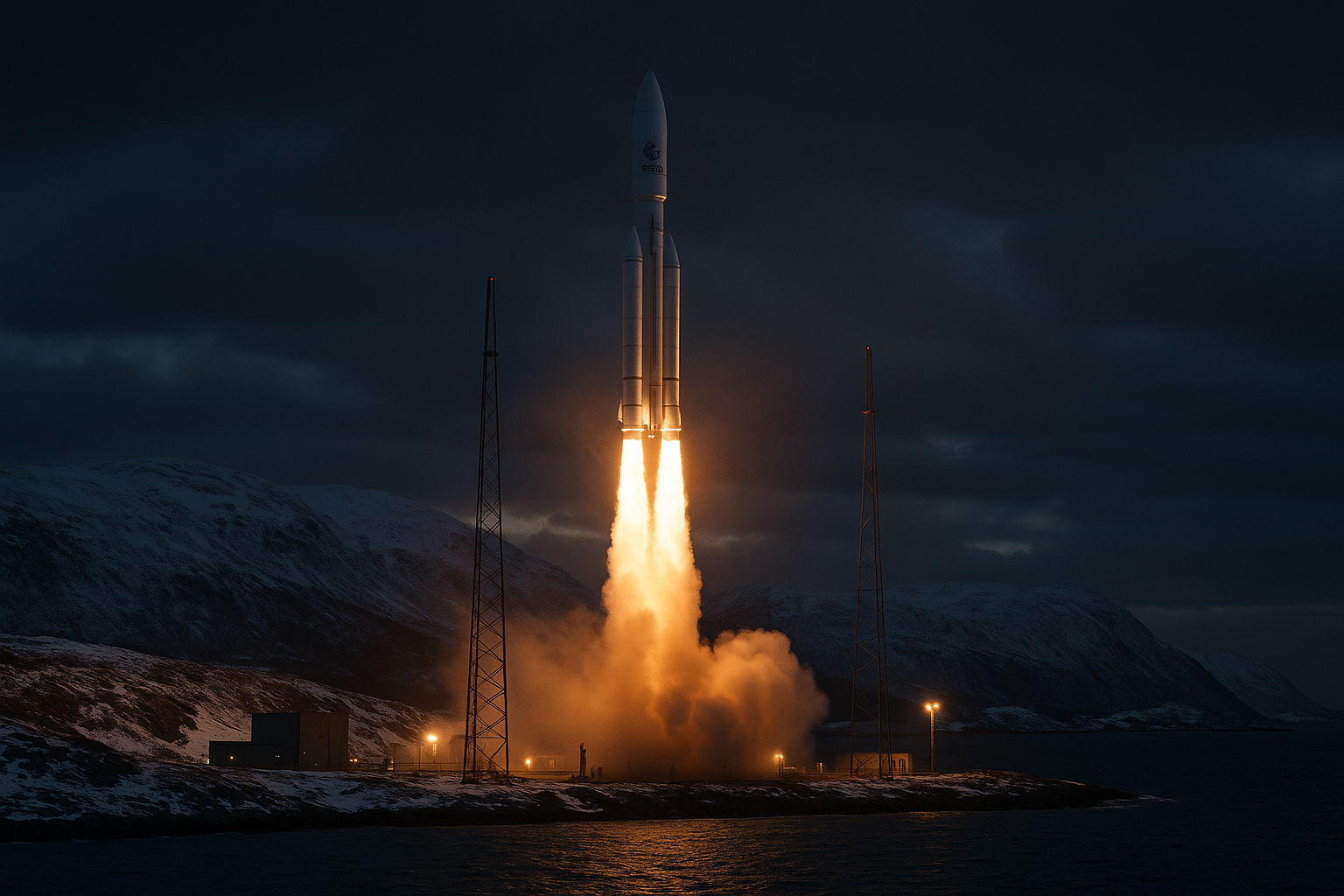
On September 5, a 28-meter rocket called Spectrum lifted off from Andøya Spaceport, an island launch complex above the Arctic Circle in Norway, and delivered six small satellites into orbit. The company behind it, Munich-based Isar Aerospace, had flown the vehicle exactly once before — a March 2025 test that tumbled into the sea about 30 seconds after liftoff.
By SpaceX standards, a small launcher reaching orbit on its second attempt is a Tuesday. By European standards, it is a first in the most literal sense: the European Space Agency calls it the first launch to orbit ever conducted from continental Europe. Every European orbital mission in the preceding half century left from Kourou in French Guiana — a spaceport on another continent, run through a single state-backed program.
That distinction sounds ceremonial. It isn't. What happened at Andøya is the most visible evidence yet that Europe's launch sector — for decades a synonym for one expensive government rocket — is turning into an actual industry, with competing private companies, fixed-price contracts, and state customers lining up behind them. For investors, the interesting part is not the rocket. It's the procurement model behind it, the money now moving, and the listing window this is likely to open.
The Gap Everyone Stopped Pretending About
Europe's launch problem stopped being a technical debate and became a strategic embarrassment years ago. Ariane 5 retired in 2023 before its successor was ready. Ariane 6 arrived years late, flies expendable, and is ramping slowly. The smaller Vega line spent long stretches grounded after failures. The result: in 2025, Europe conducted fewer than a dozen orbital launches while the United States conducted well over a hundred.
The consequences were concrete. The EU put Galileo navigation satellites — the crown jewels of European space sovereignty — on SpaceX's Falcon 9 because no European rocket was available. European governments leaned on Starlink for connectivity they could not provide themselves, even as they grew publicly uncomfortable with that dependence. In a rearming Europe where satellite communications, reconnaissance, and navigation are now defense infrastructure, "we can't get to orbit without buying American" became an unacceptable sentence to say out loud.
That is the backdrop against which a startup putting 1,000 kilograms into low Earth orbit matters far more than the payload mass suggests.
Briefings like this land in members' inboxes before the market prices them in. Join free →
Brussels Runs the NASA Playbook
The mechanism doing the heavy lifting is the European Launcher Challenge, and it is a deliberate copy of the best procurement decision NASA ever made.
In 2006, NASA's COTS program stopped paying cost-plus contracts for rockets and instead offered fixed-price milestone payments to private companies that could prove capability — the program that turned SpaceX from a struggling startup into the dominant force in global launch. ESA spent two decades resisting that model. In July 2025 it capitulated: five companies — Isar Aerospace (Germany), Rocket Factory Augsburg (Germany), MaiaSpace (France), PLD Space (Spain), and Orbex (UK) — were preselected as "challengers," each eligible for up to €169 million, contingent on reaching orbit no later than 2027. At ESA's ministerial conference in late 2025, member states committed more than €900 million to the program.
Isar is now the first challenger through the gate, with a qualifying orbital flight demonstrated a full year ahead of the deadline. That is not just an engineering milestone; it is the trigger that converts pledged public money into contracted revenue — and pressure on the other four to follow.
Fourteen Days in September
What makes this month feel like an inflection point is that the Isar flight didn't happen in isolation. Within two weeks:
- September 5: Spectrum reaches orbit from Norway carrying five university and commercial CubeSats plus a technology demonstrator.
- September 8: The UK publishes a new national Space Strategy backed by £7.8 billion through 2030 — folding civil and military space into one plan, with £2.8 billion for connectivity (a low-Earth-orbit program plus the Skynet military communications system), £148 million for European rocket programs, and £30 million for the SaxaVord spaceport in Shetland, where Orbex intends to launch.
- September 10: PLD Space unveils Miura 9 during a visit by Spain's prime minister — a 42-meter, partially reusable rocket designed to lift 1,500 kilograms to sun-synchronous orbit, with a first stage that lands propulsively on legs, SpaceX-style. It slots above the company's Miura 5 and below a planned heavy-lift family.
Individually, each item is a press release. Together they describe a flywheel: governments committing anchor demand, startups converting it into flight hardware, and national strategies explicitly framing launch as defense infrastructure. Europe has talked about space sovereignty for decades. This is the first month it has looked like an investable supply chain.
The Investor's Problem: There Is No Ticker Yet
Here is the uncomfortable truth for anyone who wants exposure: every pure-play in this story is private.
Isar Aerospace has raised roughly €800 million to date, including a €270 million Series D, and has been reported at a valuation above €2 billion — never confirmed by the company. It is the obvious European launch IPO candidate, and a successful commercial flight cadence in 2027 is the kind of proof point that opens that window. Rocket Factory Augsburg sits inside the OHB group. MaiaSpace is a subsidiary of ArianeGroup, the Airbus–Safran joint venture — meaning two of Europe's largest listed aerospace names quietly own a stake in the reusable-rocket race. Orbex and PLD Space remain venture-backed.
For now, public-market exposure runs through the incumbents that supply, own, or benefit from the buildout — Airbus, Safran, Thales, Leonardo — and through the defense-space budgets that are swelling around them. The closest public template for what a successful challenger becomes is Rocket Lab, the lone survivor of America's small-launch shakeout, which parlayed a working small rocket into a diversified space company the market now values in the tens of billions.
That template cuts both ways, and the cautionary half matters. Small launch is a brutal business: Virgin Orbit went bankrupt with a working rocket, Astra was delisted, and dozens of funded launch startups never reached the pad. Launch itself is low-margin and capital-hungry; the durable value historically accrues to whoever owns the payloads, the constellations, and the government relationships. Five European challengers chasing up to €169 million each will not all make it. The ELC is designed to find that out cheaply — which is precisely what makes it good policy and selective investing.
What to watch from here: the flow of firm ELC contracts on the back of the €900 million committed; whether RFA, MaiaSpace, PLD, or Orbex reach orbit before the 2027 deadline; Isar's first fully commercial missions and any IPO signaling; and how much of the UK's £7.8 billion turns into orders for launch rather than satellites.
Bottom Line
For fifty years, "European rocket" meant one government program launching from South America. In the span of two weeks, a private German rocket reached orbit from European soil, a second European state put £7.8 billion behind space as defense infrastructure, and a Spanish startup rolled out a reusable launcher with its prime minister standing next to it. The monopoly era of European launch is ending — not because Brussels decreed it, but because it finally started paying companies the way NASA paid SpaceX. The tickers will come later. The repricing of Europe's space ambitions has already started.
If this analysis was useful, this is what AlphaBriefing does every day — geopolitics and markets, connected to what they mean for your money. Free members get the daily brief in their inbox; paid members get the investment frameworks, scenario pricing, and catalyst calendars behind the paywall.
Get the next briefing free in your inbox: Join AlphaBriefing — upgrade whenever it earns it.
Get this level of intelligence every day. Subscribe to AlphaBriefing — free, member, and paid tiers available.
Sources & Further Reading
- ESA — Spectrum's qualifying second launch
- ESA — European Launcher Challenge
- GOV.UK — New space strategy will bolster UK defences against threats from space
- SpaceNews — PLD Space unveils plans for larger launch vehicles and crewed spacecraft
- European Spaceflight — Over €900 Million Committed to European Launcher Challenge
- SpaceNews — Isar Aerospace raises 270 million euros for global launch expansion
- NASASpaceFlight — Europe's commercial launch sector picking up the pace
- The Register — Britain reboots its space strategy with £7.8B already on the launchpad
Disclaimer
AlphaBriefing is an independent intelligence publication. The content in this article is produced for informational and educational purposes only. Nothing published by AlphaBriefing constitutes financial, investment, legal, tax, or regulatory advice, nor should it be construed as a solicitation or recommendation to buy, sell, or hold any security, asset, or financial instrument.
All views expressed are those of the author at the time of writing and are subject to change without notice. Markets are volatile and unpredictable; past performance is not indicative of future results. Any investment involves risk, including the possible loss of principal.
AlphaBriefing and its principals, employees, or contributors may hold positions in securities or assets mentioned in this article. This should be considered a potential conflict of interest. No material relationship with any company referenced exists unless explicitly disclosed. Readers should conduct their own due diligence and consult qualified financial, legal, and tax advisors before making any investment decisions.
Information in this article is drawn from public sources believed to be reliable at the time of publication. AlphaBriefing makes no warranty, express or implied, as to the accuracy, completeness, or timeliness of any information herein. AlphaBriefing accepts no liability for any loss or damage arising from reliance on this content.
© AlphaBriefing. All rights reserved. Unauthorised reproduction or distribution is prohibited.