The €800 Billion Arsenal: How Europe's Historic Rearmament Is Reshaping Global Defense Markets
Europe has launched the largest peacetime military buildup in its history. Here's what's driving it, who's winning, and what it means for your portfolio.

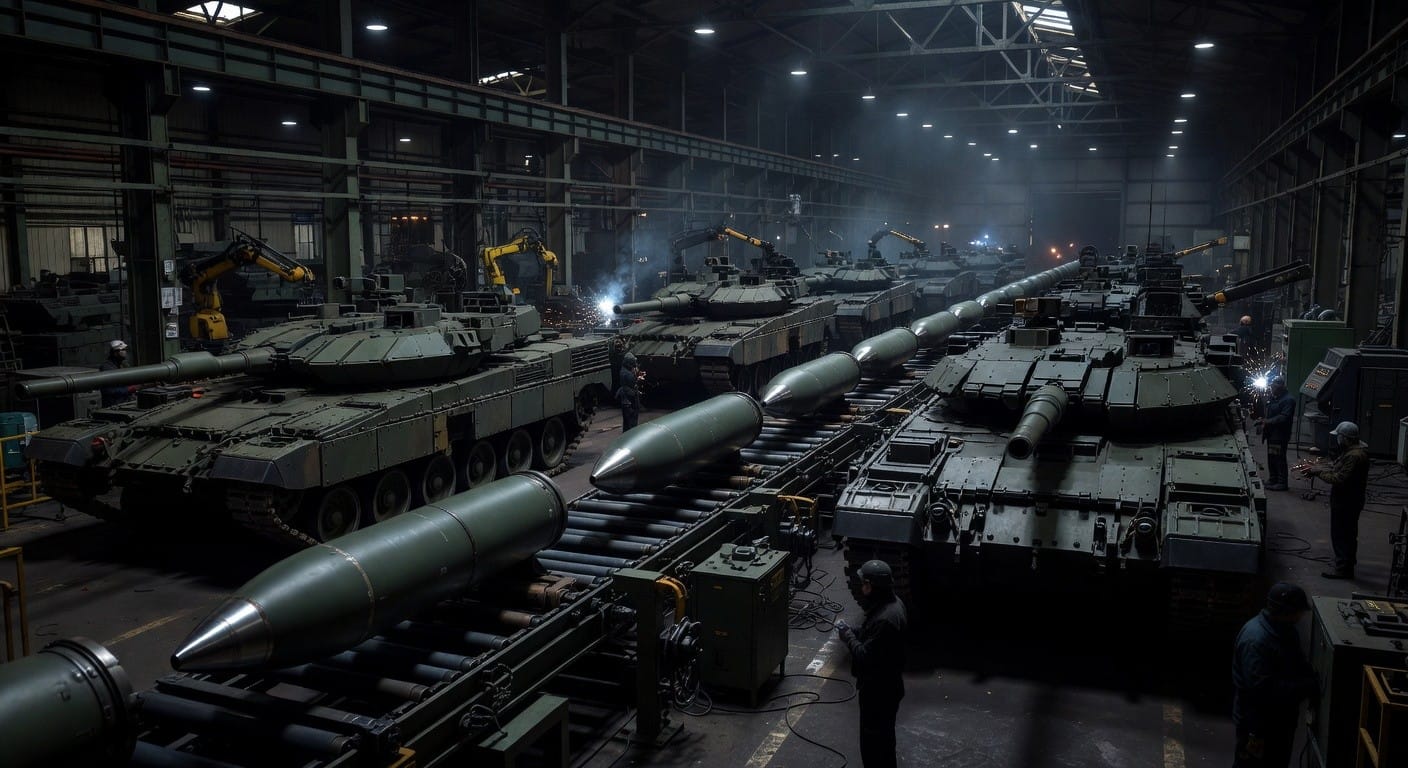
Europe spent the last 70 years outsourcing its security to Washington. That era is over.
In the span of 18 months, the European Union has gone from debating 2% GDP defense targets to mobilizing an €800 billion rearmament program — the largest peacetime military buildup in the continent's history. The strategic shock of a weakened American security guarantee, Russia's grinding war in Ukraine, and the emergence of direct conflict in the Middle East have converged to force a reckoning that European governments spent decades avoiding.
The consequences will ripple through defense stocks, government bond markets, industrial supply chains, and the broader European economy for years. This is the story of how it happened — and what it means.
The Breaking Point
For most of the post-Cold War era, European NATO members treated the 2% GDP defense spending target as a polite suggestion. Germany spent 1.3%. France hovered around 1.9%. Italy rarely cracked 1.5%. The implicit assumption: America would always be there.
That assumption started cracking with Russia's 2022 invasion of Ukraine. It shattered in 2025.
The Trump administration's consistent signals that it viewed NATO as an optional arrangement — combined with a broader pivot toward bilateral dealmaking over multilateral commitments — forced a fundamental question onto European capitals: What happens if the security umbrella closes?
The answer, delivered over the course of one extraordinary year, was Readiness 2030.
What Is Readiness 2030?
On March 4, 2025, European Commission President Ursula von der Leyen stood before the European Parliament and announced what she called a "once-in-a-generation" defense investment surge. The plan — initially branded "ReArm Europe" before being rebranded after political pushback — is built on five pillars:
-
Fiscal flexibility: Activating the EU's Stability and Growth Pact escape clause, allowing member states to run higher deficits to fund defense — up to 1.5% of GDP per year for four years.
-
SAFE loans: A €150 billion joint procurement instrument — the Security Action for Europe fund — allowing member states to borrow collectively for shared capabilities like air defense systems, ammunition, and drones.
-
EIB expansion: The European Investment Bank was given expanded authority to lend for dual-use (civil-military) infrastructure projects.
-
Cohesion fund redirection: EU structural funds — historically earmarked for regional development — can now be redirected toward defense-related industrial capacity.
-
Private capital mobilization: Through a revamped "savings and investments union," private investors are being channeled toward defense and critical infrastructure assets.
The total €800 billion is not a single fund — it's a combination of national spending boosts, joint EU financing, and mobilized private capital. The target: spend it over four years, transforming Europe's defense industrial base from a Cold War relic into a modern, autonomous, high-capacity force.
Germany Goes All In
No country exemplifies the shift more dramatically than Germany.
For decades, Berlin's post-war political culture treated military spending with deep suspicion. The concept of Kriegstüchtigkeit — "war fitness" — was almost unspeakable in polite political discourse. Then Russia invaded Ukraine, and German Chancellor Olaf Scholz announced a Zeitenwende: a historic turning point.
By 2026, Germany has become Europe's largest defense spender — projected to spend approximately $127 billion annually, surpassing both the UK ($84 billion) and France ($70 billion). A special €100 billion modernization fund has been deployed for weapons systems, readiness, and NATO commitments. Plans are underway to restore a version of compulsory military service.
The beneficiary? Germany's own defense industry, and Rheinmetall AG above all.
In March 2026, Rheinmetall — Europe's largest ammunition and armored vehicle manufacturer — forecasted an annual order boom of $16.8 billion, having now pivoted its business entirely toward defense. The company is on course to become Germany's most valuable industrial company.
The Industrial Supply Chain Race
The bottleneck isn't money. It's production.
Europe's defense industrial base atrophied over three decades of the "peace dividend." Ammunition factories were shuttered. Defense contractor workforces shrank. Supply chains for critical components — propellants, electronics, specialized steel — were consolidated or offshored.
The Ukraine war exposed this brutally. European NATO members found they couldn't sustain artillery shell deliveries to Kyiv without depleting their own stockpiles. The rate of consumption in modern industrial warfare vastly exceeded what Europe could produce.
The Readiness 2030 program is, at its core, an attempt to rebuild that capacity at speed. SAFE loan proceeds are being directed specifically toward:
- Ammunition production scaling (155mm artillery shells are a priority)
- Air and missile defense systems (IRIS-T, Patriot, SAMP/T)
- Drone manufacturing (both attack and reconnaissance)
- Cyber and electronic warfare capabilities
The European Commission's "Defence Readiness Omnibus" regulatory package is simultaneously clearing legal obstacles — procurement rules, export controls, state aid restrictions — that previously slowed the ramp-up.
The Market Implications
The STOXX Europe Aerospace & Defense Index gained over 65% in 2025 alone and is up more than 260% since 2022. Several key stocks have become must-watch for any macro-aware portfolio:
Rheinmetall (RHM.DE — Germany): The flagship. Artillery systems, ammunition, the Lynx infantry fighting vehicle, and the Panther tank. 40-45% sales growth forecast. Backlogs extend into the 2030s.
BAE Systems (BA.L — UK): Europe's largest defense company by market cap. Ships, submarines, combat aircraft, electronic warfare. Strong order book from NATO modernization programs.
Saab (SAAB-B.ST — Sweden): The Gripen fighter, the Carl-Gustaf rocket system, and a rapidly expanding missile portfolio. Sweden's NATO accession and Nordic rearmament have supercharged its order book.
Leonardo (LDO.MI — Italy): Helicopters, radar, naval electronics, cybersecurity. Betting heavily on EU institutional contracts.
Thales (HO.PA — France): Air defense radar, electronic warfare, communications. Positioned for the air defense surge across NATO's eastern flank.
For broader exposure, the Select STOXX Europe Aerospace & Defense ETF (EUAD) provides diversified access to the sector without single-stock risk.
The Risks
No investment thesis is without friction.
Valuation: Many European defense stocks have already priced in significant future growth. Rheinmetall, for example, has pulled back ~20% from its 2025 highs as investors begin demanding earnings proof rather than promise. The risk: disappointing order conversion rates or execution delays could compress multiples.
Political fragility: The Readiness 2030 consensus required rare political unity. A shift in government in Germany, France, or Hungary — or renewed debate about joint EU borrowing — could slow implementation. Defense budgets approved in principle are different from money actually flowing to contracts.
Supply chain bottlenecks: Scaling up defense production requires skilled labor, specialized raw materials, and qualified subcontractors that cannot be conjured overnight. Lead times for some systems extend years into the future.
Antitrust friction: The European Commission is still grappling with how to handle defense sector consolidation. Proposed mergers that would accelerate industrial scale-up are facing regulatory scrutiny designed for a world that no longer exists.
The geopolitical wildcard: A negotiated end to the Ukraine conflict — particularly one that leads to reduced threat perception — could take the political oxygen out of rearmament budgets faster than industry can absorb. Markets would re-price accordingly.
The Bottom Line
Europe's rearmament is not a cyclical uptick in defense budgets. It is a structural realignment of the continent's industrial, fiscal, and strategic posture — one driven by a threat environment that has fundamentally changed since 2022.
The €800 billion Readiness 2030 program is the largest coordinated defense investment the EU has ever attempted. Germany alone is committed to becoming NATO's most powerful conventional military force within this decade. Defense companies with deep backlogs, proven production capacity, and exposure to European institutional procurement are sitting in the middle of a multi-year tailwind.
The window to position before this story fully enters mainstream investor consciousness may already be narrowing.
Get this level of intelligence every day. Subscribe to AlphaBriefing — free, member, and paid tiers available.
Sources & Further Reading
- Reuters — NATO sees sharp increase in Europe and Canada defense spending
- Breaking Defense — Germany's Rheinmetall predicts $16.8B annual order boom, will focus entirely on defense
- European Parliament — ReArm Europe / Readiness 2030 briefing
- DW — European NATO defense spending rose by almost 20% in 2025
- Janus Henderson — European defense stocks: the magnitude of Europe's rearmament remains underappreciated
- Wall Street Journal — Europe's $1 trillion race to build back its defense industry
- Financial Times — Europe arms spending single market push
- Kinstellar — Defence Readiness Omnibus: €800 billion to be spent on defence in the next four years
Disclaimer
AlphaBriefing is an independent intelligence publication. The content in this article is produced for informational and educational purposes only. Nothing published by AlphaBriefing constitutes financial, investment, legal, tax, or regulatory advice, nor should it be construed as a solicitation or recommendation to buy, sell, or hold any security, asset, or financial instrument.
All views expressed are those of the author at the time of writing and are subject to change without notice. Markets are volatile and unpredictable; past performance is not indicative of future results. Any investment involves risk, including the possible loss of principal.
AlphaBriefing and its principals, employees, or contributors may hold positions in securities or assets mentioned in this article. This should be considered a potential conflict of interest. No material relationship with any company referenced exists unless explicitly disclosed. Readers should conduct their own due diligence and consult qualified financial, legal, and tax advisors before making any investment decisions.
Information in this article is drawn from public sources believed to be reliable at the time of publication. AlphaBriefing makes no warranty, express or implied, as to the accuracy, completeness, or timeliness of any information herein. AlphaBriefing accepts no liability for any loss or damage arising from reliance on this content.
© AlphaBriefing. All rights reserved. Unauthorised reproduction or distribution is prohibited.