China's Energy Lifeline Is Being Cut Off. Here's What Happens Next.

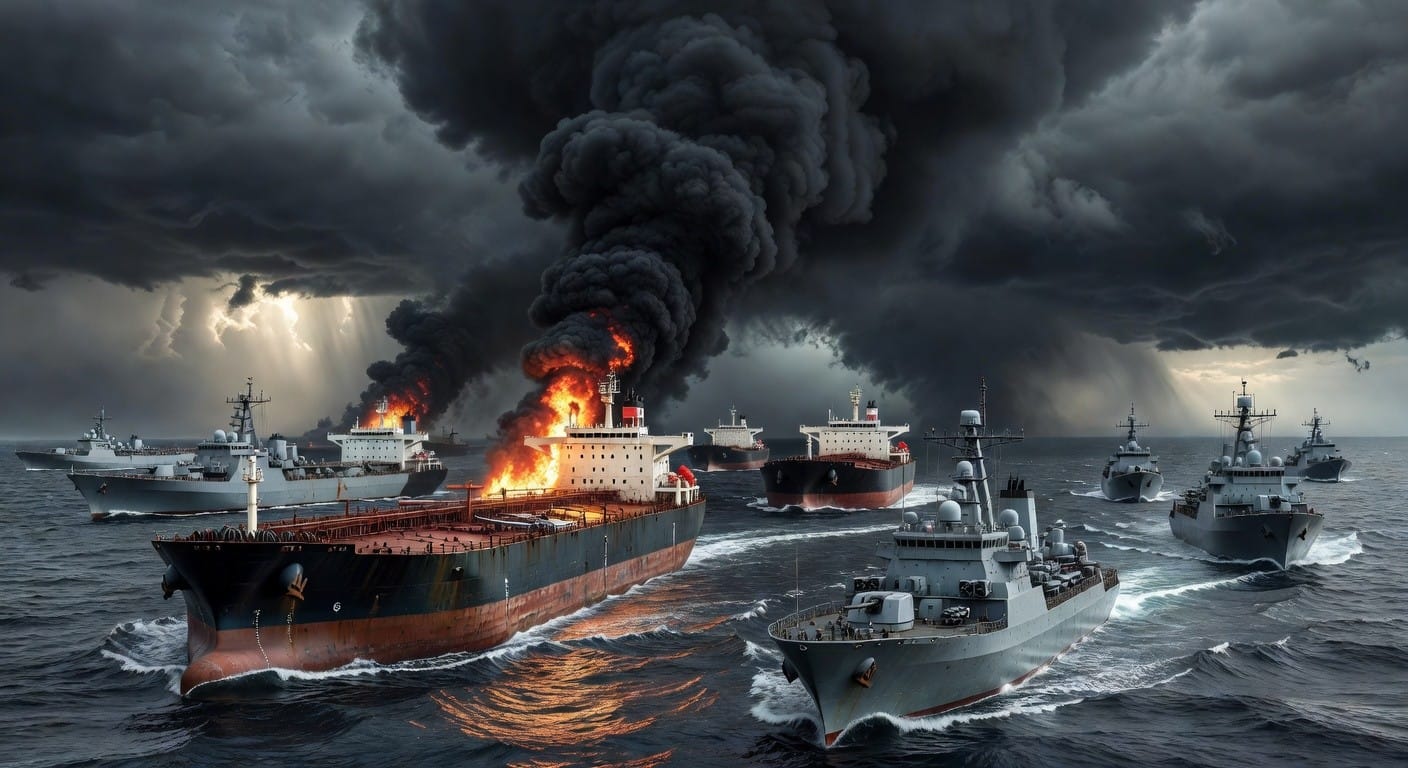
The Iran war has been burning for six weeks. The Strait of Hormuz remains choked. Oil is trading above $105 a barrel. And while the world's attention has fixed on Tehran, Washington, and Tel Aviv, one country is quietly recalculating everything: China.
Beijing has officially stayed neutral. It has called for de-escalation. It has offered to mediate. But beneath the diplomatic language, China is staring at an energy vulnerability that no amount of careful positioning can fully hide — and the way it responds over the next few months could reshape global oil markets, the US-China relationship, and the balance of power across the Indo-Pacific.
The Numbers Behind the Exposure
China is the world's largest crude oil importer, pulling in roughly 11–12 million barrels per day. Of that, approximately 42–50% transits the Strait of Hormuz. Saudi Arabia alone supplies around 14% of Chinese crude imports. Iraq adds another 11%. The UAE chips in 7%. Then there's Iran — officially minimal volumes, but in reality an estimated 1.38 million barrels per day in 2025 flowed into Chinese "teapot" refineries via third-country relabeling.
When Iran closed the Strait on March 4 — a retaliatory move following the US-Israeli strike campaign that began February 28 — it effectively blockaded the single most important chokepoint in China's energy supply chain. Not a disruption. A near-shutdown.
Brent crude surged from $72 pre-war to above $112 by late March, peaking near $120 at points. Asian LNG spot prices doubled to $25 per million BTU. China's import bill exploded overnight.
China's Buffer — And Its Limits
Beijing was not entirely unprepared. In the weeks before the war, China had aggressively pre-positioned. January–February 2026 imports were up 16% year-on-year, adding to strategic reserves that now stand at roughly 1.39 billion barrels — more than 120 days of net imports at pre-war levels.
Russian crude imports have surged 41% year-on-year in the first two months of 2026, and "teapot" refineries are drawing down stored Iranian and Russian barrels. Saudi Arabia and the UAE can reroute some volumes via pipeline and the Red Sea, bypassing Hormuz entirely — potentially 4–5 million barrels per day in alternative routing capacity.
On the structural side, China's energy transition has genuinely reduced its oil exposure. Renewables and EVs now displace an estimated 1 million-plus barrels per day of demand that would otherwise sit at the mercy of Gulf shipping lanes.
But none of this fully closes the gap. Reserves are finite. Russia's export infrastructure has capacity limits. A prolonged Hormuz closure — stretching beyond two to three months — starts producing outcomes that no amount of pre-positioning can absorb: cost-push inflation across Chinese manufacturing, stress on fertilizer and plastics supply chains, and a GDP drag that analysts estimate could reach 1–2% in a worst-case scenario.
The Geopolitical Calculation
Here is where it gets interesting for investors and strategists.
China has enormous leverage in this crisis — and almost no good way to use it.
On one hand, Beijing could theoretically accelerate pressure on Washington by threatening to deploy its own naval assets, by sharply escalating support for Iran's regional proxies, or by weaponizing the rare earths and critical mineral supply chains it still controls. None of these options are cost-free. A direct confrontation with US forces in the Gulf risks a conflict China is not ready for. Doubling down on Iran support risks permanent damage to Gulf Arab relationships — Saudi Arabia, the UAE, Qatar — relationships China has spent a decade carefully cultivating as an alternative to US dependency.
On the other hand, doing nothing has costs too. Every day the Strait stays closed, China bleeds energy dollars and watches the gap between its rhetoric of multipolarity and the reality of US military dominance widen in real time.
Beijing's current posture — active neutrality, quiet reserve drawdown, discreet pivot to Russian supply — is the most rational play available. But it is a holding action, not a strategy.
The delayed Trump-Xi summit (previously eyed for May, now complicated by the Iran crisis) will be the first major test of whether the two powers can build a framework that separates their bilateral relationship from the Gulf conflict — or whether the war becomes yet another accelerant in their structural rivalry.
What It Means for Markets
The immediate implications are already priced in — $100+ oil, elevated LNG, stress on Asian manufacturing margins. The more interesting question is what happens in the scenarios the market hasn't fully modeled:
Scenario 1 — Short war, quick reopening: If the Strait reopens within 60–90 days, markets snap back, China's reserves prove adequate, and the main lasting damage is a deepened conviction in Beijing that energy diversification is existential. Long-term beneficiary: Russian pipeline gas, domestic renewables, nuclear.
Scenario 2 — Prolonged closure, 6+ months: Oil sustains above $110. Chinese manufacturing costs embed structural inflation. Beijing accelerates decoupling from dollar-denominated oil markets — potentially fast-tracking yuan-settled crude contracts with Gulf states. Long-term beneficiary: non-dollar commodity settlement infrastructure, CNOOC, CPEC logistics corridors.
Scenario 3 — Chinese intervention or escalation: Low probability but non-zero. If China decides the cost of passivity exceeds the cost of action, markets face a category-five event — oil potentially above $150, global supply chains fracturing, a military confrontation that makes every other risk calculation irrelevant.
The Bottom Line
The Iran war isn't just a Middle East story. It is a live-fire stress test of the global order — and China is the country whose response will do the most to define what comes next.
Beijing has bought itself time with strategic reserves and Russian oil. But time is the one resource it can't stockpile indefinitely. The decisions made in the next 60 days — at the summit table, at the Hormuz negotiating table, and inside China's National Development and Reform Commission — will have consequences that outlast the war itself.
For investors, the question isn't just where oil goes from here. It's what kind of world emerges when the smoke clears.
Get this level of intelligence every day. Subscribe to AlphaBriefing — free, member, and paid tiers available.
Sources & Further Reading
- Columbia University SIPA — Implications of the Middle East Conflict for China's Energy Security
- Reuters — China's Heavy Reliance on Iranian Oil Imports, 2026
- CNBC — China Oil Shock: Iran War, Hormuz, Energy Transition
- Wikipedia — Economic Impact of the 2026 Iran War
- Atlantic Council — What a Middle East Oil and LNG Crisis Means for China and East Asia
- Reuters — Dozens of Countries Discuss Coalition to Secure Passage Through Strait of Hormuz
- Brookings — The Delayed Trump-Xi Summit: Iran and the US-China Relationship
- PIIE — China No Longer Buys US Exports: Drawing the Right Lessons
Disclaimer
AlphaBriefing is an independent intelligence publication. The content in this article is produced for informational and educational purposes only. Nothing published by AlphaBriefing constitutes financial, investment, legal, tax, or regulatory advice, nor should it be construed as a solicitation or recommendation to buy, sell, or hold any security, asset, or financial instrument.
All views expressed are those of the author at the time of writing and are subject to change without notice. Markets are volatile and unpredictable; past performance is not indicative of future results. Any investment involves risk, including the possible loss of principal.
AlphaBriefing and its principals, employees, or contributors may hold positions in securities or assets mentioned in this article. This should be considered a potential conflict of interest. No material relationship with any company referenced exists unless explicitly disclosed. Readers should conduct their own due diligence and consult qualified financial, legal, and tax advisors before making any investment decisions.
Information in this article is drawn from public sources believed to be reliable at the time of publication. AlphaBriefing makes no warranty, express or implied, as to the accuracy, completeness, or timeliness of any information herein. AlphaBriefing accepts no liability for any loss or damage arising from reliance on this content.
© AlphaBriefing. All rights reserved. Unauthorized reproduction or distribution is prohibited.