The Peace Broker: How China Is Quietly Winning the Iran War Without Firing a Shot
Beijing didn't send warships. It sent diplomats. How China's behind-the-scenes mediation in the Iran war is reshaping global power — and what it means for markets.

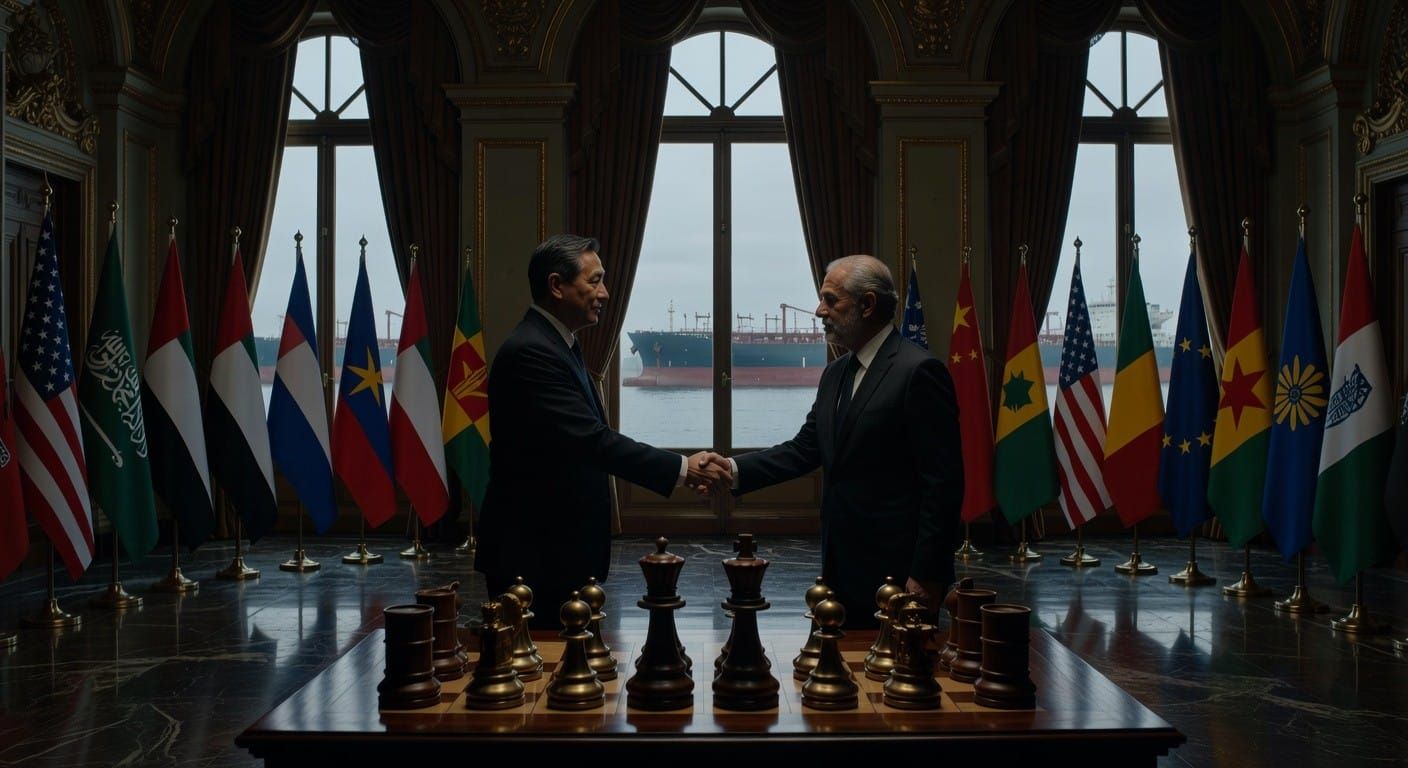
Beijing didn't send warships. It didn't impose sanctions. It didn't grandstand at the UN Security Council. Instead, China dispatched Special Envoy Zhai Jun on a series of quiet shuttle missions across the Middle East, racked up 26 phone calls between Foreign Minister Wang Yi and regional leaders, and co-authored a five-point peace plan with Pakistan that even Washington grudgingly acknowledged had merit.
The result: a fragile ceasefire that, as of this writing, still holds — tenuously — over the Iran war.
And in the process, Beijing may have reshaped the global order more than any aircraft carrier strike group ever could.
The Quiet Campaign
When U.S. and Israeli strikes hit Iranian targets on February 28, triggering Iran's partial closure of the Strait of Hormuz and the worst energy shock since the 1973 oil embargo, the world braced for escalation. Washington deployed carrier strike groups. Tehran threatened to mine the entire Persian Gulf. Oil spiked past $100 a barrel.
China's response was conspicuously different: diplomacy at scale, conducted almost entirely behind closed doors.
Starting in early March, Beijing launched a coordinated diplomatic offensive that looked nothing like its usual cautious, statement-issuing foreign policy. Zhai Jun crisscrossed Tehran, Riyadh, Abu Dhabi, and Islamabad. Wang Yi worked the phones with Iranian, Israeli, Russian, and Gulf state leaders. And on approximately April 1, China and Pakistan jointly unveiled a five-point framework calling for an immediate ceasefire, formal peace negotiations, protection of civilian infrastructure, regional security guarantees, and freedom of navigation through the Strait of Hormuz.
It worked — at least partially. On April 8, Iran accepted a two-week ceasefire. Iranian officials privately confirmed that Beijing had been the decisive influence, urging "flexibility." President Trump, in a press conference, acknowledged China's role while insisting the ceasefire was ultimately an American achievement.
Why Beijing Moved
China's motivations are straightforward — and enormous.
Oil dependency. Iran supplied approximately 1.38 million barrels per day to China through 2025, roughly 12-13% of total Chinese crude imports. By March 2026, as the war disrupted alternative Gulf suppliers, Iran briefly surged to become China's largest single crude source at 2.5 million barrels per day — a staggering 21.4% of total Chinese seaborne imports. China isn't just Iran's biggest customer. For a critical period, Iran became China's most important supplier.
Beijing had prepared for disruption — strategic petroleum reserves built through 2025 give Chinese refiners an estimated 120+ days of cover — but no stockpile lasts forever. Every week the Strait of Hormuz remains contested costs China billions.
Global image. Beijing has spent years positioning itself as an alternative to what it frames as American unilateralism. The 2023 Saudi-Iran normalization deal, brokered in Beijing, was the template. The Iran war offered a far higher-stakes canvas: if China could credibly claim to have brokered peace — or at least a pause — in a conflict that the United States started, the narrative writes itself.
Avoiding a trap. China walked a razor's edge. Too much support for Iran risks U.S. secondary sanctions and a trade war escalation Beijing cannot afford. Too little risks losing its most important sanctioned oil supplier and its credibility as a "responsible great power." The solution: influence without commitment, pressure without fingerprints.
The Market Impact Is Already Massive
The financial consequences of the Hormuz disruption — and the ceasefire it produced — are playing out across every major asset class.
Energy. Brent crude sits at approximately $105 per barrel as of April 25, having spiked above $100 earlier this month. Daily vessel traffic through Hormuz fell by an estimated 95% at the peak of the crisis. War risk insurance premiums for Gulf transits surged 500-1,000%, with VLCC tanker insurance costs hitting $2-4 million per voyage — up from roughly $250,000-$750,000 pre-conflict.
Shipping. Freight rates quadrupled. VLCC charter rates reportedly hit $800,000 per day. The Lloyd's Joint War Committee expanded its high-risk zone designation to cover the entire Persian Gulf and extended into the Red Sea and Gulf of Aden.
Sovereign responses. Governments have stepped in as insurers of last resort. The U.S. Development Finance Corporation created a $40 billion reinsurance facility for commercial shipping. India announced $1.5 billion in sovereign guarantees plus a $300 million emergency claims fund. These are extraordinary measures — the kind typically reserved for existential economic threats.
Growth. The IMF, in its April 14 World Economic Outlook, cut its 2026 global growth forecast to 3.1%, down from a pre-conflict projection of 3.4%. The Fund was explicit: this assumes a "limited and short-lived conflict." A prolonged war or renewed Hormuz closure could push the global economy toward recession.
What the Ceasefire Actually Means — and Doesn't
The current ceasefire, brokered through Pakistan-mediated indirect talks, is fragile by any measure. Israel's Defense Minister stated on April 23 that Israeli forces are "prepared to resume the war against Iran" and are awaiting a U.S. green light. Iran has warned of "harsher retaliation" if strikes resume. Trump extended a separate ceasefire arrangement with Hezbollah in Lebanon by three weeks on April 25 — a sign that the broader conflict architecture remains deeply unstable.
The ceasefire has not normalized shipping through Hormuz. Insurance premiums remain 8x pre-war levels. Vessel traffic has partially resumed but remains far below normal. And the underlying conflict — the U.S. naval blockade of Iranian ports, initiated April 13 — remains in place.
In other words: the ceasefire bought time. It did not buy peace.
The Bigger Picture: China's New Diplomatic Leverage
What matters most for investors and strategists is not whether this particular ceasefire holds — it may not — but what China's role reveals about the shifting architecture of global power.
Three things stand out:
First, China has demonstrated that it can influence outcomes in conflicts where the United States is a direct belligerent. This is qualitatively different from the Saudi-Iran deal in 2023, which involved two regional powers. Here, Beijing pressured a party (Iran) to accept terms in a war with Washington — and Washington noticed.
Second, China's diplomatic capital is growing precisely because it isn't a combatant. In a region exhausted by American military interventions and Israeli operations, Beijing's pitch — trade, not troops — resonates with Gulf states, Pakistan, and even elements within Tehran who see China as the only counterweight with enough economic leverage to matter.
Third, this creates a new form of geopolitical risk that markets haven't fully priced. If China's diplomatic influence over Iran grows, it could complicate future U.S. military options in the Gulf. It could also create new channels for sanctions evasion, energy trade rerouting, and security arrangements that bypass Western-led institutions entirely.
The Investment Lens
For investors parsing these dynamics, several themes emerge:
Energy will stay expensive. Even if the ceasefire holds, Hormuz risk premiums are likely to persist for months or years. Shipping insurance, freight rates, and energy prices all reflect a structural repricing of Gulf transit risk. Long energy, long tanker equities, long defense contractors with Gulf exposure.
China's strategic petroleum position matters. Beijing entered this conflict with strategic reserves estimated at more than three times U.S. levels. That buffer gives Chinese policymakers — and by extension, Chinese-listed energy companies — more room to maneuver than Western counterparts.
Emerging market mediators gain clout. Pakistan's role as a ceasefire host, alongside China, is elevating Islamabad's strategic profile. Watch for increased Gulf investment flows into Pakistan, potential IMF program upgrades, and a diplomatic dividend that could improve the country's risk profile.
The "peace premium" is fragile. Markets rallied on ceasefire hopes. But every reassurance from Beijing or Islamabad is met by hawkish signals from Jerusalem and uncertain commitments from Washington. Positioning for renewed volatility is prudent.
The Bottom Line
China didn't fire a shot. It may not even get formal credit for the ceasefire. But in the fog of the Iran war, Beijing has quietly advanced a proposition that investors need to take seriously: that the next global order won't be imposed by the country with the most aircraft carriers, but by the one best positioned to broker the peace.
Whether that proposition holds — or collapses under the weight of a resumed conflict — will define markets for the rest of 2026.
Get this level of intelligence every day. Subscribe to AlphaBriefing — free, member, and paid tiers available.
Sources & Further Reading
- AP News — China's Behind-the-Scenes Role in Iran War Diplomacy
- Al Jazeera — How China Is Gaining From Iran War by Showing It Is 'Different From US'
- Reuters — China's Heavy Reliance on Iranian Oil Imports
- IMF — World Economic Outlook, April 2026
- World Economic Forum — How Middle East War Is Turning Governments Into Insurers of Last Resort
- Reuters — India Plans Sovereign Guarantees as Iran War Heightens Shipping Risks
- S&P Global — War Risk Insurance Costs Still Elevated in Persian Gulf
Disclaimer
AlphaBriefing is an independent intelligence publication. The content in this article is produced for informational and educational purposes only. Nothing published by AlphaBriefing constitutes financial, investment, legal, tax, or regulatory advice, nor should it be construed as a solicitation or recommendation to buy, sell, or hold any security, asset, or financial instrument.
All views expressed are those of the author at the time of writing and are subject to change without notice. Markets are volatile and unpredictable; past performance is not indicative of future results. Any investment involves risk, including the possible loss of principal.
AlphaBriefing and its principals, employees, or contributors may hold positions in securities or assets mentioned in this article. This should be considered a potential conflict of interest. No material relationship with any company referenced exists unless explicitly disclosed. Readers should conduct their own due diligence and consult qualified financial, legal, and tax advisors before making any investment decisions.
Information in this article is drawn from public sources believed to be reliable at the time of publication. AlphaBriefing makes no warranty, express or implied, as to the accuracy, completeness, or timeliness of any information herein. AlphaBriefing accepts no liability for any loss or damage arising from reliance on this content.
© AlphaBriefing. All rights reserved. Unauthorized reproduction or distribution is prohibited.