Blood Alliance: North Korea Just Built a War Memorial for Its Troops Killed Fighting Russia's War — and It Changes Everything
Kim Jong Un just inaugurated a memorial for 6,000 North Korean casualties in Ukraine. The blood-for-technology pipeline between Pyongyang and Moscow is reshaping the Indo-Pacific security order — and investors need to pay attention.

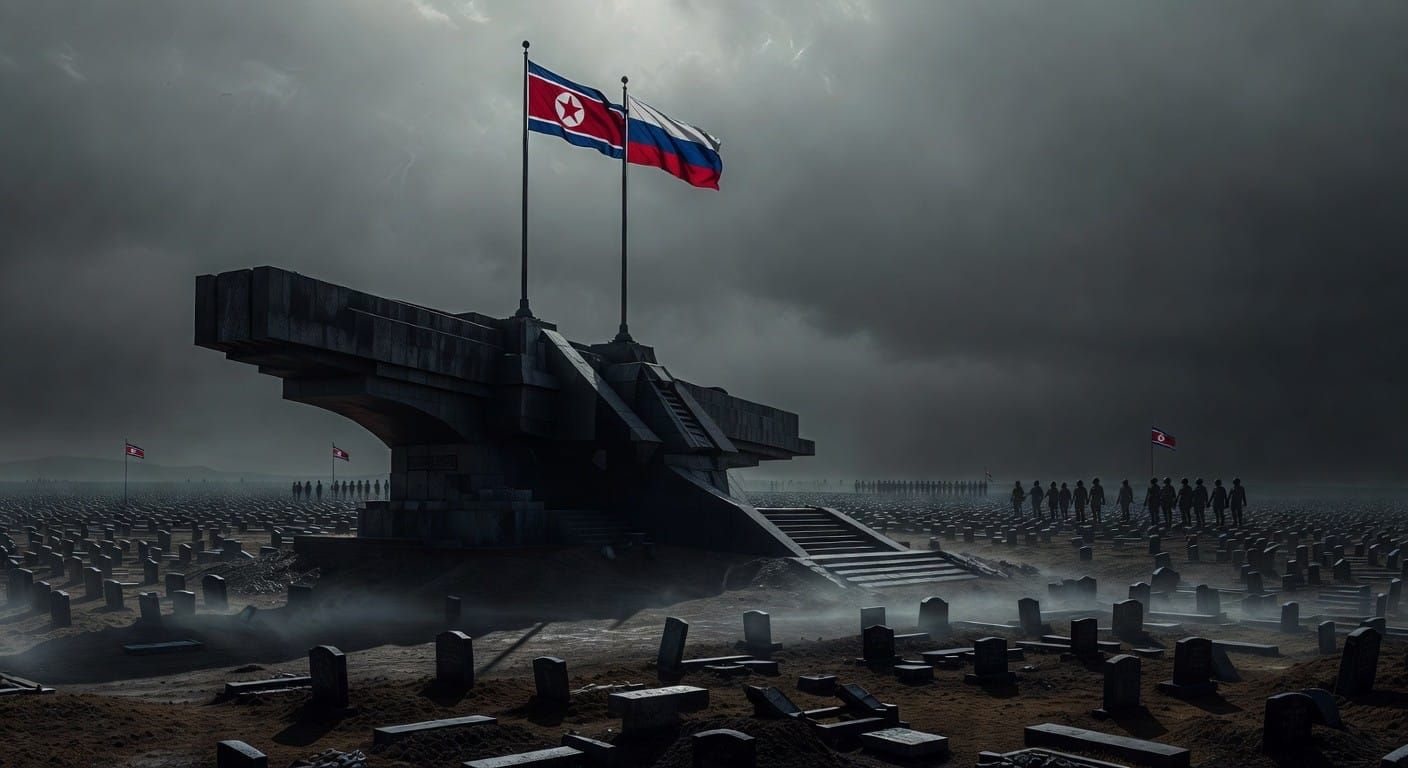
Today, as the world's attention remained fixed on the Strait of Hormuz and oil prices, something extraordinary happened in Pyongyang.
Kim Jong Un inaugurated a war memorial museum — not for a hypothetical conflict, but for thousands of North Korean soldiers killed fighting Russia's war in Ukraine. Russian Defense Minister Andrei Belousov attended. Vladimir Putin sent a personal letter of gratitude. Medals were pinned to North Korean uniforms.
This isn't Cold War nostalgia. It's a new military alliance being forged in blood — and it's already reshaping the security calculus for every country in the Indo-Pacific.
The Blood Price
South Korean intelligence estimates approximately 6,000 North Korean troops have been killed or wounded since Pyongyang began deploying forces to Russia's Kursk front in late 2024. The memorial museum, located in Pyongyang and inaugurated on April 27, coincides with the one-year anniversary of Russia's recapture of Kursk from Ukrainian forces.
Kim's speech at the ceremony left no room for ambiguity. He praised his soldiers' "heroic sacrifices," emphasized the "strategic significance" of the deployments, and signaled that North Korea's military involvement alongside Russia will continue indefinitely.
This is the first time in modern history that North Korea has built a war memorial for troops killed fighting overseas. It marks a dramatic departure from decades of plausible deniability. Pyongyang isn't just helping Russia — it's publicly celebrating the partnership.
What Russia Is Paying
The relationship is not sentimental. It's transactional — and the currency is technology.
Under the June 2024 Treaty on Comprehensive Strategic Partnership, Russia and North Korea established a mutual defense pact with provisions for immediate military assistance. But the real prize for Pyongyang isn't the treaty's Article 4 — it's what flows back across the border in return for soldiers and artillery shells.
Western intelligence agencies have documented an accelerating pipeline of Russian military technology transfers to North Korea:
- Air defense systems: Russia delivered advanced missile defense components in late 2024, significantly upgrading Pyongyang's ability to counter precision strikes.
- Submarine and warship technology: Reports indicate Russian technical assistance for North Korea's submarine-launched ballistic missile program.
- Fighter jets: Intelligence reports suggest negotiations over Su-35 deliveries, which would represent a generational leap for the Korean People's Air Force.
- Multiple-warhead missile technology: Perhaps most alarming, Washington Post reporting indicates potential Russian assistance with MIRV capabilities — the ability to put multiple nuclear warheads on a single missile.
In exchange, North Korea has provided Russia with over 11,000 troops, millions of artillery shells, and KN-23/24 ballistic missiles — a package estimated at roughly $14 billion in total value.
The Feedback Loop
Here's what makes this alliance uniquely dangerous: North Korean soldiers are gaining real combat experience in Ukraine, then returning home with skills that directly enhance Pyongyang's conventional and asymmetric warfare capabilities.
This isn't theoretical. North Korean units in Kursk have been involved in infantry combat, drone operations, and combined arms maneuvers — exactly the kind of experience the Korean People's Army has lacked since the 1953 armistice. Every surviving soldier who returns to the peninsula carries tactical knowledge that no amount of peacetime training can replicate.
Meanwhile, the technology transfers are creating a more capable North Korean military across every domain — air, sea, undersea, and nuclear. The result is a feedback loop: North Korea sends troops and ammunition to Russia, gains combat experience and advanced technology in return, and emerges as a significantly more dangerous adversary for South Korea, Japan, and the United States.
The Indo-Pacific Response
The region is already reacting. South Korea has finalized a 2026 defense budget of 65.86 trillion won ($44.8 billion) — a 7.5% increase focused on drones, robotics, and missile defense. Japan's defense spending has hit a record 9 trillion yen ($58 billion), pushing toward the 2% of GDP target ahead of schedule.
Both countries have resumed joint military exercises halted nearly a decade ago, and trilateral cooperation with the United States has deepened to include real-time missile warning sharing. The logic is straightforward: if North Korea is becoming a battle-tested, technologically upgraded military power backed by Russia's nuclear arsenal, the democratic alliance in Northeast Asia needs to match the escalation.
For investors, this acceleration has direct consequences:
- South Korean and Japanese defense contractors are benefiting from sustained budget increases with multi-year procurement commitments.
- The won and yen face periodic geopolitical risk premiums tied to Korean Peninsula tensions.
- Global defense primes with Indo-Pacific exposure — Lockheed Martin, Northrop Grumman, Raytheon — have structural tailwinds from ally defense spending surges.
- Insurance and reinsurance markets are quietly repricing Korean Peninsula risk, with implications for companies operating in the region.
The Bigger Picture
The Pyongyang memorial is a symbol, but the strategic reality it represents is concrete. The post-Cold War assumption that North Korea was an isolated, technologically stagnant regime is no longer operative. Through its partnership with Russia, Pyongyang is acquiring capabilities that fundamentally alter the balance of power in Northeast Asia.
This also creates a proliferation problem that extends beyond the Korean Peninsula. If Russia is willing to transfer advanced weapons technology to North Korea in exchange for battlefield support, the precedent applies globally. Every sanctioned state with something Moscow needs — troops, ammunition, raw materials — now has a potential path to military modernization.
The North Korea-Russia axis is no longer a diplomatic curiosity. It's a functioning military alliance, validated in combat, sealed in blood, and celebrated in marble. The memorial in Pyongyang isn't the end of a chapter — it's the beginning of one.
Get this level of intelligence every day. Subscribe to AlphaBriefing — free, member, and paid tiers available.
Sources & Further Reading
- AP News — North Korea Opens Memorial Museum for Troops Killed Fighting for Russia in Ukraine
- Washington Post — North Korea Opens Memorial for Soldiers Killed Fighting for Russia
- NBC News — Kim Jong Un Vows to Continue Support for Russia as Memorial Opens
- Korea Times — North Korea Expanding Nukes, Missiles Poses Significant Threat
- Reuters — South Korea, Japan Defense Ministers Agree to Upgrade Cooperation
- CSIS — The New Russia-North Korea Security Alliance
Disclaimer
AlphaBriefing is an independent intelligence publication. The content in this article is produced for informational and educational purposes only. Nothing published by AlphaBriefing constitutes financial, investment, legal, tax, or regulatory advice, nor should it be construed as a solicitation or recommendation to buy, sell, or hold any security, asset, or financial instrument.
All views expressed are those of the author at the time of writing and are subject to change without notice. Markets are volatile and unpredictable; past performance is not indicative of future results. Any investment involves risk, including the possible loss of principal.
AlphaBriefing and its principals, employees, or contributors may hold positions in securities or assets mentioned in this article. This should be considered a potential conflict of interest. No material relationship with any company referenced exists unless explicitly disclosed. Readers should conduct their own due diligence and consult qualified financial, legal, and tax advisors before making any investment decisions.
Information in this article is drawn from public sources believed to be reliable at the time of publication. AlphaBriefing makes no warranty, express or implied, as to the accuracy, completeness, or timeliness of any information herein. AlphaBriefing accepts no liability for any loss or damage arising from reliance on this content.
© AlphaBriefing. All rights reserved. Unauthorized reproduction or distribution is prohibited.