Beijing Didn't Come to the Summit to Give Up Its Best Card
The September 24 Trump-Xi summit will be sold as detente. The real leverage is a rare-earth licensing regime with a November 10 snapback nobody is watching. Trade the chokepoint, not the photo op.

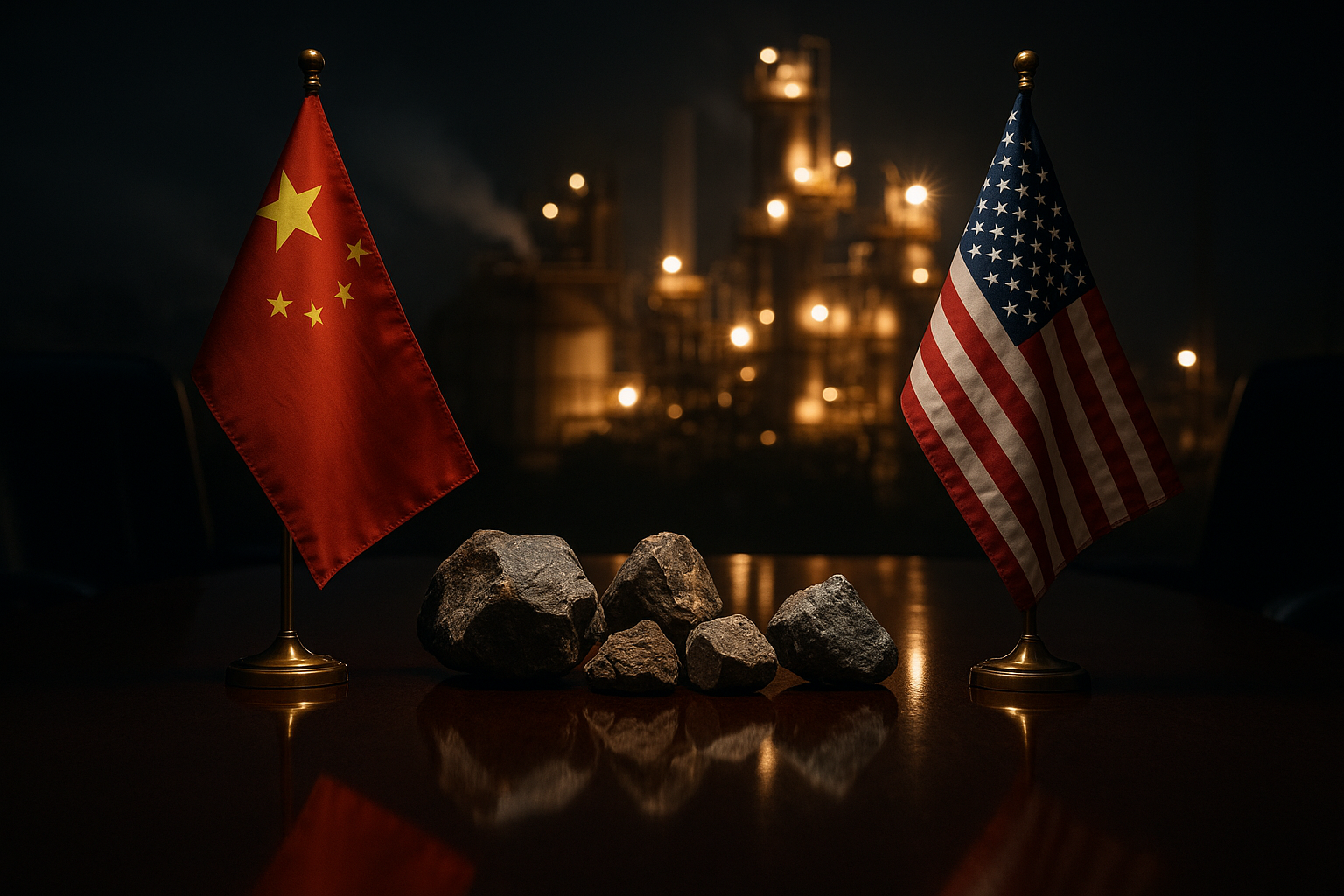
On September 24, Donald Trump will host Xi Jinping in Washington. The stated purpose is to extend the trade truce the two leaders struck in October 2025 — the deal that stopped a tariff spiral from becoming a full economic decoupling. The optics will be détente: handshakes, a communiqué, headlines about "stability." Markets will likely read it as risk-off pressure lifting.
That reading misses where the leverage actually sits. In the twelve months since the truce, Beijing has not stood still. It has quietly rebuilt the single most effective coercive tool it possesses — not tariffs, which hurt both sides symmetrically, but control over the critical minerals the Western industrial base cannot substitute on any timeline that matters. The summit is theater staged on top of a chokepoint. And the chokepoint has a countdown clock on it that almost nobody in the equity market is watching.
That clock reads November 10, 2026 — the date a suite of "paused" Chinese export restrictions is scheduled to snap back into force. The summit is six weeks before it. Understanding why those two dates are the same story is the difference between trading the handshake and trading what the handshake is designed to obscure.
Briefings like this land in members' inboxes before the market prices them in. Join free →
The truce that never touched the real weapon
The October 2025 agreement did what truces do: it froze the most visible escalation. Tariff rates stopped climbing. Both governments could tell domestic audiences they had held the line. But a tariff is a blunt, reciprocal instrument — it taxes trade in both directions and its pain is broadly legible. It is a negotiating tool, not a stranglehold.
China's genuine leverage was never the tariff schedule. It is processing capacity. Beijing controls roughly 90% of global rare-earth processing, alongside dominant shares of tungsten (around 80%) and antimony (around 60%). Mining can, in theory, be diversified — deposits exist in Australia, the US, Africa. Processing is the bottleneck, and it is concentrated in China by decades of accumulated capital, tolerated pollution, and industrial policy the West spent thirty years offshoring. You cannot stand up a separation-and-refining complex in a fiscal quarter. You cannot do it in a fiscal year.
Through 2026, Beijing has been methodically converting that structural dominance into an operational licensing regime:
- Order No. 839, effective June 2026, formalized traceability and export-licensing requirements across a widened list of rare-earth items and dual-use categories.
- China widened targeted export controls to 10 US firms in June and 14 EU firms in July.
- MOFCOM Announcement No. 26, effective July 1, established a public-reporting mechanism for strategic-mineral export-control violations — a whistleblower architecture that signals enforcement, not just rulemaking.
- Enforcement went physical: two Japanese nationals were detained in Dalian over alleged rare-earth-related smuggling, and a Chinese optics executive was placed under compulsory measures for misdeclaring germanium-bearing lenses.
This is not a country preparing to give up its best card at a summit. This is a country building the bureaucratic and criminal-enforcement machinery to use that card with precision — firm by firm, license by license — while keeping headline tariff numbers frozen so the truce survives.
Why the price signal already told you
Markets have a habit of pricing the mechanism before the narrative catches up. The critical-mineral complex has been screaming for months. Gallium is up on the order of 120%, germanium north of 200%, antimony up triple digits. European firms report license approval rates below 25%. The IEA has flagged that something like $6.5 trillion of annual Western downstream production — EVs, defense systems, semiconductors, wind turbines — now runs through inputs exposed to a licensing desk in Beijing.
The equity market keeps treating each Chinese restriction as an isolated headline and each summit as a de-escalation. The commodity market is treating them as one continuous tightening. When the price tape and the political narrative disagree this sharply, the price tape is usually the one that has read the situation correctly.
So the question the summit actually poses is not "will the truce hold?" It almost certainly will, at the tariff level. The question is: what happens on November 10, and who is positioned for it?
The rest of this briefing is for paid members: the three-scenario probability map into November 10, the specific asset vectors that express each scenario (Western separation capacity, the gallium/germanium/antimony complex, the defense-supplier re-rate), and the three tells to watch between the summit and the snapback deadline.
AlphaBriefing Paid gets you every investment thesis, scenario framework, and catalyst brief we publish — the analysis private intel clients pay four figures for, at a fraction of that.