The Race for the Top of the World: How Arctic Competition Is Reshaping the Global Order
The Arctic is melting — and the great powers are racing to claim what emerges. With the US committing $30 billion to icebreakers and Greenland's critical minerals suddenly in play, the High North is graduating from geopolitical narrative to investable reality.

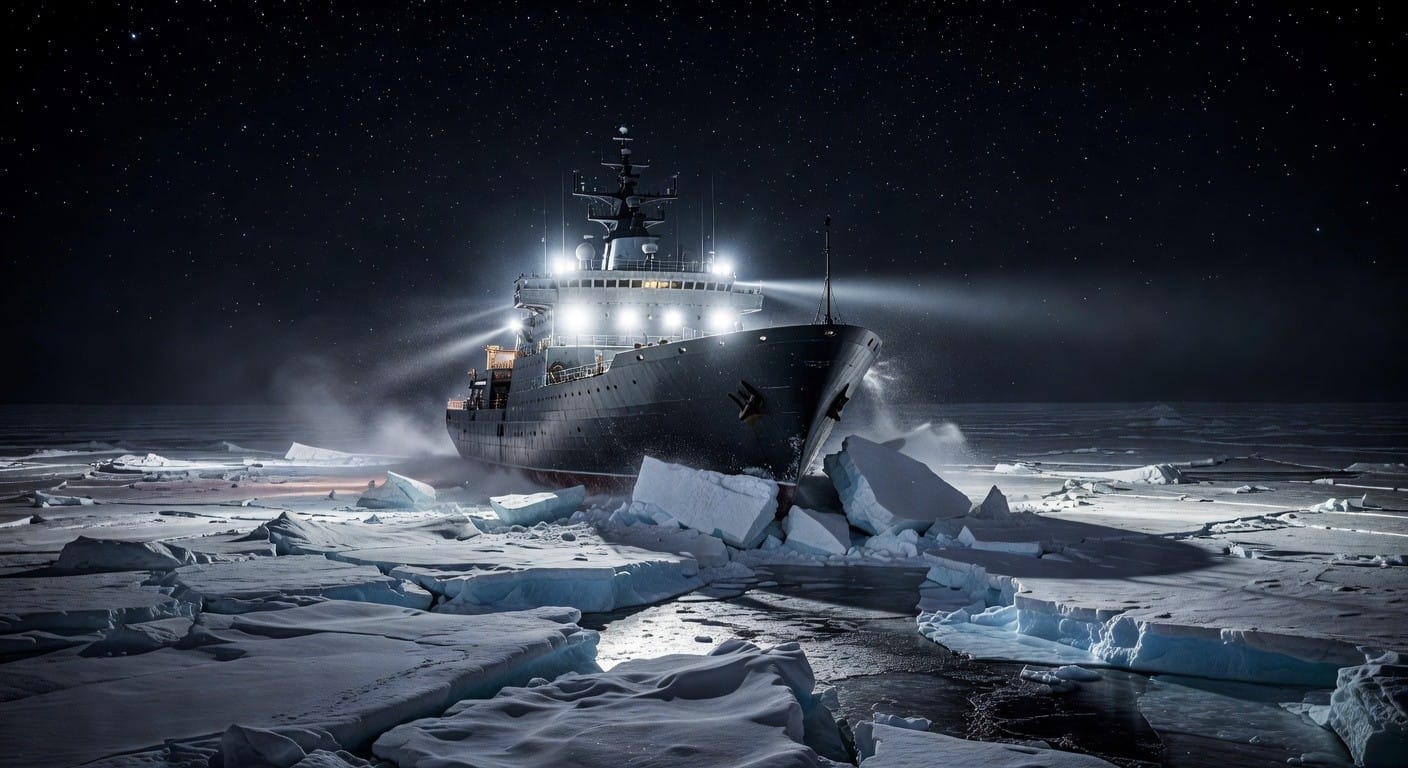
The Arctic was once geography's afterthought — a frozen barrier at the edge of the known world. Today it is the fastest-warming region on Earth, a contested theater where the United States, Russia, and China are deploying hard cash, icebreakers, and strategic doctrine to seize the terrain that climate change is unlocking.
The numbers frame the urgency. The Arctic holds an estimated 13% of the world's undiscovered oil, 30% of its undiscovered natural gas, and mineral deposits worth trillions — including critical inputs for semiconductors, defense systems, and the energy transition. Russia controls the lion's share of Arctic coastline (over 50%) and has militarized it accordingly. China, which calls itself a "near-Arctic state," has poured $9–10 billion into mines, ports, and icebreaking capacity. And the United States, which spent decades neglecting its polar capability, is now scrambling to catch up.
The trigger was a convergence: melting ice opening commercially viable shipping lanes, the Trump administration's aggressive posture on Greenland, and a February 2026 Maritime Action Plan commissioning 11 new polar icebreakers at an estimated cost of $30 billion. The Arctic is no longer a peripheral concern. It is becoming a central front in the contest for the 21st century.
The New Geography of Power
The Northern Sea Route (NSR), hugging Russia's Arctic coast, offers the most dramatic illustration. In a world of fully navigable Arctic summers, Asia-to-Europe shipping times shrink by roughly 4,500 nautical miles — 10–15 days off a standard Rotterdam-to-Shanghai container run. In 2025, over 1,800 vessel transits used the NSR. China completed 14 voyages, including COSCO's first containership crossing. Total cargo: 37 million tonnes.
But the strategic picture is more complicated than pure logistics. Russia controls NSR transit — charging fees, requiring icebreaker escorts, and reserving the right to close the route. For Beijing, that dependency is a strategic vulnerability dressed up as a commercial opportunity. China's "Polar Silk Road" initiative is partly a hedge: build the icebreakers and infrastructure now, accumulate leverage, and ensure that no single power can close the tap.
NATO is watching closely. Finland and Sweden's accession strengthened the alliance's northern flank, but the United States remains materially outgunned in icebreaker capacity. Russia operates roughly 45 icebreakers, including 8 nuclear-powered vessels. China has 3 operational icebreakers with a nuclear-powered unit in development. The US Coast Guard currently has 2 operational heavy icebreakers — one of which is approaching end of life — and 1 medium. That asymmetry is not an oversight. It is a strategic liability.
Greenland: The $12 Trillion Pressure Point
No piece of Arctic real estate has more concentrated geopolitical tension than Greenland. President Trump's push to acquire or control the island — twice floated in his first term, aggressively revived in his second — is not purely rhetorical. Greenland ranks among the world's top ten mineral-endowed territories: 1.5 million tonnes of rare earth elements, significant uranium, copper, graphite, lithium, gold, germanium, and gallium. These are not abstract reserves. They are the feedstock for F-35 components, smartphone displays, electric vehicle batteries, and radar systems.
In January 2026, the Trump administration announced a framework agreement with NATO granting the US and alliance partners preferential mineral rights access while explicitly restricting Chinese involvement. A $12 billion public-private critical minerals stockpile was launched alongside $10 billion in US government financing for domestic manufacturing resilience. The deal stops short of altering Danish sovereignty — but it signals clearly that Washington views Greenland's subsoil as a national security asset.
Investor interest has responded accordingly. Greenland has begun easing permitting and tax conditions. The US Export-Import Bank issued a $120 million loan letter of interest for Tanbreez, the world's tenth-largest rare earth deposit, operated by Critical Metals Corp., a New York-based company that blocked a prior Chinese acquisition attempt. Amaroq Minerals, active in gold, copper, germanium, and gallium extraction, is in active discussions with US government officials on offtake agreements and infrastructure financing.
This is where the analysis gets actionable. AlphaBriefing members get the full investment framework — scenarios, positioning, and the bottom line.
Subscribe to AlphaBriefing — Free, Member, and Paid tiers available.