America Can't Find the Workers It Needs — and It's a Trillion-Dollar Problem
The U.S. needs 2.1 million skilled tradespeople by 2030. It's not even close. The data center boom, energy transition, and reshoring push are all hitting the same wall — and nobody can build their way past it.

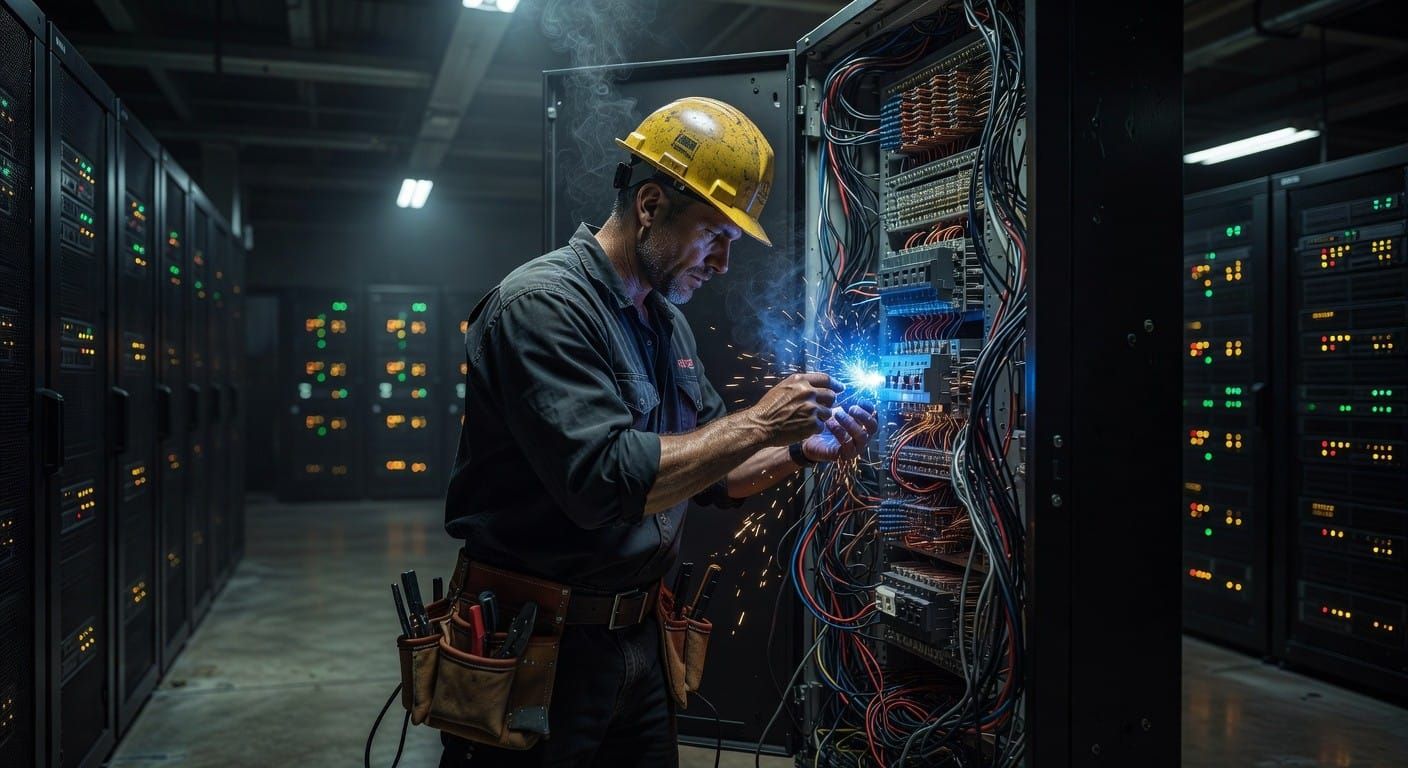
America's most ambitious infrastructure projects — from AI data centers to EV charging networks — are running into the same bottleneck. It's not capital, regulation, or technology.
It's people. Specifically, the electricians, plumbers, HVAC technicians, and welders who actually build and maintain the physical world.
The United States is staring down a skilled trades shortage of historic proportions. By 2030, an estimated 2.1 million trades jobs could go unfilled, with potential economic losses reaching $1 trillion annually, according to a JLL report citing U.S. Department of Education data. And the gap is widening, not closing.
This isn't a slow-burn demographic trend anymore. It's an active constraint on America's ability to compete.
The Numbers Are Brutal
Last year, nearly 600,000 skilled trades positions were posted in the United States. Only about 150,000 new workers entered the pipeline through apprenticeship programs. That's a 4:1 gap between demand and supply — and it's getting worse.
The retirement wave is accelerating. More than one in five construction workers is currently over 55. Among electricians, 39% are 45 or older. The retirement-to-replacement ratio in manufacturing, construction, and skilled trades sits at roughly 5:2 — five workers leaving for every two entering.
Electrician positions alone are projected to grow 9.5% through 2034, more than triple the 3.1% average across all occupations. HVAC roles are expected to grow 8.1% over the same period. The Bureau of Labor Statistics projects about 81,000 electrician job openings per year through 2034, accounting for both growth and replacements.
These aren't marginal shortfalls. They're structural.
AI's Dirty Secret: It Needs Humans to Build It
Here is the irony that almost nobody in Silicon Valley wants to talk about: the companies eliminating white-collar jobs with AI cannot build their AI infrastructure without blue-collar workers.
Electrical work accounts for 45% to 70% of total data center construction costs, according to the International Brotherhood of Electrical Workers (IBEW). A single large data center can require up to 1,500 workers during peak construction. Meta's Hyperion project in Louisiana is expected to reach four times the size of Central Park. McKinsey estimates cumulative global data center investment could hit $6.7 trillion by 2030.
The IBEW calls the electrician shortage a "life or death" situation for the data center buildout. The numbers back them up: over 300,000 new electricians are needed in the next decade just to meet AI-driven demand.
Microsoft president Brad Smith has identified electrical talent shortages as the number-one problem slowing data center expansion in the U.S. Microsoft is already employing electricians commuting from 75 miles away or temporarily relocating to fill positions. Oracle had to shift some data center completion dates from 2027 to 2028, partly due to labor constraints.
Google pledged $15 million and partnered with the Electrical Training Alliance to expand the pipeline of electrical workers. But $15 million against a trillion-dollar infrastructure deficit is a rounding error.
"The electrician shortage is quite dire," Darrell West, a senior fellow at the Brookings Center for Technology Innovation, told Fortune. "Those people are in short supply all across the country, and this has become a leading barrier to data center construction."
The Wage Shock Is Coming
When supply is this tight and demand is this strong, economics dictates what happens next: prices go up. In this case, that means wages.
Electrician wages have been climbing 3-4% annually, and the trajectory is steepening. Hadrian CEO Chris Power, whose company automates defense manufacturing, predicts outright hyperinflation in blue-collar salaries.
"All the white-collar jobs are going to get automated," Power said at the Hill and Valley Forum. "I think we're going to see massive hyperinflation in blue-collar salaries." Even with robotic welding on his own factory floor, Power says he still can't hire enough welders to meet demand from the U.S. Navy.
His advice: "Everyone, go tell your kids to quit college and university and go get a welding certification. The country needs you."
This isn't hyperbole. The trades are becoming the economically rational career choice for an entire generation. A journeyman electrician can expect to earn $71,000 or more — with zero student debt. Many experienced tradespeople in high-demand specialties (data center electrical, industrial HVAC, pipe fitting) are pulling six-figure salaries.
Meanwhile, more than half of 2023 college graduates were working in jobs that didn't require a degree one year after graduation. Unemployment among recent college grads has climbed to 5.6%.
Corporate America Is Finally Paying Attention
Lowe's announced a $250 million, decade-long commitment to train 250,000 skilled trade workers in plumbing, carpentry, and electrical work. CEO Marvin Ellison framed it bluntly:
"As powerful as AI will become, AI can't climb a ladder to change the batteries in your smoke detector. It can't change your furnace filter; it can't clean your dryer vent; it can't repair a hole on your roof."
Ford CEO Jim Farley has consistently warned about the labor wall blocking America's reshoring ambitions. "I think the intent is there, but there's nothing to backfill the ambition," Farley told Axios. "How can we reshore all this stuff if we don't have people to work there?"
The Associated Builders and Contractors estimates the U.S. needs roughly 350,000 additional construction workers in 2026 alone — rising to 456,000 in 2027.
Gen Z Is Reconsidering — But Not Fast Enough
There are early signs of a cultural shift. The share of teenagers considering vocational or trade school has more than doubled, from 12% in 2018 to 30% in 2024. Community college enrollment has risen 12% over the past five years, with construction trades and engineering technologies among the fastest-growing majors.
Nearly one in four Gen Z workers has seriously considered or is actively pursuing a career in the trades, and 75% associate desk jobs with burnout. The stigma around blue-collar work is fading — helped by social media visibility, student debt reality checks, and a growing awareness that AI is coming for the laptop class faster than the hard-hat class.
But cultural shifts take time. The pipeline of apprenticeships and training programs is still operating at a fraction of the scale needed. A 5-year electrical apprenticeship that starts today won't produce a journeyman until 2031. The data centers, EV chargers, and grid upgrades needed by 2028 can't wait that long.
The Investment Angle
For investors, the trades shortage is both a risk and an opportunity:
Risk: Any company whose growth depends on physical infrastructure buildout — data centers, energy, manufacturing, real estate — faces execution risk from labor constraints. Project delays, cost overruns, and timeline slippage are already materializing.
Opportunity: Companies that solve the pipeline problem — workforce training platforms, construction technology, modular building, prefabrication, and automation — are positioned to capture enormous value. Lowe's, Home Depot, and companies like Hadrian are already placing bets.
The broader macro signal is clear: the physical economy is becoming the bottleneck for the digital economy. For a decade, software was supposed to eat the world. Now the world is discovering it still needs people who can wire a building, fit a pipe, and keep a server farm from overheating.
The Bottom Line
America spent a generation telling its young people that the only path to prosperity ran through a four-year degree and a desk job. That advice created an oversupply of white-collar workers and a catastrophic undersupply of the tradespeople who build and maintain the country's physical infrastructure.
Now the bill is coming due. The AI boom, the energy transition, the reshoring push, and the infrastructure deficit are all converging on the same constraint: there aren't enough skilled hands to build what America needs.
This isn't a problem that can be solved by throwing money at it — though money helps. It requires a fundamental cultural recalibration about what constitutes a valuable career. It requires scaling apprenticeship programs by orders of magnitude. And it requires acknowledging an uncomfortable truth: in the age of artificial intelligence, the most strategically important workers in America might be the ones who never touch a keyboard.
Get this level of intelligence every day. Subscribe to AlphaBriefing — free, member, and paid tiers available.
Sources & Further Reading
- Fortune — America's 'Silent Army' of Skilled Trades Workers Is Vanishing
- Fortune — The AI Data Center Boom Is Creating a Dire Electrician Shortage
- Fortune — Lowe's Is Investing $250 Million to Train Skilled Trade Workers
- JLL — Critical Skilled Trades Shortage Threatens Economic Losses
- Bureau of Labor Statistics — Electricians Occupational Outlook
- Forbes — Solving the Electrician Shortage: A Data-Driven Mobility Strategy
- IBEW — The Data Center Surge: A New Generation of IBEW Jobs
Disclaimer
AlphaBriefing is an independent intelligence publication. The content in this article is produced for informational and educational purposes only. Nothing published by AlphaBriefing constitutes financial, investment, legal, tax, or regulatory advice, nor should it be construed as a solicitation or recommendation to buy, sell, or hold any security, asset, or financial instrument.
All views expressed are those of the author at the time of writing and are subject to change without notice. Markets are volatile and unpredictable; past performance is not indicative of future results. Any investment involves risk, including the possible loss of principal.
AlphaBriefing and its principals, employees, or contributors may hold positions in securities or assets mentioned in this article. This should be considered a potential conflict of interest. No material relationship with any company referenced exists unless explicitly disclosed. Readers should conduct their own due diligence and consult qualified financial, legal, and tax advisors before making any investment decisions.
Information in this article is drawn from public sources believed to be reliable at the time of publication. AlphaBriefing makes no warranty, express or implied, as to the accuracy, completeness, or timeliness of any information herein. AlphaBriefing accepts no liability for any loss or damage arising from reliance on this content.
© AlphaBriefing. All rights reserved. Unauthorized reproduction or distribution is prohibited.