Aluminum Costs 70% More in America Than Anywhere Else. The Smelters Still Won't Come Back.
The Midwest premium is above a dollar a pound and America's most famous idled smelter just became an AI data center. The tariff wall raised prices, not production — the power auction explains why.

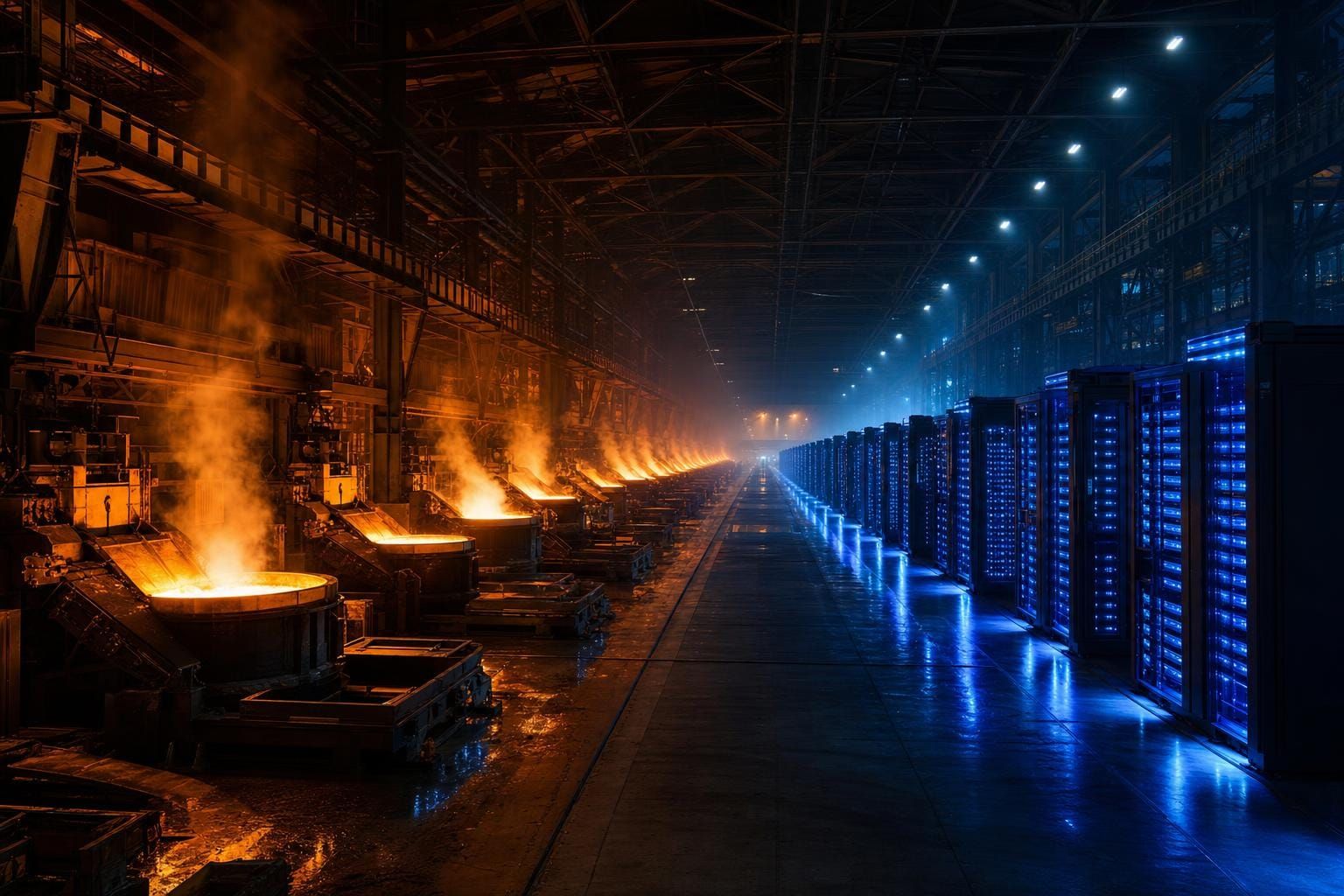
On the banks of the Ohio River in Hawesville, Kentucky, sits the clearest explanation of why America's aluminum policy is failing on its own terms. For more than half a century the site smelted aluminum — in its later years it supplied the high-purity metal that goes into U.S. fighter jets. Century Aluminum idled the plant in 2022 when power prices spiked after Russia's invasion of Ukraine, and in February of this year it stopped pretending the pots would ever restart: it sold the 750-acre site to an affiliate of data-center developer TeraWulf for $200 million in cash plus a 6.8% equity stake in the project.
TeraWulf is now building a $4 billion-plus AI computing campus on the bones of the smelter, reusing the same electrical infrastructure that once pushed current through molten alumina. In August, Kentucky's utility regulator approved a 482-megawatt power contract for the project. The grid connection that made Hawesville a strategic national asset still exists. It just feeds GPUs now.
Here is why that matters to anyone who touches the metal: America currently pays more for aluminum than anyone else on Earth, by a margin that has no precedent — and the one mechanism that is supposed to fix that, restarting idle domestic smelters, keeps losing a bidding war for electricity to the data centers.
The Most Expensive Aluminum in the World
The U.S. Midwest premium — the surcharge American buyers pay on top of the global benchmark to get metal delivered, duty paid, into the Midwest — trades at about $1.04 per pound this week, according to CME premium futures. That is roughly $2,290 per metric ton stacked on top of a world price of about $3,100–3,200. American buyers are paying more than 70% over the global price — an all-in cost around $5,400 a ton. The premium first crossed the $1-per-pound threshold in January, a level never seen before in the history of the benchmark.
This is not happening because the world is short of aluminum. It is happening because America is short of aluminum. China's exports of aluminum and aluminum products rose 18% to 5.9 million tons in the first ten months of 2026, according to Chinese customs data, and Reuters reported in October that Chinese producers' expansion abroad could tip the global market into surplus. The London Metal Exchange price has been slipping on exactly that logic. Meanwhile LME warehouse stocks hit a 36-year low in August amid war-driven supply dislocations, and spot metal still commands a stiff premium over three-month delivery — a market screaming for metal now, even as next year looks looser.
The wedge between the world price and the American price is mostly paperwork: Section 232 tariffs that reached 50% last year before being restructured in June into a 25% additional duty with carve-outs for some partners. The tariff wall did what tariff walls do — it raised the domestic price. What it has not done is the thing it was sold on.
The Wall Worked on Prices, Not Production
The United States produced about 660,000 metric tons of primary aluminum in 2025, against an installed smelter capacity of 1.31 million tons, according to the U.S. Geological Survey. Half the industry is built, permitted, connected to the grid — and switched off. Imports still cover 61% of U.S. consumption.
The standard explanation is unfair competition, and it is real: of the $11.1 billion in global aluminum-sector subsidies tallied by the Aluminum Association from OECD data for 2024, China accounted for $10.2 billion — 92%. But subsidies explain why new smelters don't get built in Ohio. They don't explain why the ones that already exist stay cold behind the highest price wall in the industry's history.
Briefings like this are free to read with a free AlphaBriefing membership. Join free →
The Power Auction
Aluminum is electricity in solid form. Smelting one ton takes roughly 13–16 megawatt-hours, and power is about 40% of production cost, per October 2026 estimates from the SAFE Center for Strategic Industrial Materials. SAFE's math says a smelter needs long-term power near $40 per megawatt-hour to compete. Alcoa's CFO Molly Beerman was even more direct at a Citi conference in December: "In terms of competing with data centers for energy, we're looking for a power price in the $30 to $40 per megawatt-hour range." U.S. industrial rates now exceed $80 in some markets.
Run the arithmetic: at 14–16 MWh per ton, every $10 move in power is $140–160 per ton of cost. The gap between the power price smelters need and the power price the market charges eats most of the Midwest premium on its own — and a smelter needs that power locked in for a decade to justify restart capital, while an AI tenant will sign tomorrow at double the price. Hawesville is not an anecdote; it is the market-clearing outcome. Century was paid more to hand its grid connection to a data-center developer than it could ever have earned feeding pots with $80 power.
Which leaves the strange situation the equity market is now pricing: the premium is at records, and the companies that collect it have been cut in half. Alcoa trades 53% below its 52-week high. Century — the purest owner of U.S. smelting capacity there is — is down 48% from its high even with every ton it makes selling at the world price plus $2,290. Someone is wrong: either the premium is about to collapse, or the producers collecting it are badly mispriced. Working out which requires looking at who actually captures that $2,290 — and at three dates between now and New Year that will settle it.
A free membership gets you access to every free article at AlphaBriefing.com: Join AlphaBriefing
The rest of this briefing is free — it just requires a free AlphaBriefing account: the four ways to own the premium (including the company sitting on both sides of the power trade), the three catalysts before year-end that decide whether any potline actually restarts, and the two scenarios that break the premium.
Create your free account → — 30 seconds, no card.